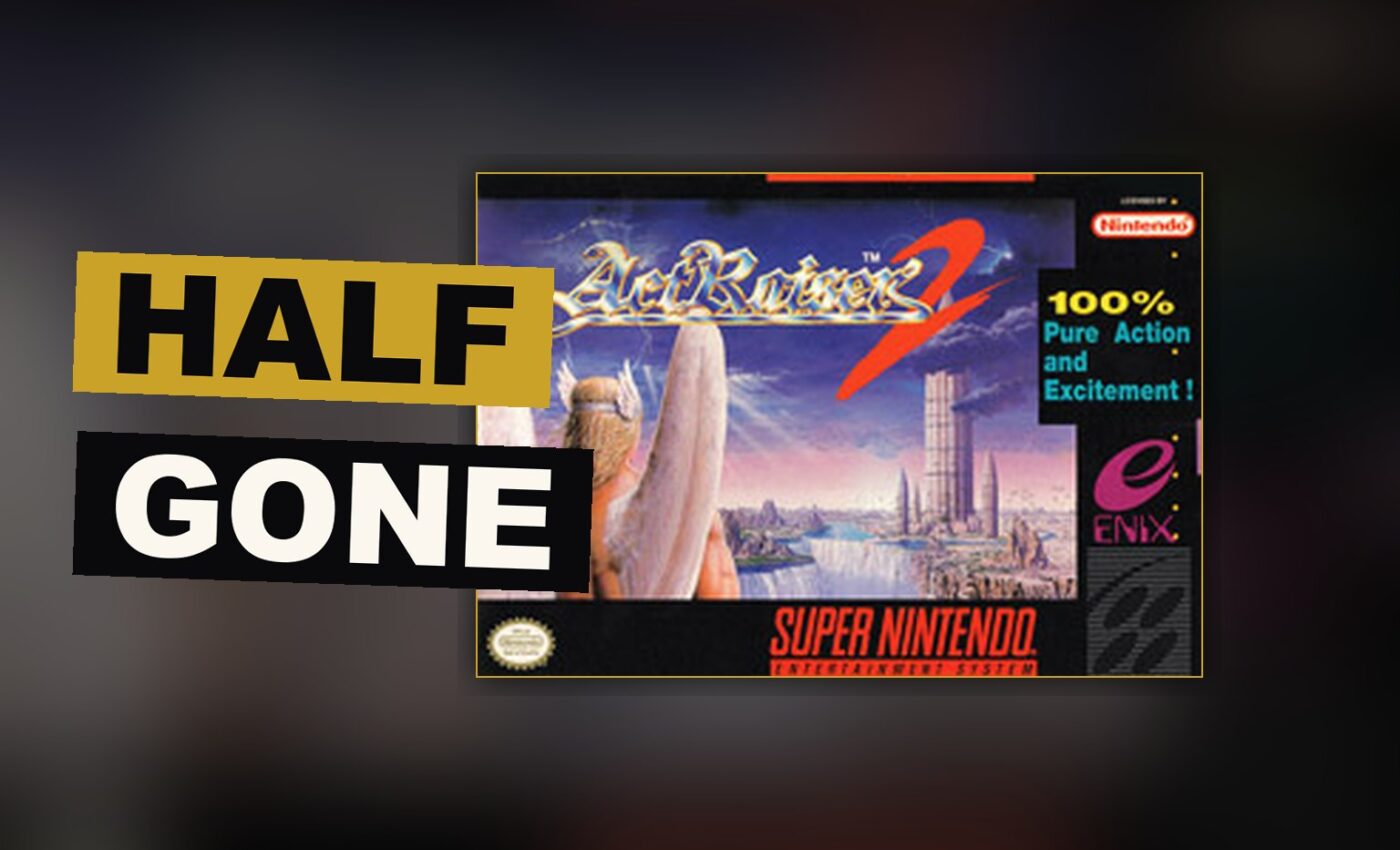
ActRaiser 2 asks you to forget the first game. Quintet built its 1993 Super Nintendo sequel as a pure side-scrolling platformer, cutting the city-building simulation that split the original in two. What is left is a harder, stranger game about a winged god with a sword and a limited supply of magic.
The Master Returns to a Broken World
You play the Master, still called God in the Japanese version. He floats above the world in a palace, drops into each region, and fights. Tanzra, once the Master’s servant, led a rebellion, lost, and was cast out of the Sky Castle. His body fell to the underworld, where his seven deadly sins and their minions raised him again.
Each area holds two acts. The first act spawns monsters from a lesser demon named for an unfavorable condition. The second brings the primary evil, named for one of the seven deadly sins, with more peril and more challenge.
Wings, a Sword, and Magic You Charge
The Master now has a full set of working wings. You jump, fly, fall and float through dungeons, carrying a sword and a shield that deflects some attacks. The shield is not enough. Magic carries the game.
Hold the button to charge, release to cast, and a magic scroll is spent. Scrolls are limited when you enter an area, and each spell suits a particular situation. Some hit harder than others.
How the Two Games Differ
The first ActRaiser made you pick one magic before descending and locked you to it. ActRaiser 2 hands you the whole set and makes you choose in the moment.
| Feature | ActRaiser (original) | ActRaiser 2 |
|---|---|---|
| Structure | Platform acts plus city-building simulation | Platform acts only |
| Magic | Selected before a fight, fixed for its duration | Charged and released in play, limited by scrolls |
| The Master | No functional wings | Full set of wings |
Leon, Kolunikus, and the Tower of Babel
The story borrows from Paradise Lost and the Divine Comedy. Some stages are built to be ironic about Tanzra’s demons. In Leon, a newly appointed king named Kolunikus sends townsmen to the underground prison of Gratis for not paying taxes. Kolunikus is afflicted by Doom.
Kill the first six deadly sins and the Tower of Babel appears — Tower of Souls in the western release. There the Master faces Destruction, a mechanically engineered god representing Pride.
The Run Through the Sins
The game moves in a fixed order from lesser demon to deadly sin, then to the tower.
| Stage | Act | Enemy source |
|---|---|---|
| Each region | First act | Lesser demon named for an unfavorable condition |
| Each region | Second act | Primary evil named for a deadly sin |
| Final level | Tower of Babel | Destruction, representing Pride |
A Palace Used as a Battering Ram
Beat the false god and the Death Heim rises, an underworld where Tanzra waits behind a barrier that blocks any ordinary descent. The barrier kills the usual method.
So the Master crashes the Sky Castle domain into Death Heim as a battering ram. The barrier breaks. The castle is ruined, and the angels take many casualties. That is the best idea in ActRaiser 2: a god who has run out of clean options and spends his own house to get one last fight.
What the Sequel Gains and Loses
Cutting the simulation was the right call for a sequel that had nothing new to say about city-building. What Quintet replaced it with is thinner than the original’s two halves, but sharper. The charge-and-release magic gives every encounter a decision the first game never asked for, and the wings turn navigation into its own test.
The cost is variety. ActRaiser 2 is one kind of game played well, not two kinds played adequately.
The Score
ActRaiser 2 is a confident, difficult platformer that understands its own best idea — a fallen god spending everything he has. It does not reach the original’s range, and the difficulty will shed players. It earns its place anyway.
7.6 of 10.
Get the Notebook.
The day's best stories and every fresh verdict, in plain English, in your inbox by seven. One email a day, no more.