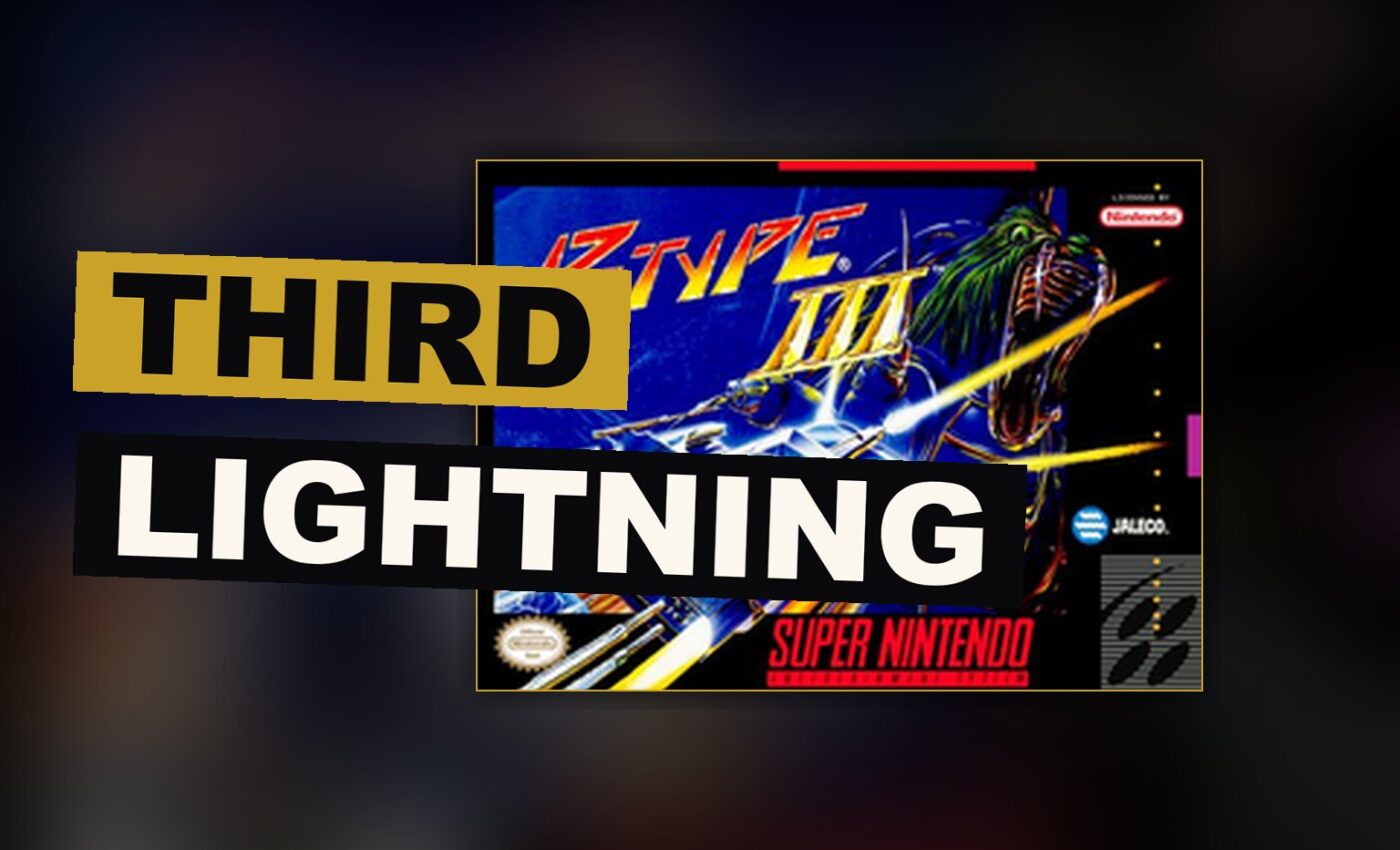
R-Type III: The Third Lightning gives players one job on the Super Nintendo: keep going. Enemies arrive in a steady stream, one wave after another. The pace forces a player to watch, react, and remember what is coming next. Each of the five stages is built to be learned, not rushed.
The Force System
The core trick of R-Type III: The Third Lightning is the Force, a small round object that attaches to the front or back of the player’s ship. Set it free and it drifts on its own, taking enemy fire or standing in the way of shots aimed at the ship. Bring it back and it becomes both a shield and a second source of fire.
This game adds a new twist: three different Force types, each firing in its own way. Changing between them during a level changes the whole way a boss fight is fought.
That choice is the best idea in the game.
Level Design and Difficulty
The five stages in R-Type III: The Third Lightning are carefully built, full of tight passages, moving walls, and bosses that fill most of the screen. Nothing here is left to chance. Every enemy, every wave, every danger is placed on purpose, which means failure almost always feels like something learned rather than bad luck.
That said, the game is hard. Save points are few, lives are limited, and a single slip near a boss can send a player back several minutes.
Some will call that fair, in keeping with the genre. Others will find it hard without enough reward. The instructions that came with it explain the controls but not the way a boss moves, so the early hours are rough going.
Sound and Look on the SNES
The look of R-Type III: The Third Lightning holds up well because the SNES pushes large, detailed figures on screen and layers of scenery that move at different rates. That gives the levels a sense of depth uncommon for its time. Boss designs are built from parts of metal and flesh that change shape as they take damage.
The music fits the mood without taking over the action. It is quiet, mechanical, and steady in a way that suits the level design rather than drawing attention from it. None of the tracks stand out on their own, but none of them get in the way either.
How It Compares
| Feature | R-Type III: The Third Lightning (SNES) | Common Genre Standard |
|---|---|---|
| Force types | Three distinct types | Usually one fixed type |
| Save points | Few | Often more common |
| Look and depth | Layered, detailed figures | Mixed, depends on the machine |
| Difficulty | Hard, little forgiveness | Hard, but often less hard at the start |
| Guns | Charged gun and Force fire | Charged gun common, fewer added types |
This table shows where the game sets itself apart. The Force choices mark real thought, even if the difficulty stays in line with what players of the genre already know to expect.
Closing
Once a player learns the levels, the five stages of R-Type III: The Third Lightning can be finished in under an hour. That is short given the price at the time, but the difficulty means most players will not reach the end quickly.
Learning the game is much of the game itself. Doing the same thing again and again is part of the design, not a weakness in it.
There is no second path through the game, no other mode, no extra items to find along the way. What a player sees the first time is what the game offers, and that plain design suits the genre well by keeping the focus on skill rather than searching. The last boss asks for everything learned across the earlier four stages, every Force type, every save spent wisely, and beating it once is enough. The game gives no second ending to chase and asks for nothing more once the credits appear.
R-Type III: The Third Lightning earns a score of 7 of 10, a mark that reflects a short but demanding game built for players willing to fail often before they finish it.