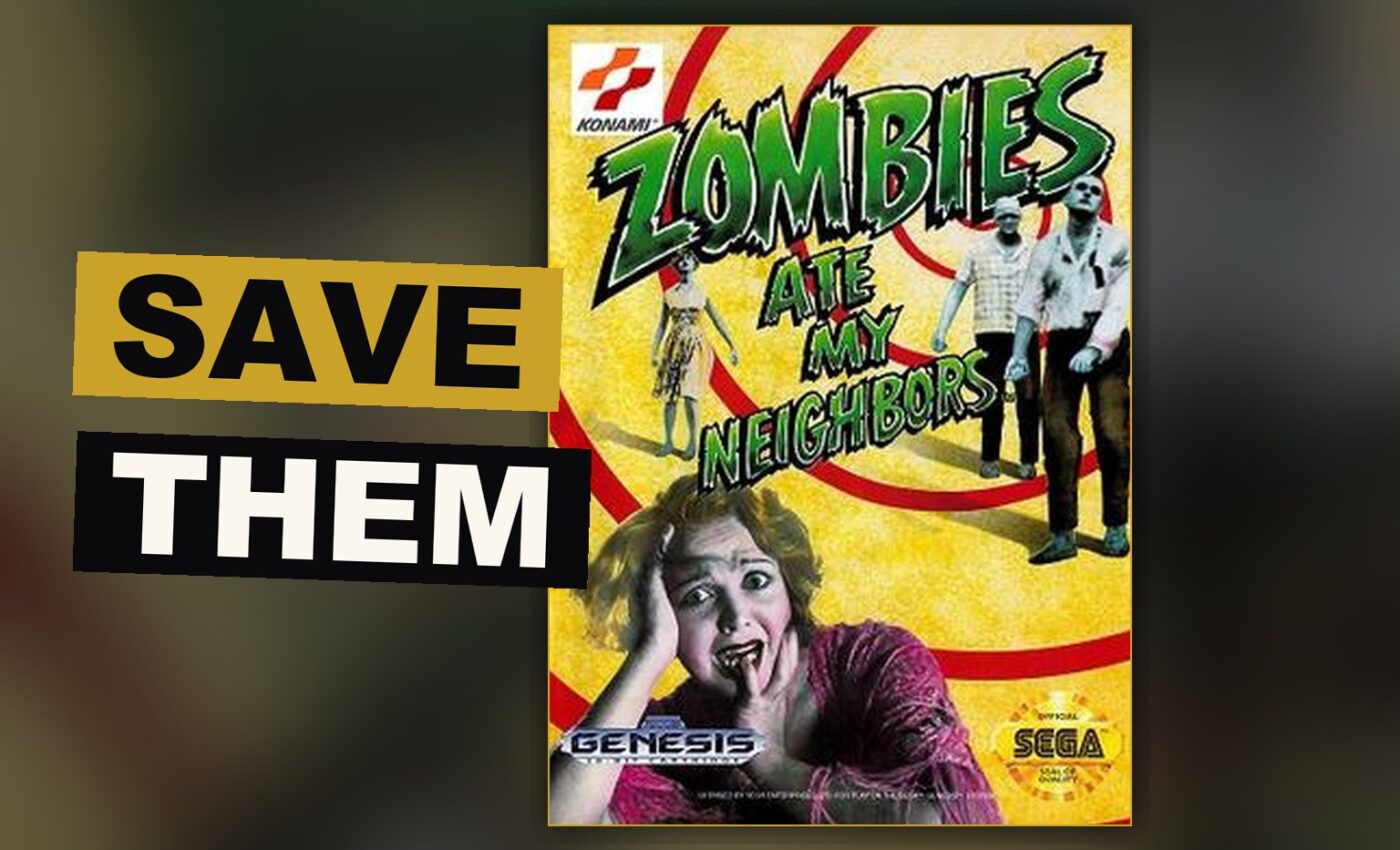
Zombies Ate My Neighbors wastes no time explaining itself. Dr. Tongue, a mad scientist, has built a menagerie of monsters in his castle and turned them loose on the suburbs. Two teenagers, Zeke and Julie, grab whatever weapons they can find and go save the neighbors. That is the whole setup, and it is enough.
The game shipped in 1993 from LucasArts, published by Konami for the Super Nintendo Entertainment System, the Sega Genesis and the Wii. It is a run and gun shooter with beat ’em up and hack and slash in its blood, played from a bird’s-eye isometric view. You pick Zeke or Julie, or both in two-player co-op, and you work through 48 stages — seven of them optional bonus levels — killing horror-movie monsters and touching neighbors before the monsters do.
It scored 8.3 out of 10. That is the right number, and this review will explain why.
Dr. Tongue’s Monster Menu
The enemy list reads like a video store’s horror aisle emptied onto one cartridge. Vampires, werewolves, mummies, spiders, squidmen, evil dolls, aliens, UFOs, giant ants, blobs, giant worms, chainsaw-wielding maniacs, and “pod people” — aggressive alien clones of the players themselves. Then there are the huge demonic babies, which are exactly what the name promises and somehow worse in motion.
Zombies Ate My Neighbors does not treat any of this as scary. It treats it as funny, and the joke lands because the game commits to it. A giant baby is a boss. A squidman is a standard enemy. The title itself is a punchline delivered straight.
The levels move through suburban neighborhoods, shopping malls, pyramids, haunted castles, beaches and football fields. A grocery store sits next to a pyramid. Nothing connects them except the game’s refusal to pick a lane, and that refusal is the point.
Saving Cheerleaders Before Nightfall
The rescue mechanic is where Zombies Ate My Neighbors stops being a shooter and starts being a game about triage. Each stage has a set number of neighbors: barbecue chefs, teachers, babies, tourists, archeologists, soldiers, dogs, cheerleaders. You save them by touching them. Enemies kill them by touching them first.
Once a neighbor dies, they are gone for the rest of the game unless an “Extra Bonus Victim” is awarded. That is a harsh rule and it is the best thing in the game. It turns every level into a routing problem. Do you clear the monsters near the cheerleaders first, or do you grab the tourists on the far side of the mall and hope the zombies are slow?
At least one neighbor must survive each level to move on. Once every neighbor is either saved or dead, a door opens and takes you to the next stage.
Then there is nightfall. On some levels, daytime gradually turns to night. When the sun goes down, tourists transform into werewolves and cannot be saved — the game counts them as killed. A level you were winning can quietly become a level you have already lost, and the game will not stop to tell you.
A Bazooka and a Water Gun
The weapon list is deliberately absurd. You get a bazooka. You get a water gun. You get whatever else the game hands you, and you use it on a dragon or a giant ant at the end of a stage. The arsenal is not balanced in any serious way and it is not meant to be. It is a punchline you can fire.
Two-player co-op is the mode that matters. Zeke and Julie on screen at once, splitting the map, arguing over who takes the left side of the mall. The game supports single player and multiplayer, but the cooperative mode is where the design shows its teeth. Two players can cover twice the ground and still lose a neighbor because neither of them looked behind the pyramid.
The isometric perspective helps and hurts. It gives the levels a diorama feel, a toy set you are wrecking from above. It also makes depth hard to read, and a zombie you thought was two tiles away is suddenly on top of your cheerleader.
Censorship and the Ghoul Patrol Sequel
Some of the game’s more violent content was censored in Europe and Australia, where it shipped as Zombies. That is a strange fate for a game whose violence is played for laughs, but the era did not distinguish carefully between cartoon gore and the real thing.
It was not a great commercial success. That is worth saying plainly, because the game’s reputation has grown in the decades since while its sales did not. LucasArts made something odd and Konami put it out, and the market did not reward it the way it rewarded safer platformers.
It spawned a sequel, Ghoul Patrol, in 1994. Both games were re-released together as Lucasfilm Classic Games: Zombies Ate My Neighbors and Ghoul Patrol for the Nintendo Switch, PlayStation 4, Xbox One and Microsoft Windows by Disney Interactive in June 2021. That re-release is how most people will meet the game now, and it holds up.
Why 8.3 Is the Right Score
The case for Zombies Ate My Neighbors is the rescue rule. Most shooters of its era ask you to survive. This one asks you to save, and it punishes you permanently when you fail. The neighbor who dies early is still dead later. That is a design choice with weight, and few games of the period had the nerve to make it.
The case against is the isometric view and the difficulty curve. Depth is genuinely hard to judge, and the game stacks monsters faster than it teaches you to handle them. Some levels tip from frantic into unfair. The weapon variety papers over that more than it fixes it.
What matters most is the tone. Zombies Ate My Neighbors is a comedy that never winks at the player. It presents a giant demonic baby as a boss with a straight face and lets you decide whether to laugh. That restraint is why the humor still works and why the game does not feel like a period piece. The horror references are decoration; the rescue mechanic is the architecture.
The 2021 re-release matters more than the original sales figures. A game that missed commercially in 1993 has now been packaged and sold three decades later on four modern platforms. That is not nostalgia alone. It is a game that did something no one else was doing — permanent consequences for failure, wrapped in a monster movie joke — and that something is still rare.
The sequel, Ghoul Patrol, did not match it. That is the usual story. Zombies Ate My Neighbors remains the one worth playing, and the one worth replaying, because the routing problem changes every time you pick a different pair of neighbors to save first.
KEY FACTS
– Release year: 1993
– Developer: LucasArts
– Publisher: Konami
– Platforms: Super Nintendo Entertainment System, Sega Genesis, Wii
– Genre: Run and gun, shooter, hack and slash/beat ’em up
– Perspective: Bird’s-eye isometric
– Modes: Single player, multiplayer, co-operative
– Stages: 48, including seven optional bonus levels
– Sequel: Ghoul Patrol (1994)
– Re-release: Lucasfilm Classic Games: Zombies Ate My Neighbors and Ghoul Patrol, June 2021, for Nintendo Switch, PlayStation 4, Xbox One and Microsoft Windows by Disney Interactive
– Score: 8.3/10
Zombies Ate My Neighbors is not a perfect game. The isometric depth is a real problem, the difficulty spikes without warning, and the commercial failure of 1993 was not an accident of marketing. But the rescue rule — save them by touching them, lose them forever if a monster gets there first — is one of the sharpest ideas in any game of its era, and the horror-comedy tone has not aged a day. It earns the 8.3. Play it with a second player if you can.
Get the Notebook.
The day's best stories and every fresh verdict, in plain English, in your inbox by seven. One email a day, no more.