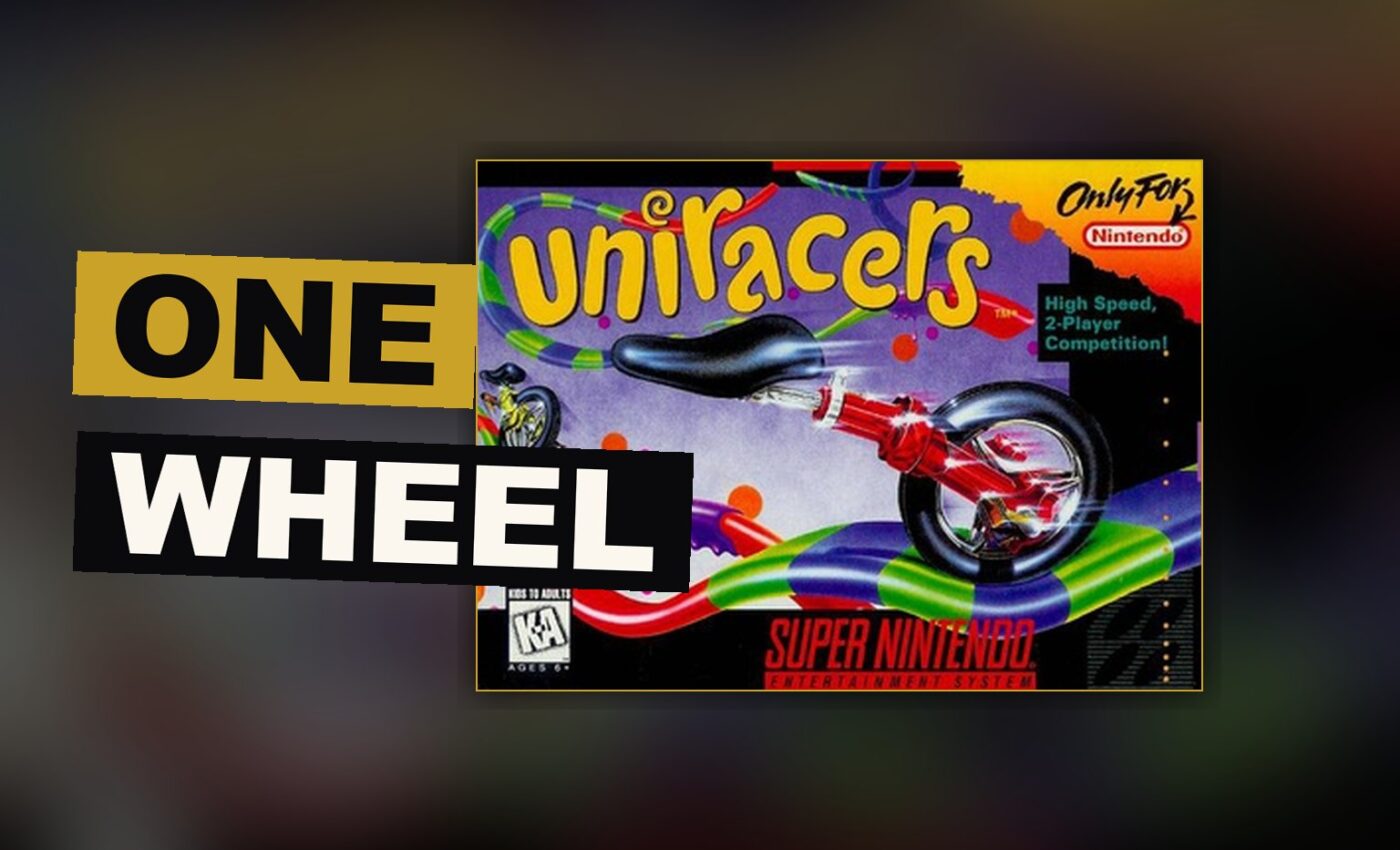
Uniracers is a racing game about a unicycle with no rider. That should not work. It does.
DMA Design built the game around a single strange idea: the trick is the throttle. Land a stunt and the unicycle speeds up. Wipe out and you lose everything you built. Nintendo published it for the Super Nintendo Entertainment System in North America in December 1994, and in PAL territories as Unirally on 27 April 1995. It was one of the stronger releases of the console’s late years. Then it vanished.
A Unicycle With No Rider
The setup is as bare as a game can get. You race a riderless unicycle around a 2D track, side view, from point A to point B, against an opponent. No enemies. No power-ups. No story.
What holds it together is the stunt system. Jump, rotate around an axis in 3D space, and land on the wheels. The better the trick, the bigger the speed increase. Miss the landing and the unicycle wipes out, and the speed you had saved up is gone.
That one rule changes how the whole game feels. You are not racing and then doing tricks. You are doing tricks to race.
Nine Tours, Forty-Five Tracks
Uniracers ships with nine tours of five tracks each. That is 45 tracks total, split into two race tracks, two circuit tracks and one stunt track per tour.
The first eight tours ask you to beat computer-controlled opponents at bronze, silver and gold ranks. The ninth is different. The opponent is the Anti-Uni, and hitting it does things to the game itself: the track goes invisible, your controls reverse, and the backgrounds come apart from what you are doing.
The tracks are built from bars whose patterns tell you what is coming. A solid yellow bar means a shortcut. Orange and yellow bars mean a hazard ahead. Corners, loops, corkscrews, twists, jumps and speed boosts fill out the rest.
| Track type | Goal | Opponent |
|---|---|---|
| Race | Finish first | Computer-controlled racer |
| Circuit | Finish first, build speed through stunts | Computer-controlled racer |
| Stunt | Score points against the clock | None — a set target score |
Stunt Tracks Are the Real Test
Stunt tracks strip out the other unicycle. No rival, no finish line, just a clock and a points target. You earn style points by landing tricks, and the tricks themselves are simple — jump, spin, land.
Simple to describe. Not simple to do. A stunt track asks you to perform tricks quickly in tight situations, and the landing is where it goes wrong. The unicycle has to come down on its wheels. Anything else costs you the run.
That is the whole game in one demand: speed and precision at the same time, with the punishment for failure built into the reward for success.
Two Players, Sixteen Unicycles
Split-screen two-player modes are in, including a league mode that puts up to eight players into one-on-one races. There are 16 colored unicycles to pick from. Each one gets its own save file and a name you can change.
Racing against a person is a different game than racing the computer. The Anti-Uni’s tricks — invisible tracks, reversed controls — are designed chaos. A second player is chaos you can read, and the league mode gives the multiplayer a shape beyond one-off races.
A Cartridge That Stopped Being Made
Uniracers did not get a second life. Pixar brought a copyright infringement lawsuit, and DMA Design and Nintendo were forced to stop producing cartridges as a result. The game has not been rereleased since.
That is the fact that sits over everything else here. A game this odd, this specific, this hard to replace, is locked to the original cartridge. There is no port, no reissue, no modern version.
It is worth saying plainly what was lost. The trick-to-speed system is a real design idea, not a gimmick, and it is the kind of idea that would have been copied, refined and argued over if the game had stayed in print. It did not.
What Uniracers Gets Right
The comparison everyone reaches for is Sonic the Hedgehog crossed with Tony Hawk’s Pro Skater, and the source material makes that case directly: high-speed platform racing plus crazy stunts and tricks. It is an odd pairing on paper. In play it is one system, not two.
Strip out Sonic’s enemies, power-ups and obstructions and you have a game about pure movement. Uniracers takes that and adds a reason to show off. The trick is not decoration. It is how you go faster.
The unicycle itself is the joke and the point. Unicycles are stupid and difficult, and fun once you get the hang of them. Uniracers is stupid and difficult, and fun once you get the hang of it. That is not a knock. It is the most honest thing about the game.
Where it falls short is variety. The tricks stay simple. Jumping and rotating around an axis covers most of what you will do across 45 tracks, and the stunt tracks lean on the same handful of moves. The difficulty curve is real, but it comes from execution, not from new ideas arriving late.
The Anti-Uni tour is the exception, and it is the best stretch in the game. Invisible tracks and reversed controls are cheap tricks on their own. Used as a final opponent, they force you to race on instinct, which is exactly what the stunt system has been training you to do for eight tours.
Multiplayer is the other reason to keep the cartridge. Eight players in a one-on-one league is more structure than most racers of the era bothered with, and 16 unicycles with their own save files and names gives the whole thing a personal stake that the single-player mode cannot.
So: a game with a genuinely original core mechanic, a thin trick set, a strong final tour, and a legal ending that took it off the shelf for good. The camera stays side-on, the unicycle stays riderless, and the whole thing stays strange in a way that holds up.
Uniracers is not a forgotten classic in the sense of being flawless. It is a forgotten classic in the sense that it did one thing nobody else did, did it well, and then got pulled from production before anyone could build on it. That is a real loss for the Super Nintendo Entertainment System’s last years, and a real reason to track down a cartridge.
Get the Notebook.
The day's best stories and every fresh verdict, in plain English, in your inbox by seven. One email a day, no more.