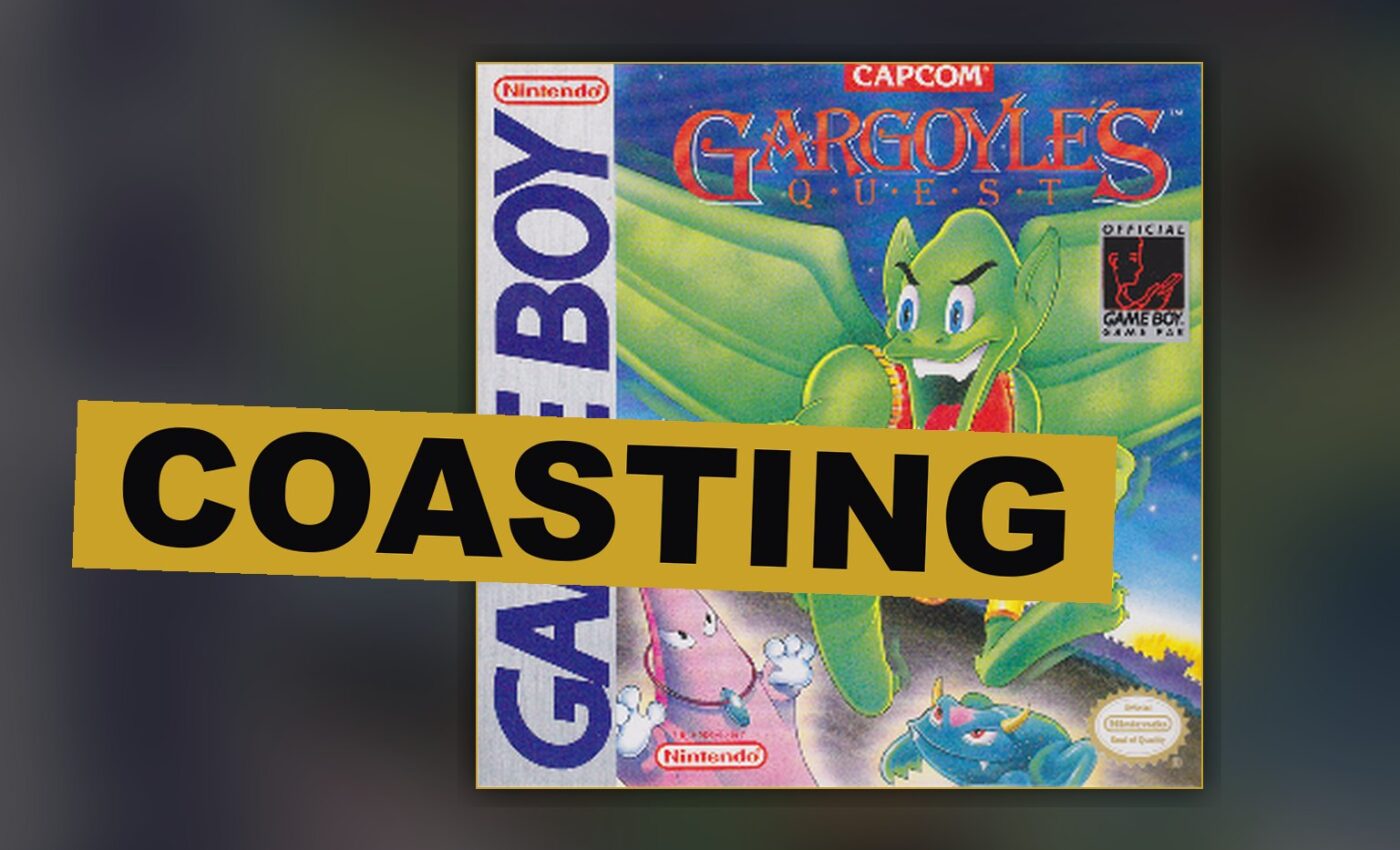
Demon’s Crest puts players in control of a small red hero who spends most of his adventure coasting, striking and burning his way through a dark realm found deep beneath the world above. The title follows Gargoyle’s Quest and was built for the Super Nintendo, joining scrolling action with a high view mode for wandering and choosing paths, a mix that still feels well built today.
The Core System
The action stages ask players to spring, coast and send flame at a steady stream of enemies. The hero cannot fly freely; he can only stay in the air briefly after a spring, which turns every platforming portion into a puzzle about timing and control. That limit shapes the entire game. Levels are built around empty openings, hard edges and narrow footing that demand precise use of the coasting motion, not quick reactions alone.
Between action stages, the game changes to a high view of its dark world. Here the hero walks through towns, talks to other winged figures and picks the next stage to take on. This design gives the game a light planning feel without holding back the action once a stage begins.
Boss fights are where Demon’s Crest earns its reputation. Each fight forces players to learn the hero’s set of moves again under pressure, and most fights depend on reading enemy movements rather than grinding for stats. Wins reward new abilities, including stronger forms of the hero that open up paths that were closed off before.
- A stronger coasting motion that covers more distance
- A charged flame attack for harder enemies
- New motion choices tied to certain late-game places
That last point matters. Nothing in Demon’s Crest feels handed out for its own sake. Every gained ability opens a real path forward, and the game trusts players to remember where those closed paths were.
How the Game Paces Itself
The table below lays out the rough order stages tend to be taken on in, based on how the game closes off progress behind new abilities.
| Stage Order | World Type | Key Hazard |
|---|---|---|
| 1 | Opening ruins | Simple openings and enemies |
| 2 | Fire passages | Precise platforming |
| 3 | Ruins under water | Secret dangers below the surface |
| 4 | High points | Upward coasting portions |
| 5 | Final approach | Combined dangers, boss rush |
This isn’t a fixed schedule set by the game itself, but the natural order most players fall into as new abilities open new paths.
Pacing stays tight throughout. Stages are short enough that a single loss never feels like a major loss, but full enough that mastering a level’s design takes real effort.
The game is not without rough edges. Some hit detection on later enemies feels harsh, and a few platforming portions ask for very precise coasting that punishes small errors badly. New players not used to the coasting motion may find the early hours frustrating before the controls feel natural.
The high view wandering portions, while a clever design idea, can also feel thin. Talks with other winged figures rarely offer more than a hint toward the next goal, and there isn’t much reason to stay long in town once a new stage is ready.
Sound and Look
The soundtrack turns toward dark, heavy pieces that suit the world’s tone without ever becoming too strong. Sprite work is detailed for the time, particularly on the hero’s various forms and the larger bosses, which are drawn with clear, readable attack tells.
None of this is fancy by modern standards.
It does not need to be.
Demon’s Crest succeeds because its central idea — a hero who cannot fly, only coast through the air — is followed through with discipline. Every stage, boss and ability upgrade exists to test or grow that one system. The high view portions add texture without filling out the length for no reason, and the difficulty, while sometimes hard, rewards players who study a stage rather than rush it. It’s a tightly built action game that knows exactly what it’s asking players to master, and it rarely asks for anything it has not already taught. Demon’s Crest earns its place in the series with an 8.7 of 10.