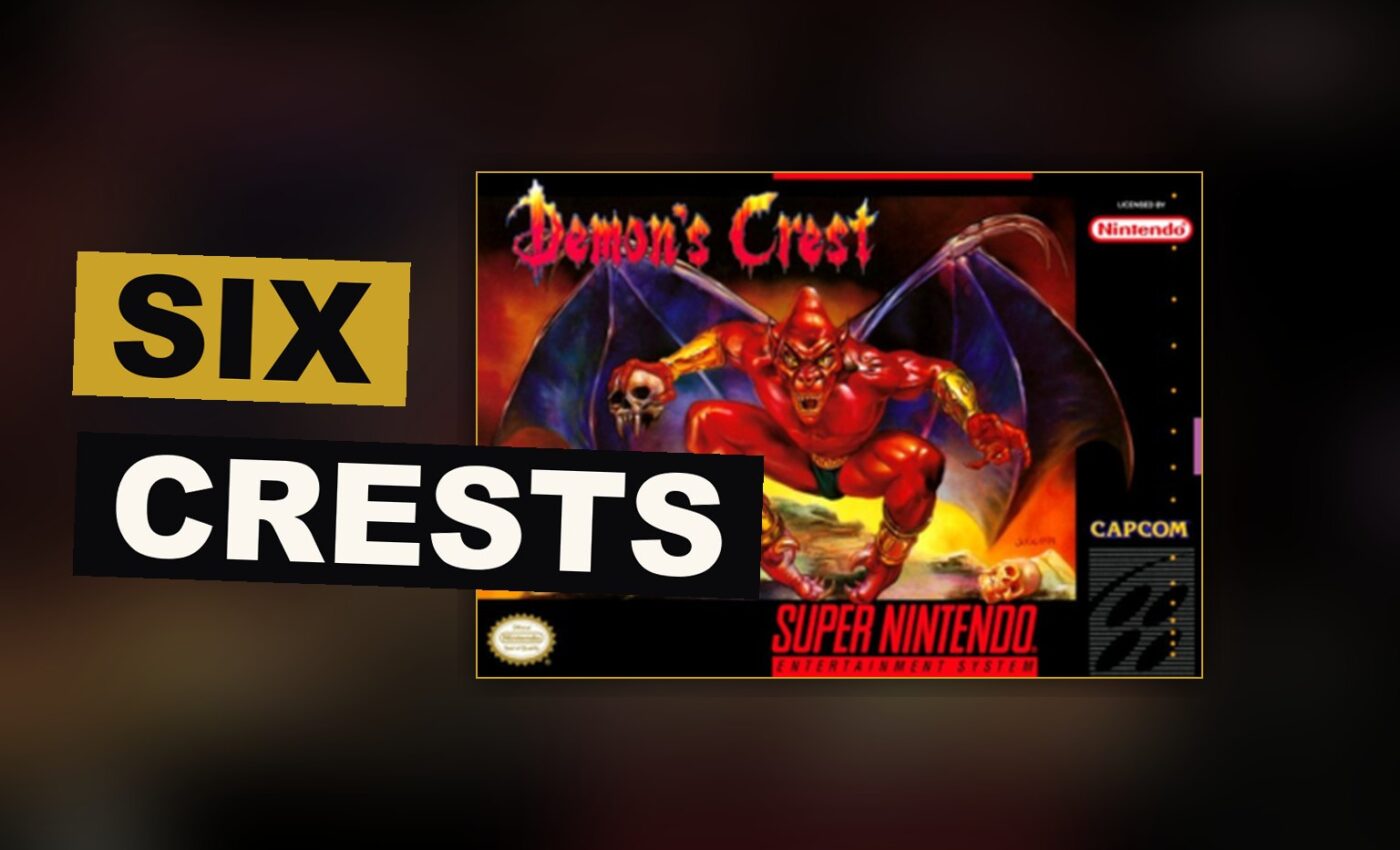
Demon’s Crest arrived in 1994 as the third game to star Firebrand, the red demon known in Japan as Red Arremer and everywhere else as a recurring menace from Ghosts ‘n Goblins. Capcom developed and published it for the Super Nintendo Entertainment System. By Capcom’s own internal accounting, it failed to sell. The game’s reputation has since outgrown that commercial verdict.
Play it now and the reason is plain. This is one of the sharpest, strangest action games on the system, a platformer built around transformation, backtracking and a gothic world of demons at war with each other.
Firebrand loses everything in an amphitheater
The setup wastes no time. Firebrand has spent the demons’ long war collecting five of the six Crests, the magical stones that govern Fire, Earth, Water, Air, Time and Heaven. Combine all six and the Crest of Infinity appears, granting its holder endless power and dominion over every realm. Firebrand beats a Demon Dragon for the Crest of Heaven and walks away badly hurt. A rival named Phalanx jumps him in that weakened moment and takes the lot, except the Fire Crest, which shatters into five shards.
Firebrand keeps one shard. Phalanx keeps the rest and starts ruling the Demon Realm with them.
The game opens with Firebrand locked in an amphitheater, forced to fight the zombified Demon Dragon, Somulo. He escapes. Then he goes hunting for the Crests and for Phalanx, and that hunt is the whole game.
Six areas, and you will visit them again
Demon’s Crest plays as a side-scrolling platformer with mild RPG elements folded in. The stages break into six areas, and you can run each of them more than once. That structure matters, because the game leans on Metroidvania logic: a path you could not take on your first pass opens once you carry the right Crest back to it. Items, boss fights and whole sections sit behind those locks. A map handles navigation.
Firebrand’s base kit is fire breath, claws that cling to walls, and wings that let him hover. He cannot gain height early on, which keeps the first stretch honest.
The Crests change him. Each one grants a transformation with its own combat and exploration use:
- Ground Gargoyle
- Aerial Gargoyle
- Tidal Gargoyle
- Legendary Gargoyle
- Ultimate Gargoyle
Beyond the transformations, Firebrand collects extra hit points, flasks and spell vellums that fuel consumable magic, and talismans that sharpen his existing abilities. None of it is busywork. The transformations are the game.
Phalanx, Arma and three ways to end it
Phalanx spends most of Demon’s Crest already in charge, which is a smarter position for a villain than waiting at the end of a hallway. He does not sit still, either. His general, Arma, keeps showing up to challenge Firebrand, and Arma grudgingly hands back most of the Crests out of respect for Firebrand’s strength. That gives the middle of the game a rival who is not simply an obstacle.
The finish happens in Phalanx’s castle inside the Demon Realm, and it splits three ways depending on what the player does. The worst ending has Firebrand kill Phalanx and leave the Demon Realm to collapse into complete anarchy. A better one has Phalanx seal himself inside the Crest of Heaven while Firebrand hides every Crest. The third has Phalanx summon the Crest of Infinity, transform into a hideous beast, and die at Firebrand’s hands before the Crests get tossed away.
Three endings in a 1994 cartridge platformer is not nothing. Two of them are genuinely bleak.
The commercial failure Capcom admits to
Capcom considered Demon’s Crest a commercial failure internally, and that judgment had consequences. A studio that would later become Renegade Kid pitched a port to the Game Boy Advance. Capcom turned it down. The game stayed where it was.
That decision looks worse every year. The game Capcom passed on bringing forward is the same one players now seek out, and the port it refused is the clearest evidence that the company’s own read on the title was short-sighted.
Where the game actually holds up
The transformations carry the design. Ground, Aerial, Tidal, Legendary and Ultimate Gargoyle are not cosmetic swaps; each reshapes how Firebrand moves and fights, and the Metroidvania backtracking only works because the player wants an excuse to try a new form on an old room. The hover is the anchor. Losing the ability to gain height early makes the first hours feel grounded, and earning altitude back through the Crests lands as real progress rather than a stat bump.
The Crest collection itself is clean design. Hit points, flasks, spell vellums and talismans all feed the same loop without bloating it. Nothing here is a menu chore.
The plot earns its place too. Firebrand is a demon who wanted infinite power, got jumped, and now wants revenge. The endings respect that. Anarchy, self-imposed exile, or a beast slain and the Crests thrown away — none of these read as a reward.
What the 8.7 out of 10 reflects
Demon’s Crest is not flawless. The six-area structure demands repeated visits, and players who want a straight line from start to finish will find the map and the locked paths tiresome. The opening stretch, with no ability to gain height, is the weakest part of the game and the part most people will see first. That is a real cost.
It is also a cost worth paying. The transformation roster is generous, and the three endings give the last hour a gravity that most platformers of the era never attempt.
The 8.7 out of 10 is the right number. Demon’s Crest sits just below the very best of the Super Nintendo library, held back by pacing and by a structure that punishes impatience, and lifted by a transformation system that remains one of Capcom’s sharpest ideas. It is the rare commercial failure that deserved better at the time and has since proven it.
Get the Notebook.
The day's best stories and every fresh verdict, in plain English, in your inbox by seven. One email a day, no more.