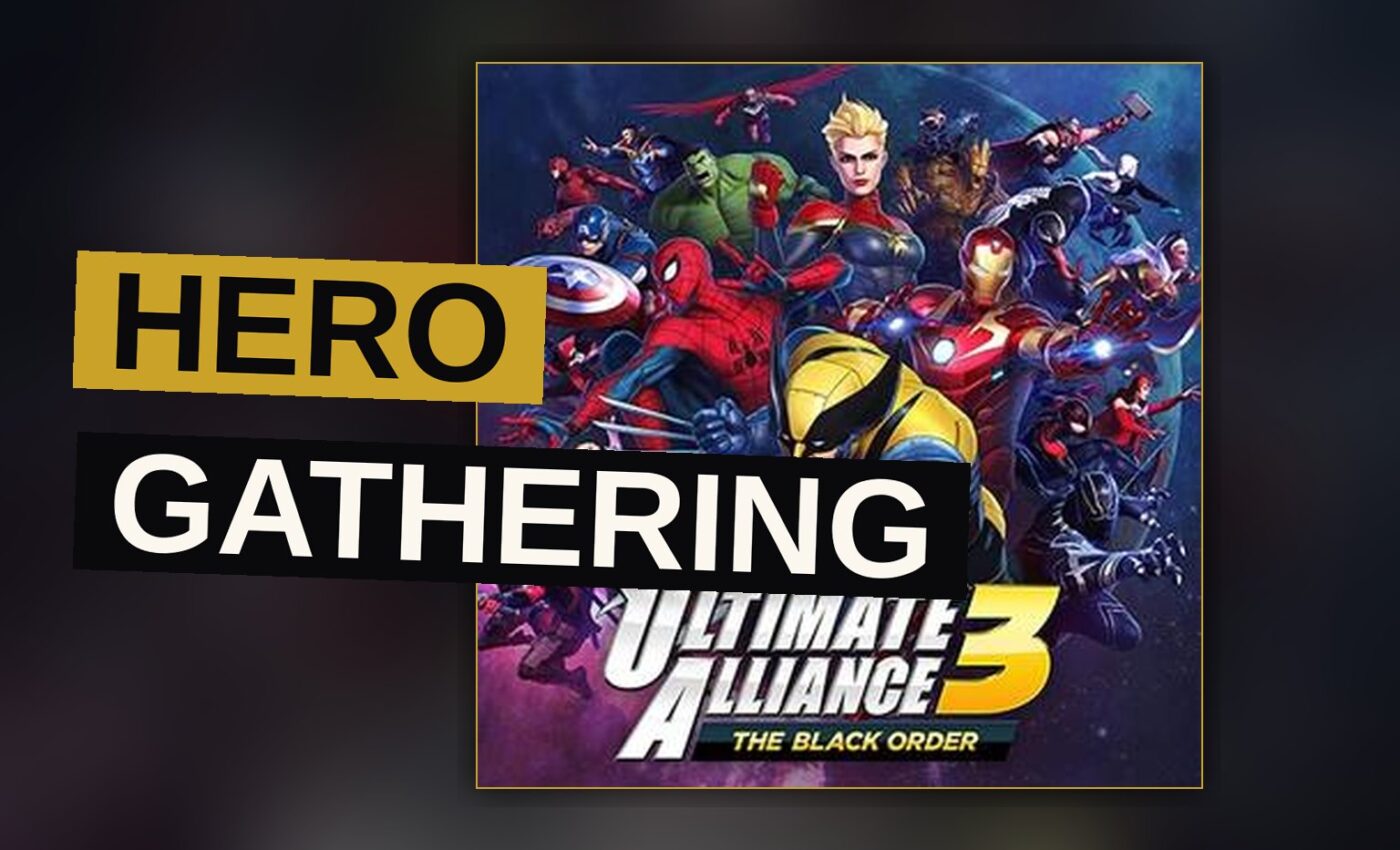
Marvel Ultimate Alliance 3: The Black Order is a reunion tour that never quite sells out the arena. Nintendo published it in 2019 for the Nintendo Switch, Team Ninja developed it, and it arrived as the first entry in the series since 2009’s Marvel: Ultimate Alliance 2 — and the first made without Activision, whose Marvel Games license expired in 2014. The pitch is simple: four heroes on screen at once, a cast pulled from every corner of Marvel, and Thanos waiting at the end. The execution is good enough to keep you playing and plain enough to remind you the series has not moved much in a decade.
Trailer, via Nintendo of America.
Four Heroes, One Switch, Four Systems
The structure is a top-down dungeon crawler with co-operative play at its center, the same shape as the first two games. Up to four players join locally on one docked Switch, or undocked across up to four systems, or online with friends or random lobbies. You pick four characters from Marvel’s various teams and push through linear stages, fighting enemies and bosses. Certain character combinations unlock passive buffs.
Every character controls the same way: jump, light attack, heavy attack, dodge, block, and four special abilities. Special abilities chain with your other three party members for a synergy boost, and all four syncing at once unleashes an especially powerful attack. New characters arrive through story progression or optional Infinity Rift challenges.
Progression borrows from traditional role-playing games. Party members level up by defeating enemies and bosses, gaining stat increases. ISO-8 crystals equip passive buffs to characters, with one exception: the alternate playable version of Thanos cannot take them. A sprawling skill tree lets characters buy permanent stat increases with in-game currency. The systems are legible and the loop is steady. Nothing here reinvents the genre, and the game does not pretend to.
Thanos, the Black Order, and Six Stones
The plot is original and ignores the continuity of the first two games. Thanos and his Black Order — Corvus Glaive, Proxima Midnight, Ebony Maw, Cull Obsidian, and Supergiant — hunt the six Infinity Stones for galactic conquest. Nebula and Ronan the Accuser were guarding them. The Guardians of the Galaxy stumble onto the Order’s attempt to hide the stones and accidentally give away their position. Star-Lord uses the Space Stone to scatter the rest across Earth and get his team to safety. S.H.I.E.L.D. detects them, and Nick Fury Jr. pulls the Guardians and Earth’s heroes together to find the stones first.
The quest runs through Marvel’s map. The Time Stone comes off the Sinister Six, led by Green Goblin, during a breakout at the Raft. The Mind Stone comes off Ultron when he assaults Avengers Tower. The Power Stone turns up with the Hellfire Club, then again with Magneto, Mystique, and Juggernaut of the Brotherhood of Mutants, who briefly steal it during a Sentinel attack Ultron orchestrates at the Xavier Institute for Gifted Youngsters. The Reality Stone is recovered from Dormammu in the Dark Dimension after the heroes escape the Black Order. The Soul Stone is claimed from A.I.M., led by MODOK, after Winter Soldier briefly secures it arriving in Wakanda for reinforcements.
Along the way the heroes help the Defenders retrieve an ISO-8 crystal from the Kingpin and face the Hand at Shadowland. They stop an attempted coup by Maximus in the Inhuman city of Attilan. They form uneasy alliances with Venom, the Brotherhood, Loki, and Thane, Thanos’ illegitimate son. When the Black Order finds them in Wakanda, Thane hands himself and the stones over to guarantee the heroes’ safety.
A Story Built to Stand Apart
The game takes inspiration from Avengers: Infinity War and Avengers: Endgame, both of which drew on the 1991 storyline The Infinity Gauntlet. But the writers built the plot to reflect a wider cast and to stand apart from the Marvel Cinematic Universe, the comics, and other popularized versions.
The source list is long. It pulls from Marvel Comics runs including the 2008 Guardians of the Galaxy series, Spider-Verse, New Avengers, the 2017 Defenders series, Shadowland, Midnight Sons, Avengers: Ultron Unlimited, X-Men, Avengers/Defenders War, Inhumans, Ta-Nehisi Coates’s Black Panther, Uncanny Avengers, The Infinity Gauntlet, Illuminati, Avengers Assemble, Infinity, Doctor Strange: Damnation, X-Men: The Dark Phoenix Saga, and Jack Kirby’s Fantastic Four.
That is a lot of borrowing, and it shows in the best way and the worst way. The stops are fan service with real affection behind them — Shadowland, Attilan, the Dark Dimension — and the collisions of characters who would never share a page land more often than they should. The problem is that a tour through twenty storylines has no spine of its own. The game moves you from set piece to set piece, and the set pieces are the point.
The Heroic Camera and the Fourth Controller
The headline addition is the Heroic Camera, an over-the-shoulder perspective that shifts the view closer to the action. It is a series first, and it works better than a top-down camera has any right to in a four-player brawler. It also does not fix the core tension: a game built for four people on one screen still asks you to track four characters at once, and the isometric view remains the honest way to play.
The co-op design is the most generous thing here. Drop-in and drop-out play lets players build their own alliance at will. Pass a Joy-Con to a friend and they join your team. With another pair of Joy-Con controllers, sold separately, four players share one system. Online, offline local wireless, or a couch full of people — the game meets you where you are. That flexibility is not a small thing. It is the reason to own this.
What 1.6 Million Copies Says
Marvel Ultimate Alliance 3 sold over 1.6 million copies by December 2022. That is a solid number for a Switch exclusive, and it says something about what players wanted: not a reinvention, a reunion. Reviews at launch were mixed. The gameplay and storyline were generally found fun, and critics were disappointed the game did not improve much on its predecessors. Both halves of that are correct, and they are the same fact told two ways.
Here is the shape of a session, roughly, for anyone planning a night with it:
| Stage | What happens | Party size |
|---|---|---|
| Raft breakout | Sinister Six, Green Goblin, Time Stone | Up to 4 |
| Avengers Tower | Ultron assault, Mind Stone | Up to 4 |
| Hellfire Club | Power Stone, then Brotherhood theft | Up to 4 |
| Xavier Institute | Sentinel attack, Magneto, Mystique, Juggernaut | Up to 4 |
| Dark Dimension | Dormammu, Reality Stone | Up to 4 |
| Wakanda | A.I.M., MODOK, Soul Stone, Thane’s surrender | Up to 4 |
Where the Game Actually Stands
The combat is identical across the roster, and that is the design, not a bug. A game with this many playable characters cannot give each one a bespoke move set and still ship. Syncing special abilities with three teammates is the skill expression, and the four-way sync is the payoff. It is a thin system stretched across a long campaign, and it holds up mainly because the campaign keeps changing the scenery.
The ISO-8 crystals and the skill tree give the RPG half something to do between fights. They are not deep. They are enough. The Infinity Rift challenges are where completionists will spend their time, unlocking characters the story does not hand you.
The story is the weakest part and the most forgivable. It disregards the first two games, which frees it to do whatever it wants with the cast, and what it wants is a greatest-hits tour. Thanos is a destination, not a character. The Black Order are obstacles with names. Thane’s surrender in Wakanda is the one beat that tries for weight, and it lands because the game has spent hours earning the alliance it breaks.
A Solid Frame, an Expensive Poster
Marvel Ultimate Alliance 3: The Black Order is a good co-op game and a cautious sequel. It does not improve much on 2006 or 2009, and it does not need to — it needs to put four Marvel heroes on one screen and let you bring three friends. On that promise it delivers, with a Heroic Camera that is a genuine option and a drop-in structure that respects your couch. What it lacks is ambition. The cast is enormous, the locations are iconic, and the systems underneath are the same ones from a decade ago. Team Ninja built a solid frame and hung a very expensive poster in it. That is worth your time if you have three people to play with, and worth less if you do not. 7.4 of 10.
Get the Notebook.
The day's best stories and every fresh verdict, in plain English, in your inbox by seven. One email a day, no more.