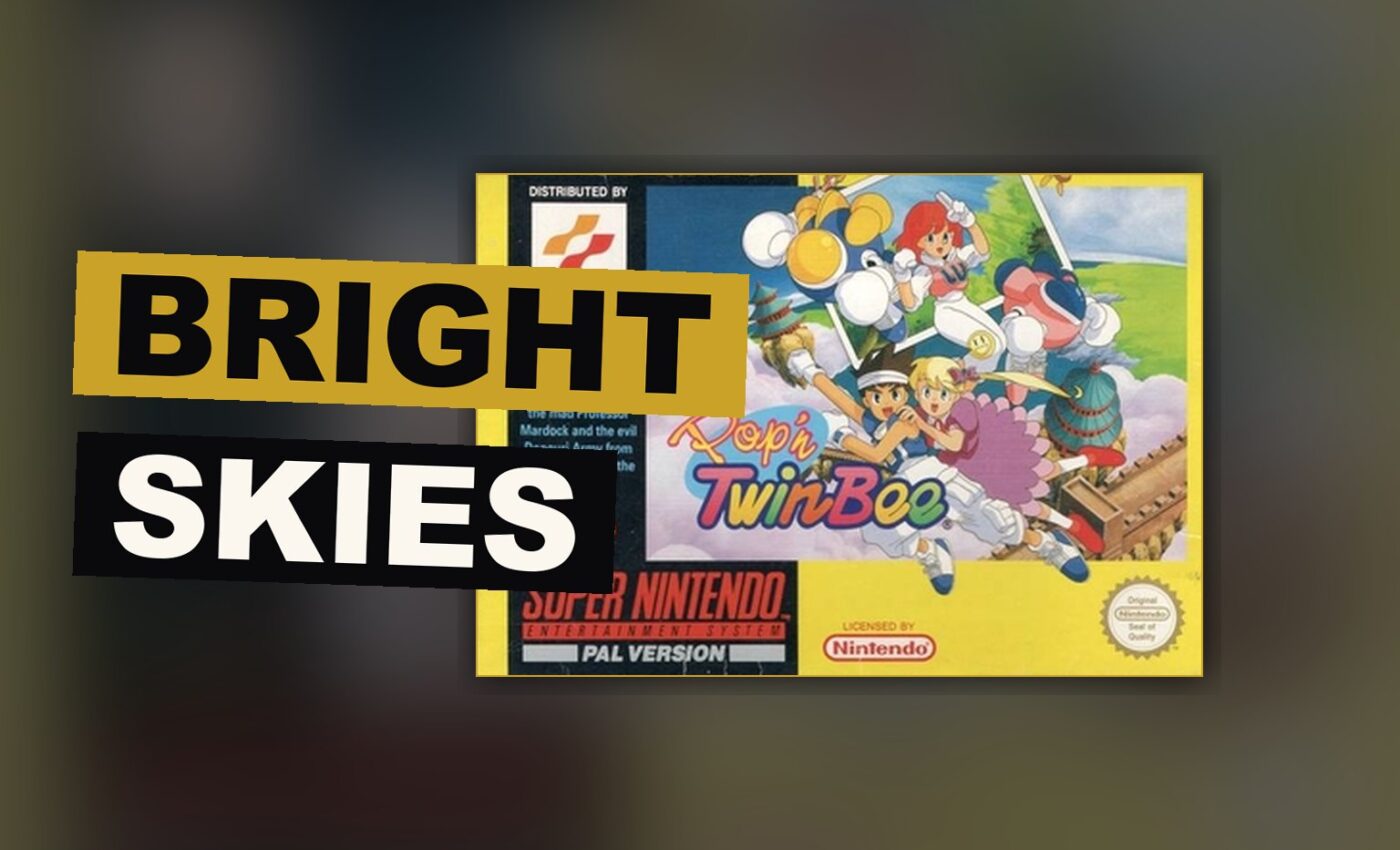
Konami’s series has never held back on color, and Pop’n TwinBee, made for the Super Nintendo, pushes further into that spirit than most games in the series before it. The game trades difficult space fighting for cheerful skies, cheerful bell rewards, and a difficulty setting built for players of many skill levels. It works more often than not.
Two Ships, One Bright Sky
Players fly TwinBee or a second fighter through stages filled with clouds and drifting enemies. The controls are light and quick to answer commands, which matters once bells start falling from every cloud. Firing at a cloud brings out a bell, and firing at it again changes its color, each one giving a different reward. It is a simple system on paper, but it asks for fast decisions once enemy fire fills the screen.
The mode built for two players is where Pop’n TwinBee earns its keep. Sharing bells with a partner, or racing to reach them first, adds a layer of teamwork and friendly competition that flying alone cannot match. Two fighters sharing a screen were not new by this point, but few games made working together feel this needed for staying alive.
The Sound That Stays With You
The music stands out on its own.
The composer’s work throughout stays bright and easy to hum, matching the soft colors of the world without wearing thin over long sessions. The boss themes stand out most, changing pace as enemy attacks grow harder to escape. It is the kind of soundtrack that stays with a player long after the console is turned off.
The look of the game holds up too. The sprite work is clear and well drawn, and each stage offers something new to look at. Even when the screen fills with enemy fire, the game keeps moving without trouble, a mark of careful work on the part of its makers. Boss designs move from plain to truly surprising, and the game never seems to run out of new shapes to throw at players.
Where the Balance Slips
Not everything holds steady. Later stages grow harder fast enough that the earlier, gentler pace feels like a different game altogether. Some enemy fire becomes thick to the point of feeling unjust, mostly for players flying alone rather than with a partner. It is a game that wants to welcome every player, then forgets that promise in its second half.
The bell system, while charming, can also work against the player. Losing a life clears away every reward earned, and the rush to win them back during a fight sometimes feels more annoying than clever. Longtime followers of the series may see this as a fair trade of risk against reward. Newer players may just find it hard to bear.
Replay Value and Modes
Pop’n TwinBee does not offer much beyond its main run of stages, but what is there holds up across repeat plays. Players chasing higher totals will find enough depth in the bell system to justify going back, and the mode built for two players alone gives the game a good deal more life.
Below is a rough guide to how a full run through the game tends to unfold, based on stage count and common pace of play:
| Stage | Time Needed | Notes |
|---|---|---|
| Stage 1–2 | 10 minutes | Easy start, few enemies appear |
| Stage 3–4 | 15 minutes | Bell system fully shown |
| Stage 5–6 | 20 minutes | Harder fights begin |
| Stage 7–8 | 20 minutes | Heavy enemy fire, boss fight |
| Final Stage | 10–15 minutes | Full test of every reward earned |
That table is not an official guide from Konami, just a plain look at what one full run tends to look like.
Pop’n TwinBee knows exactly what feeling it wants to give players, even if its difficulty does not always match that feeling. The bright look, strong soundtrack, and solid mode built for two players make it stand out among games made for the Super Nintendo, while its late-game trouble keeps it from being a game every player can finish without strain. It is a game built on charm first, challenge second, and it mostly succeeds at holding the two together.