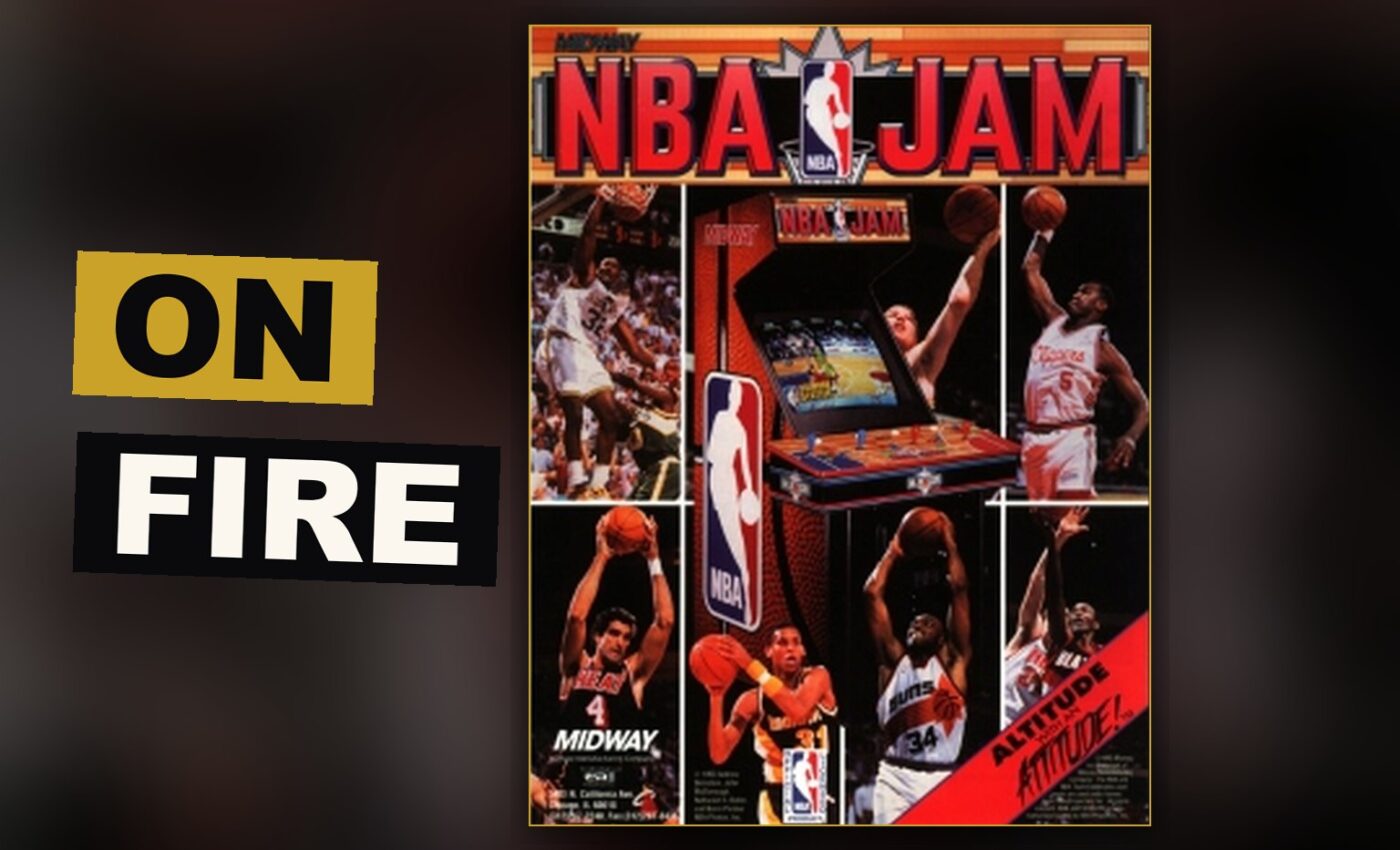
NBA Jam arrives on the SNES as a basketball game built around two players against two players, and it plays fast and loud. Players spring higher than real physics allow. The ball catches fire after a run of made shots. The game’s announcer calls out over every scoring play. The SNES cartridge carries much of the arcade version’s sound and pace, and the game holds together well on the console.
How the Game Plays
NBA Jam cuts basketball down to two players against two players, with no fouls called, and scoring plays built for a dramatic moment rather than a real match. The SNES version keeps the arcade game’s core rules whole: make enough shots in a row, and the ball catches fire, giving a player an advantage for a short time. Miss enough shots, and the balance of the game turns toward the other side.
Controls are simple. One button throws the shot, one button passes, one button makes the player spring upward. That simplicity is the point. New players can pick up a controller and score within minutes. Longtime players will find enough depth in push timing and use of the extra button to keep matches tight.
The SNES cartridge includes every team from the NBA at the time the game came out, with real player names and rough likenesses drawn in the console’s limited set of colors. Playing with a friend is where the game earns most of its reputation. Passing the ball between two human players, setting up a high pass toward the rim, and pushing a rival away from the goal are all part of the experience.
Here is a usual match, based on the game’s order of play:
| Part | Description |
|---|---|
| Opening toss | Center toss, ball control decided |
| First half | Two quarters of play, two against two |
| Halftime | Short pause, no stat changes shown |
| Second half | Two more quarters, comeback chances through “on fire” runs |
| Extra period | Added time if scores are tied |
Sound and Look
The SNES cartridge does not match the arcade original’s sound hardware note for note, but the console carries most of the same lines and effects. The announcer’s lines remain the best part of the package.
“He’s on fire!”
That line, and others like it, plays after a run of made shots, and it never stops being funny, even after dozens of games. The music is small in amount, mostly the sound of shoes on the floor and people watching, but that fits a game built around fast matches rather than quiet mood.
In appearance, the SNES version holds up well against its console rivals at the time. Player figures are large and drawn in a bold style, motion is smooth for the hardware, and the scoring plays look satisfying even in a 16-bit frame. There are moments where the action grows heavy near the goal, but they rarely break the flow of play.
This is a party game first and a strict copy of real basketball a distant second.
Playing With Others
NBA Jam rewards a room full of friends more than a single player working through a season alone. There is no deep season mode here. There is no injury system, no trade logic, no extended stat tracking.
That absence is not really a weakness. The game was built for short, loud matches, and it delivers exactly that. Every game takes minutes, not hours. Change in players and matchups keeps the way of play fresh even after long sessions.
Playing with a second person remains the game’s strongest draw. Facing a rival, or teaming up against the side controlled by the game itself, changes the rhythm of every match. Pushing becomes a planned move. Passing timing becomes a small art of its own. Nothing about the SNES version holds that back.
Final Word
NBA Jam on the SNES succeeds because it fully commits to its own odd style, far removed from how basketball is actually played. It does not try to copy real basketball closely, and it never pretends otherwise. The result is a game that has grown into a real classic of the console’s library, built for quick sessions and shared controllers rather than long sessions played alone.
Its team lists, likenesses and announcer lines tie it firmly to the NBA of its time, but the core way of fast matches with bold scoring plays has not lost its charge. Anyone who grew up with a Super Nintendo likely has a memory tied to this cartridge.
NBA Jam is not without weakness. Its lack of deeper modes limits it for a player alone, and repeat play can grow tiring without a second human player. But its center of gravity, fast, loud basketball with two players against two players, remains one of the most pleasing things on the SNES.