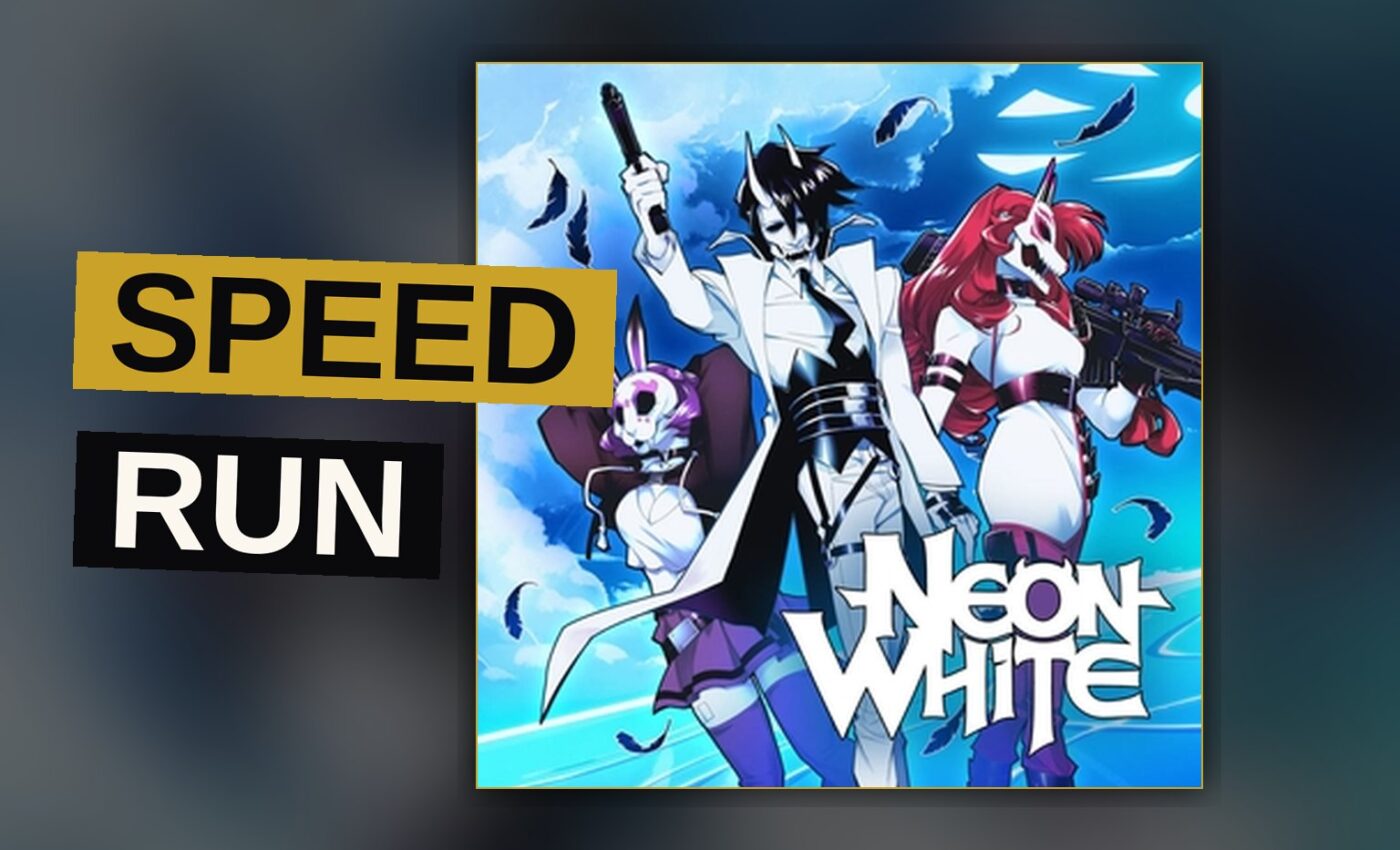
Neon White asks one question, over and over, and it asks it fast: can you get there quicker? You are an assassin pulled out of Hell, handed a gun made of a playing card, and told that the only way to stay in Heaven is to be the fastest killer in a competition of a hundred sinners. The answer takes about as long as a breath. Then the level restarts, and you try again.
Trailer, via Nintendo of America.
A Hundred Neons and Ten Days of Judgement
Neon White is a first-person shooter built around speedrunning, developed by Angel Matrix and published by Annapurna Interactive. It came out for Microsoft Windows and the Nintendo Switch on June 16, 2022. PlayStation 4 and PlayStation 5 versions followed on December 13, 2022, and the game reached Xbox One and Xbox Series X/S on July 11, 2024. It is a single-player game, and the platforms it now sits on are Xbox Series X|S, PlayStation 4, PC, and PlayStation 5.
The setup is a competition. Sinners are taken from Hell each year and brought to Heaven to cull the demons infesting it. The group is called the Neons. The beings running the contest call themselves the Believers, and they claim to speak for God. They tell the Neons that God has judged them “most unfavorably.” The prize is a mechanical halo, and the halo buys one year in Heaven. Only the Neon who kills the most demons by the end of the Ten Days of Judgement gets it.
Every Neon wears a mask. Remove it, disobey an order, or break a rule, and the mask explodes. The Believers can also set the masks off themselves, which is how they execute anyone who steps out of line. That detail does more work than any cutscene. The competition is not a game show with a prize at the end. It is a leash.
White Wakes Up With No Memory
You play as Neon White, an assassin competing for the first time. He wakes in Heaven with amnesia. He cannot recall his past life, and the people around him will not let him forget that they can. Yellow, Violet, and Red all claim, vaguely, to have known him before. The angel Mikey hands out daily missions. Another angel, Gabby, helps manage assignments.
The amnesia is not a mystery box. It is the engine of the plot. White is surrounded by people who know him and will not say how, and the game keeps that tension running under the levels rather than interrupting them.
Then there is Neon Green. Green holds the mechanical halo when the story starts, and the other Neons fear him because he kills Neons, not just demons. Violet tells White about the Old City, an abandoned stretch of Heaven rumored to hold powerful weapons. Red warns him off, because Green hunts there. White goes anyway, with Yellow. Green shows up. Yellow dies blocking a hit meant for White.
White beats Green in the fight that follows, and Green escapes. Before he goes, he says the Believers built his halo from a page of the Book of Death. He promises he has plans for White. That is the turn. White learns there is a counterpart, the Book of Life, and starts hunting it while his doubts about the Believers and the whole competition pile up.
Cards You Throw Away to Move
The shooting is only half the game. Soul Cards lie around levels or drop off dead demons. Each card fires one way and does something else when you discard it. The handgun card, thrown away, gives you a double jump. That is the whole design in one example: your ammunition is also your movement, and spending one costs you the other.
You run, you jump, you dash, you double-jump, and you shoot, and the level wants all of it stitched into one unbroken line. Kill every demon. Reach the crystal goal. If you take too much damage or fall off the map, you restart. The goal also grants Insight, an experience currency that unlocks the ability to see alternate routes and hidden items.
The game was written by Ryann Shannon, who wrote for OK K.O.! Let’s Be Heroes, and Aevee Bee, who wrote for We Know the Devil. That pairing explains a lot about the tone. The dialogue between missions is a visual novel, and it is funny in a way that a straight-faced Heaven-versus-Hell story would not be.
The Medal That Beats the Director
Finish a level and you get a medal based on your time. The tiers run Bronze, Silver, Gold, and Ace. Hit certain preset times and you earn a secret medal that the community calls a red medal. Red medals are awarded for beating the time set by the game’s director, Ben Esposito.
That is the sharpest thing in Neon White. The developer put his own name at the top of the leaderboard and dared you to take it off. Most games hide the skill ceiling. This one prints it on a medal and hands it to you.
Here is what the medal chase actually demands, in order of how much it will cost you:
- Learn the level layout, including the routes you cannot see until you spend Insight on them.
- Learn which Soul Cards to fire and which to discard, because the discard is a movement tool and not a waste.
- Learn the demon positions, since a level only ends when every one of them is dead.
- Chain all of it without stopping, because the clock does not care how good any single jump looked.
The red medal sits above all four. It is not a reward for playing well. It is a reward for playing better than the person who made the thing.
Heaven Is a Waiting Room With a Bomb on Your Face
The Believers run a daily sermon. That is where White first meets Green, the current halo holder. The Old City is the one place in Heaven that feels abandoned rather than administered, and it is where the story stops being a competition and becomes an investigation.
The masks are the best piece of worldbuilding in Neon White. They are not a metaphor you have to dig for. They are a bomb strapped to every contestant’s face, wired to obedience, and the people holding the trigger are the same people promising salvation. Heaven in this game is a bureaucracy with a body count, and the halo is a one-year lease.
The Book of Death and the Book of Life push the plot past the premise. Green’s halo was made from a page of one book, which means the competition’s prize is built out of something older and stranger than the Believers admit. White’s amnesia connects to it. So does the fact that Yellow, Violet, and Red all knew him. The game is not really about killing demons. It is about what the Believers are hiding and why they need a hundred amnesiacs to do their cleaning.
Where the Speed and the Story Pull Against Each Other
The friction is real. The visual novel sections are where the characters live, and they are also the part that stands between you and the next run. When a level has just clicked and you have a red medal in sight, a long conversation is an interruption. When the conversation is good, you resent the level waiting behind it.
The shooting itself is thinner than the movement. The guns are a means to a jump, and once you internalize that, the firing modes matter less than the discards. That is a deliberate choice and it works, but it means Neon White is a platformer wearing a shooter’s clothes, and players who come for the FPS will find the parkour is doing the heavy lifting.
None of that undoes the design. Neon White takes two things that usually fight each other, a story about damnation and a stopwatch, and makes them feed. The masks give the competition stakes. The competition gives the masks a clock. The red medal gives the whole thing a punchline that is also a challenge.
The critical aggregate sits at 8.9 out of 10 across six outlets. That number is fair, and it is fair for a specific reason: Neon White is not a game you finish, it is a game you keep shaving time off. The campaign is short. The leaderboard is not. Angel Matrix built something that respects the player’s patience and then tests it, and the test is the point.
The part worth watching is not the sequel or the port list. It is whether other developers copy the red medal. Putting the director’s own time on the board as the final tier is a small idea with a large effect. It tells the player that mastery is expected, not optional, and it costs nothing to implement. Neon White earns its score on that confidence, on Shannon and Bee’s writing, and on a discard button that turns a gun into a jump.
Get the Notebook.
The day's best stories and every fresh verdict, in plain English, in your inbox by seven. One email a day, no more.