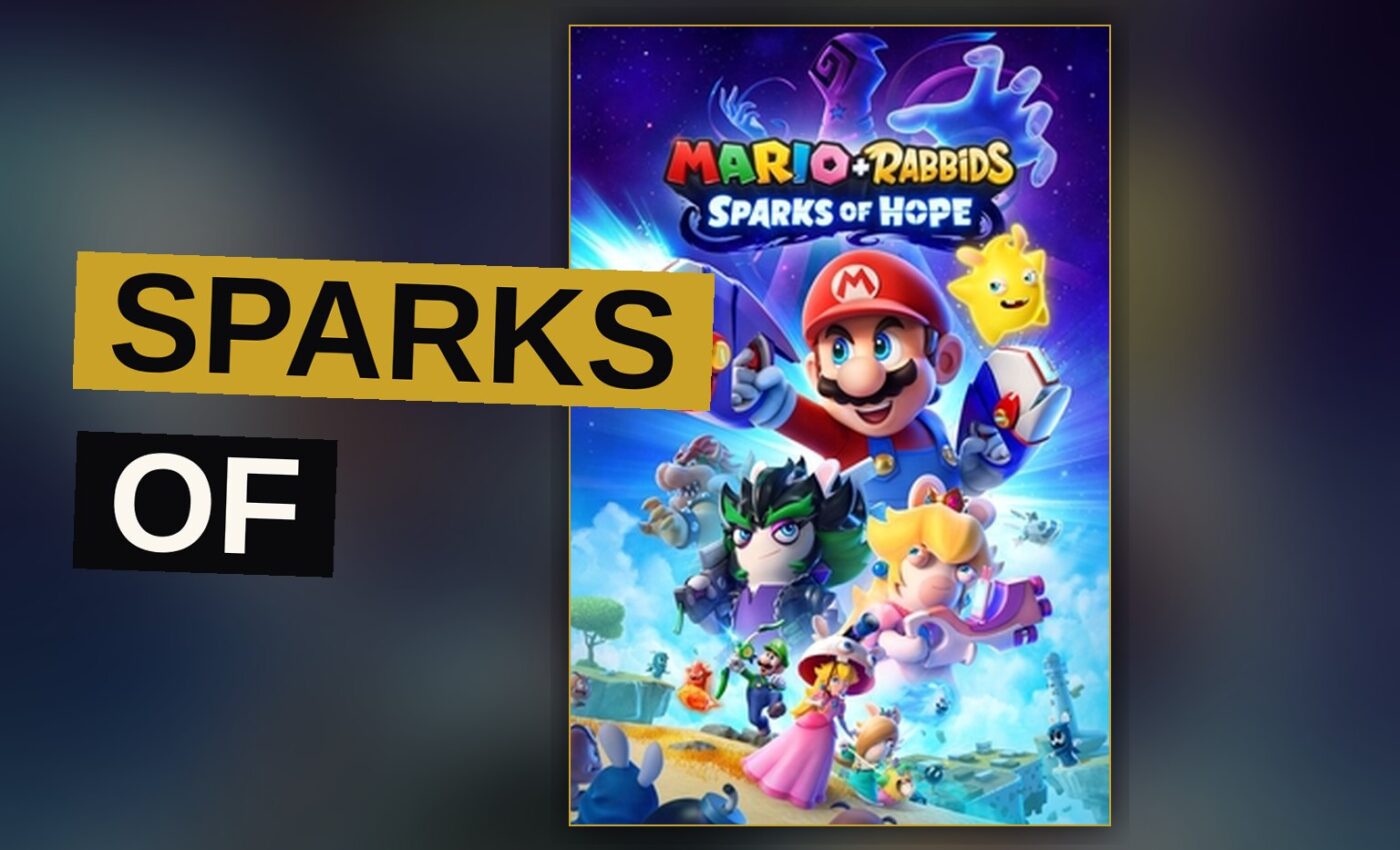
Mario + Rabbids Sparks of Hope asks a simple question: what happens when you take the grid away? The 2022 tactical game from Ubisoft Milan and Ubisoft Paris answers by letting Mario and his friends roam free inside a bounded space, then punishing anyone who wanders without a plan. It is a sequel that improves on Mario + Rabbids Kingdom Battle in almost every way that matters, and it underperformed commercially anyway. Both things are true.
Trailer, via Ubisoft.
A Spaceship Built From a Washing Machine
The setup is thinner than the combat, and that is fine. After the events of Kingdom Battle, the Mushroom Kingdom’s residents live alongside the Rabbids, who have learned to speak. Then Sparks appear — hybrids of Rabbids and Lumas — pursued by a manta ray-like creature soaked in Darkmess, a shadowy corruptive substance. Rabbid Peach gets abducted while trying to take a selfie. Mario and Beep-0 pull her out of a pocket dimension.
Cursa, the malevolent entity behind all of it, wants to absorb the Sparks’ power. The heroes escape aboard the WM-ARC, a spaceship built from the Rabbids’ Time Washing Machine, and its AI explains the stakes. The unique fusion of Rabbid and Luma DNA gives the Sparks unlimited power, and Cursa’s corruptive influence has already spread across the galaxy.
The team resolves to find Cursa’s stronghold, save as many Sparks and corrupted planets as possible, and locate Rosalina, the missing guardian of the Lumas. That is a serviceable frame for a game that mostly wants to move you from one fight to the next.
Five Planets, Three New Heroes
Mario’s crew travels to five planets while gathering purified Darkmess: Beacon Beach, Pristine Peaks, Palette Prime, Terra Flora and Barrendale Mesa. Along the way they pick up three recruits.
- Edge, a stoic sword-wielding Rabbid also looking to save the Sparks
- Rabbid Rosalina, a gloomy but intelligent Rabbid searching for her original counterpart, whom she idolizes
- Bowser, Mario and company’s perpetual arch-enemy
Bowser joining the party is the kind of move that should feel like fan service and instead feels like a genuine shift in how the roster plays. Edge and Rabbid Rosalina add two more distinct bodies to a squad that already ran deep. The Rabbids are fully voiced for the first time here, which is either a selling point or a warning depending on your tolerance.
The Grid Is Gone
This is the part that matters. Kingdom Battle built its fights on a grid, and Sparks of Hope throws it out. Lead designer Xavier Manzanares described what the change allows. A character can cross the movement zone however the player likes, scoop up a Bob-omb mid-dash, and then has only a few seconds before it goes off. That real-time pressure is what separates the new system from the old one.
That pressure is the whole game in miniature. You slide a character anywhere inside a movement zone, pick up an explosive, and then have seconds to decide where to throw it. The turn-based structure holds, but the texture underneath it changes. Enemy encounters also happen outside turn-based combat now, which keeps the pace from settling into a rhythm you can predict.
Mario can be swapped out of the active party, a small change with large consequences for how you build a team. The Sparks themselves provide distinct powers that shape those builds, and rescuing them across the galaxy gives the exploration a purpose beyond scenery.
Less Linear, More Legible
Level design in Sparks of Hope is less linear than in Kingdom Battle. That sounds like an improvement, and mostly it is, though it also means more time spent reading a map instead of a battlefield. The trade is worth making. The planets are varied enough that moving through them does not feel like filler between fights.
Loading times drew criticism at launch, and they are the one place where the game’s ambition works against it. A tactical game lives on rhythm — plan, execute, reset — and a long wait between those beats drains momentum. It is not a fatal flaw. It is the kind of flaw you notice every single session.
The battle system’s improvements are what carry the game. Removing the grid could have flattened the tactics into mush. Instead it opens up angles and timing that the first game could not offer, and it makes the dash mechanic feel like a tool rather than a formality.
A Galaxy That Looks the Part
Graphics and soundtrack earned praise, and the praise is earned. The galaxy has a consistent look across its five planets without any of them blurring into the others. The score does more work than the plot does, which is a compliment to the composers and a slight against the script.
The story is the weakest pillar. Cursa is a force rather than a character, and the Darkmess is a substance rather than a threat you can picture. The game knows this, and it spends its energy on the party instead. Edge, Rabbid Rosalina and Bowser get more personality than the villain does, and the fully voiced Rabbids give the comedy somewhere to land.
None of that is a reason to skip it. It is a reason to know what you are buying.
The Last Mario With Charles Martinet
There is a piece of history attached to Sparks of Hope that has nothing to do with its quality. The game marks the final Mario franchise title to feature longtime voice actor Charles Martinet performing as Mario and Luigi, through archival voice clips, before he stepped down from his various roles in the series in 2023 to become a brand ambassador for the property.
That fact will outlast the conversation about loading times. It also means the game sits at the end of an era it did not choose to end, which is a strange weight for a crossover about Rabbids in spacesuits.
What the Combat Change Actually Bought
Sparks of Hope received generally positive reviews, and Ubisoft has said the game underperformed commercially. Those two facts sit awkwardly together, and they should. A game can be good and still miss its numbers, and this one did. The sequel improved its battle system, expanded its roster, dropped the grid that defined its predecessor, and still could not convert that into the sales Ubisoft wanted.
What is actually worth watching here is the combat. The move away from grid-based tactics is the kind of change that usually goes wrong — it either overcomplicates the board or strips out the strategy entirely. Sparks of Hope does neither. Manzanares and his team found a middle ground where real-time reactions sit inside turn-based planning, and it works. That is the achievement, not the story, not the villain, not the five planets.
The loading times are real and annoying. The plot is forgettable. The roster is the best it has been. And the final Martinet performance gives the whole thing a historical marker it never asked for.
Mario + Rabbids Sparks of Hope is a tactical game that trusts its players to think on their feet, and it deserves a bigger audience than it found. Score: 8.8 of 10.
Get the Notebook.
The day's best stories and every fresh verdict, in plain English, in your inbox by seven. One email a day, no more.