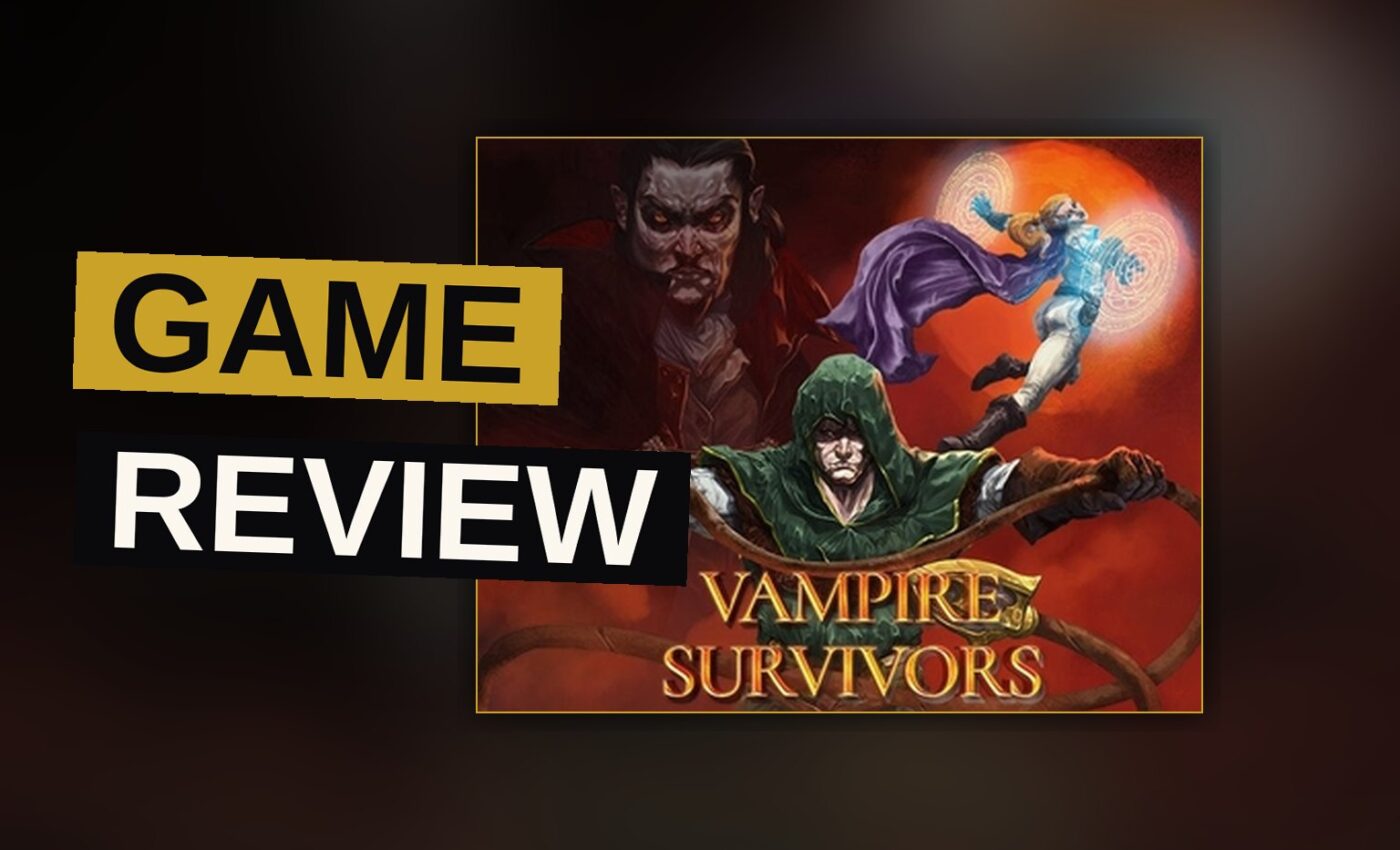
Vampire Survivors is a game that looks like a forgotten Flash title from 2008 and plays like the most addictive thing you will touch all year. It costs a few dollars and runs on almost anything. The premise is absurdly simple: you move a character around a dark map, enemies flood in from all sides, and your weapons fire automatically. You do not aim. You do not press attack buttons. You just move.
That is the whole pitch, and it is enough. The game understands that the player’s job is to make interesting decisions, not to perform busywork. Your only real choice is where to stand, what to pick up, and when to run. Everything else is a cascade of numbers, upgrades, and escalating chaos that never feels unfair. It is a slot machine disguised as a gothic horror, and it works.
The game launched in early access in 2021 and hit its 1.0 release in 2022, landing on PC, Xbox, and eventually mobile and other platforms. It is now available on Series X|S, PS4, Linux, and Android, among others. I spent the most time with the Xbox release, which added a co-op mode the original PC build lacked — an addition that turned a solitary obsession into a couch co-op riot.
Trailer, via XBOX.
Core Loop: Survive 30 Minutes
You pick a character, each with a starting weapon and a passive bonus. You load into a stage — a single screen that scrolls infinitely in all directions — and you survive for 30 minutes. There is no story, no campaign, no boss rush. Just 30 minutes of escalating pressure, and then the run ends.
Enemies come in waves that grow denser and faster as the clock ticks. They drop gems that give experience points. Every level-up offers a choice of three or four upgrades: new weapons, passive items, or boosts to your existing kit. Weapons evolve when you max them out and pick up the right supporting item. The combinations are the heart of the game, and discovering them is half the fun.
The other half is spectacle. By minute 20, the screen is a swirling mass of hundreds of enemies, projectiles, and explosions. The game slows down on weaker hardware, but on a modern console it runs at a smooth 60 frames per second even when the screen is packed. It is chaos, but legible chaos: you always know where your character is, what is killing you, and what to grab.
There is no skill ceiling in the traditional sense. What you need is knowledge: which weapons synergize, which characters start strong, which maps hide secrets. Every run teaches you something, even the ones that end in a messy death at minute 12.
Weapon Evolutions and the Grim Reaper
Each of the dozens of weapons has a final form, unlocked by maxing the weapon and pairing it with a specific passive item. Garlic becomes Soul Eater, which drains health from everything nearby. The Magic Wand becomes Holy Wand, which fires faster and never misses. The Axe becomes Death Spiral, a spinning blade that clears the screen.
These evolutions change how the weapon behaves, often turning a weak early tool into a late-game lifesaver. The King Bible becomes Vespers, a rotating ring of holy texts that blocks projectiles, essential in the final minutes. Knowing which evolutions to chase is the difference between a run that fizzles and one that ends with the Grim Reaper himself.
The Grim Reaper appears at the 30-minute mark: a massive, slow-moving wall of death with an absurd amount of health, killable only with a fully evolved build and a bit of luck. It is the game’s ultimate, entirely optional challenge. The run ends when he touches you and the credits roll; there is no final boss beyond him.
The system is legible: each passive item has a symbol matching the weapon it evolves, so once you learn the icons you can plan your build from the first minute. That clarity is rare in the genre, and it is why the game feels fair even when it is brutal.
Characters: From Antonio to Mortaccio
The roster is a parade of references and jokes. Antonio Belpaese is the default swordsman. Imelda Belpaese starts with a magic wand and extra experience gain. Pasqualina Belpaese fires projectiles in four directions. The Belpaese family is a running gag, but the roster goes far beyond them.
You unlock characters by completing challenges: surviving a certain number of minutes, killing a certain number of enemies, or collecting a certain amount of gold. Each has a unique starting weapon and passive bonus, and some have hidden unlocks requiring specific actions in specific stages.
My favorite is Mortaccio, a skeleton who starts with three bone projectiles that pierce enemies; his passive increases projectile count every 20 levels, turning him into a screen-filling monster by the end of a run. Poe Ratcho starts with Garlic and a health bonus, the tanky option for players who want to survive through attrition.
The characters change how you play. A fast character like Krochi Freetto encourages aggressive gem collection; a slow one like Clerici encourages careful positioning. The unlocks give you a reason to try everyone at least once.
Stages, Secrets, and Sound
The base game ships with five stages. Mad Forest is the tutorial, a wide-open field with trees that block movement and secrets hidden in the corners. Inlaid Library is a long horizontal corridor. Dairy Plant is a maze of walls and narrow passages. Gallo Tower is a vertical climb. Cappella Magna is the final stage, a sprawling map with angels, demons, and the most aggressive enemy spawns in the game.
Each stage hides items and secret areas. A coffin in a corner might hide a new character; a specific pattern of torches might reveal a passive item that is otherwise unavailable. The game rewards exploration, and finding a secret is a genuine thrill.
There is a purely cosmetic day-night cycle: the lighting shifts, the enemies change slightly, the mood darkens. The game is not scary, but it is moody, with a pixel art style that evokes the 16-bit era without copying any single game.
The music is a standout mix of chiptune and synthwave that pulses with the action; the main theme gets stuck in your head. The sound design is punchy, with satisfying thuds and pops for every gem pickup and kill.
Co-Op on Series X|S
The Xbox version added local co-op for up to four players, and it is a revelation. The game scales enemy count and health to the number of players, but the core loop stays the same. You move independently, share the same gem drops, and level up together. The screen does not split; everyone stays on the same map, and the chaos multiplies.
Co-op changes the strategy. You can split up to cover more ground or stay together to share the load. Weapon synergies matter more because each player brings their own build, and the shared experience pool keeps everyone roughly equal in power. It is a cooperative mode that actually feels cooperative — a genuine addition, not a port feature bolted on as an afterthought, and a strong reason to pick up the game on Series X|S.
The mobile version is free-to-play, with ads and a single in-app purchase that removes them. The touch controls are serviceable, and it runs well on most Android devices, though the smaller screen makes the late-game chaos harder to read. The Linux version is a straight port of the PC build, with no compromises.
Why the Design Works
Vampire Survivors strips the genre down to its essentials and builds back up with elegance. No inventory management, no crafting, no dialogue trees — only movement, choice, and escalation. It trusts the player to figure things out and rewards curiosity with secrets and synergies.
It respects your time: a run is 30 minutes, you can quit at any point, and there is no save system because there is nothing to save. You either survive or you die, and both outcomes teach you something.
The difficulty curve is a masterclass: a gentle first five minutes, a steady ten-minute ramp, a relentless final ten. The game never spikes unfairly and never lets you get complacent. Every run feels like a test, and passing it feels earned.
The game impresses not with graphics or story but with design — it understands what makes games fun and cuts everything else away. It has also spawned a genre; the “survivor-like” is now a crowded field of imitators and successors. But the original still holds up: still the best at what it does, still the most fun you can have with a joystick and a prayer.
Score and Availability
Vampire Survivors is a masterpiece of minimalism. It does not need a big budget or a long campaign; it needs a good idea, and it has one. It is available on Series X|S, PS4, Linux, and Android, and it is worth your time on every one of those platforms.
It is not for everyone. If you need a story, a cinematic presentation, or a deep combat system, you will be disappointed. But if you want pure, unadulterated fun, Vampire Survivors delivers — the kind of game that reminds you why you play games in the first place.
| Platform | Release Status | Co-Op | Price |
|---|---|---|---|
| Series X | S | Available | Yes, 4-player local |
| PS4 | Available | No | Budget |
| Linux | Available | No | Budget |
| Android | Available | No | Free with ads |
The game has earned its place in the canon of great indie titles and deserves every bit of praise it has received.
Vampire Survivors scores 9.1/10 on the IGDB critic aggregate, based on 5 outlets.