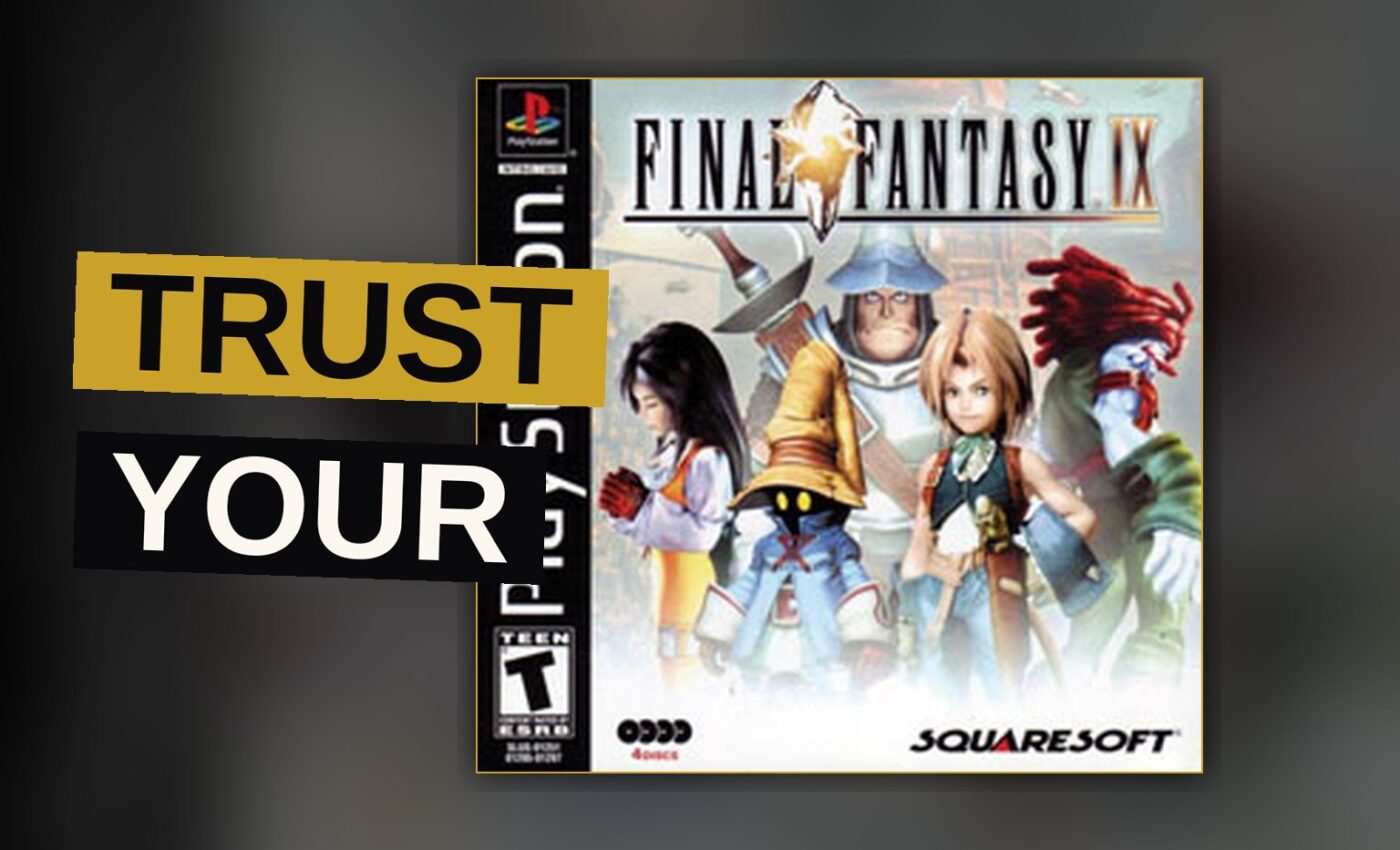
Final Fantasy IX arrives on the original PlayStation as a breath of fresh air for the series. After years of dark, mature settings, Square turns back to a simpler, brighter fantasy world. The result is a game that feels both classic and surprisingly modern, even two decades later.
The story follows Zidane Tribal, a thief who lives on the floating continent of Gaia. He kidnaps Princess Garnet, thinking she is a treasure for hire, but discovers she carries a stone that could bring down his entire world. Alongside him are Vivi, a young mage, and Steiner, a knight loyal to the kingdom of Alexandria. Together they chase after Garnet, but the journey pulls them into a war between nations, monsters, and gods.
Zidane, Garnet, and the Cast
Zidane is the star of Final Fantasy IX, and he is one of the best characters the series has ever put forward. He speaks with a quick wit and a grin, and his scenes carry the emotional weight of the story without ever turning heavy-handed. His relationship with Garnet drives the plot forward, and the game spends real time building the bond between them.
Garnet is not a damsel in distress. She holds her own, fights alongside the group, and carries a secret that changes everything once it comes out. Her arc moves from fear to strength, and the game trusts the player to watch her grow without spelling it out.
Vivi is a small boy who can summon magic spells, and Steiner is a rigid knight whose devotion to duty sometimes clashes with common sense. The supporting cast includes Quina, a creature who eats almost everything, and Freya, a huntress who knows the wilds better than anyone. Each character gets their own moments, and the game manages to make a large party feel less like a list of names and more like a group of friends.
The dialogue is sharp, and the voice acting on the original PlayStation hardware holds up well. The script avoids the cynicism that marked some earlier games in the series, opting instead for humor, warmth, and occasional tragedy. The result is a story that is easy to follow and hard to forget.
The World of Gaia
Gaia is a bright, colorful world full of distinct regions. There are forests, mountains, deserts, and cities, each with its own look and its own people. The game does not waste time on filler areas; each location serves the story or the setting, and the world feels alive.
The music matches the tone. Composer Nobuo Uematsu returns with a score that mixes orchestral pieces with light, playful tracks. The main theme, “Trust Your Heart,” became one of the most beloved songs in the series, and it sets the tone for the whole game. The sound design is clean, and the battle themes are energetic without being overwhelming.
The presentation is a step up from earlier entries in the series. Character models are expressive, and the animation during cutscenes is fluid. The game runs smoothly, and the loading times are short. On the original PlayStation, this is a technical high point.
The Battle System
The battle system in Final Fantasy IX is simple on the surface but deep underneath. It uses the Active Time Battle format familiar to players of the series, with ATB bars filling up for each character. Players choose commands from a menu, and the battles move quickly once the action starts.
What sets this game apart is the Materia system. Each character gains Materia, which grant new abilities. These can be combined and arranged in different ways, giving players room to customize their fighters. It is a system that rewards experimentation without punishing those who want to stick to the basics.
The game also introduces the summon materia, which lets players call forth powerful allies for a turn. These summons are not just attacks; they have their own stories and personalities, and calling them out during a battle adds a layer of spectacle that the game leans into heavily.
The difficulty curve is gentle, especially in the early and middle parts of the game. Bosses demand careful planning, but they rarely feel unfair. The game is generous with hints, and it rewards patience over speed.
The Side Content
Final Fantasy IX includes a large amount of side content, and much of it is worth pursuing. The chocobo racing minigame is a highlight, letting players ride across the world and race through courses for prizes. The card game is another standout, a strategic mode that rewards memory and pattern recognition. Both systems are optional, but they add replay value for players who want it.
There is also a vast world to explore. Hidden paths, treasure chests, and side quests fill the game’s map, and finding them all takes time. The game does not force players to chase every one, but it rewards those who do with extra equipment, items, and a deeper sense of the world.
The story itself is not long. A full playthrough can be completed in twenty hours or less, but the game offers enough content to stretch that out for players who want to see everything. The pacing holds steady throughout, with no slow patches in the middle of the game.
The Plot and Its Weak Points
The story in Final Fantasy IX is strong, but it is not perfect. Some plot threads get resolved quickly, and a few characters disappear from the main story without much warning. The game also leans on its world-building to explain things that could have been shown through scenes, which breaks the flow at times.
The ending is divisive. It resolves the main conflict, but it leaves some questions unanswered and asks players to accept certain events without much explanation. It is a bold choice, and it does not work for everyone.
The game also suffers from a few technical issues. Some battles can freeze for seconds, and the game stutters during certain animations. None of these problems break the experience, but they are noticeable enough to remember.
How It Holds Up Today
Final Fantasy IX remains a beloved entry in the series, and it holds up well against modern standards. Its presentation is dated, but the core design still feels sound. The story is engaging, the characters are memorable, and the gameplay is solid.
Playing it now, the game feels like a warm hug. It is not the most complex or the most ambitious entry in the series, but it is one of the most comfortable. The game knows what it wants to be, and it delivers on that promise without much fuss.
| Stage | Event | Time |
|---|---|---|
| 1 | Introduction to Zidane and Garnet | 1 hour |
| 2 | Meeting Vivi and Steiner | 1 hour 30 minutes |
| 3 | Chocobo racing and card game introduction | 2 hours |
| 4 | Mid-game boss fights | 3 hours |
| 5 | The final push toward the climax | 4 hours |
| 6 | The ending sequence | 1 hour |
The game is best played at a steady pace. Rushing through it misses the smaller moments, and taking your time lets the world breathe. The side content is optional, but the main story is short enough that players can dip in and out without feeling lost.
Final Fantasy IX is a game that rewards patience and curiosity. It is not the deepest or the most challenging entry in the series, but it is one of the most enjoyable. The characters are memorable, the world is bright, and the story holds together despite a few rough edges.
It earns an 8.4 out of 10.