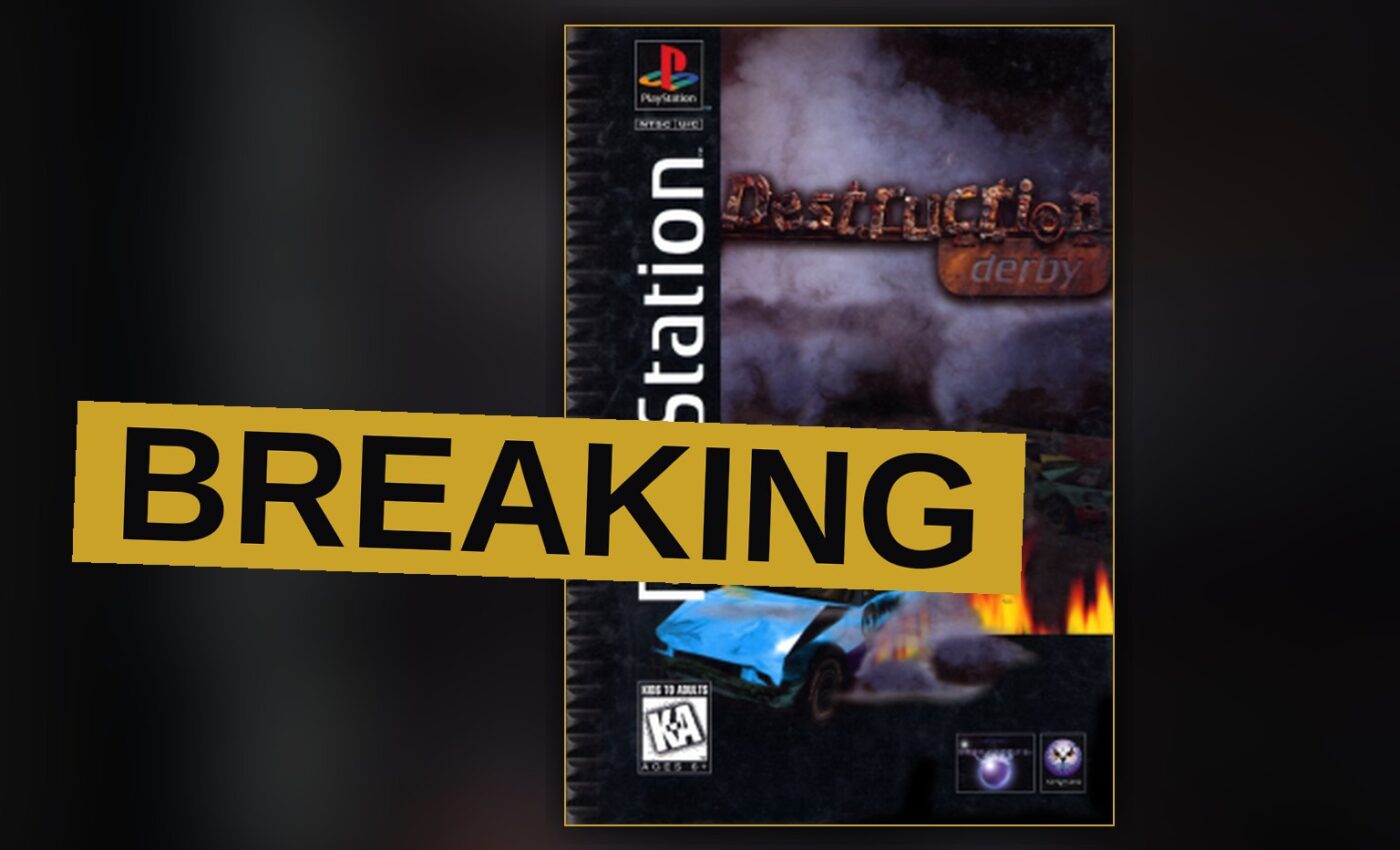
Destruction Derby arrived on the original PlayStation in 1995 as a driving game that refused to play nice. Built around the idea of wrecking cars into walls, ramps and each other, it took the arcade racing genre and bent it toward demolition. The game asked players to stop thinking about winning races and start thinking about making noise.
A Car Built for Breaking
The core loop is simple. Drive a heavy vehicle around a closed track, hit things, and watch metal fold. There is no boost gauge, no drift system, no power-ups scattered across the course. There is only the car itself and the wall in front of it. That simplicity is the point. Destruction Derby trades speed for force, and the result is a game that feels heavier than almost anything else on the console at the time.
The vehicles are built to take punishment. Each one carries a damage model that tracks dents, cracks and broken parts, and the game rewards players who push their car to the point of collapse rather than those who simply cross the finish line first. A damaged car handles worse, but it also hits harder when it finally explodes, and that explosion is the whole reason anyone plays this game.
“Destruction Derby” is a game about the sound of metal folding.
The Track Itself
The tracks are tight, narrow and full of blind corners. They are not designed for fast laps. They are designed for collisions. Walls sit where you expect them to sit, but the game rarely tells you where they are until you hit them. That design choice creates a constant feeling of pressure, because the track is always trying to end your run.
There are no open spaces to escape into. The track is a trap, and the only way out is through the finish line. This forces a style of play that rewards patience over haste. Players learn to hold back, wait for a moment, and then strike when the window opens.
Sound and Look
The presentation is rough by modern standards, but it was ahead of its time in 1995. The vehicles are detailed enough to show the damage they take, and the lighting on the tracks gives the game a sense of weight that few other titles managed at the time. The sound design is where the game truly stands out. The crunch of metal, the roar of engines and the crackle of explosions all feed into a relentless audio assault that makes every collision feel larger than it looks.
The music is minimal, a simple techno beat that repeats across the menu and the track. It does not get in the way, but it does not add much either. The real star is the engine noise, which rises and falls with the pace of the action. It is a game that speaks more through sound than through pictures.
How the Game Works
Destruction Derby offers a career mode where players build a reputation, win money and buy new cars. There is also a free-for-all mode where multiple players can destroy each other on the same track. The career mode is the heart of the game, but the multiplayer mode is where the chaos really takes hold.
The career mode is structured around a series of races. Win one, advance to the next. Lose too often and the game ends. The stakes are small, but the tension is real. Every race matters, because a loss means starting over. That structure gives the game a sense of progress even though the actual content is limited.
The free-for-all mode is the mode that defines the game’s identity. Players enter a track together, and the goal is not to win but to survive. The last car standing wins, but surviving long enough to see that victory is half the battle. It is a mode that rewards aggression and punishes hesitation, and it remains one of the best multiplayer modes ever made for the console.
Where It Falls Short
The game is not perfect. The camera is often difficult to read, especially in the narrow passages of the track. It is easy to lose sight of where you are going, and that can lead to frustration when a crash feels unfair. The game also lacks a save feature, meaning progress is lost if the console is turned off during a session. These are minor complaints, but they are the kind of complaints that stick with players long after the game is finished.
The difficulty curve is steep. New players will find themselves crashing into walls they could not see, and the game does not explain itself well. It expects players to learn through failure, and that approach will not suit everyone. It is a demanding game, and it does not apologize for being demanding.
What Remains
What stays with players is the feeling of impact. The game is built around the moment when a car hits something, and that moment is rendered with care. The metal folds, the glass shatters, and the game slows down to let you watch the damage unfold. It is a small detail, but it is the reason Destruction Derby remains remembered today.
The game also introduced a scoring system that rewards destruction. Points are awarded for hitting other cars, for taking damage, and for staying alive. This system rewards players who drive aggressively, which fits the game’s overall tone. It is a reward structure that rewards risk, and it works.
Final Word
Destruction Derby is a game about breaking things, and it does that better than almost anything else on the original PlayStation. Its career mode offers a solid campaign, its multiplayer mode offers a chaotic experience, and its presentation, while dated, still carries a weight that few games of its era matched. It is not a deep game, and it is not a forgiving one, but it is a confident one.
Key Facts
– Platform: Original PlayStation
– Developer: Codemasters
– Year: 1995
– Genre: Racing / Destruction
– Career Mode: Yes
– Multiplayer Mode: Yes
Destruction Derby earns its place in gaming history through its focus. It knows exactly what it wants to be and does not waste time pretending otherwise. The camera trouble and the lack of a save feature are real issues, but they are minor compared to what the game gets right. It is a game about destruction, and it delivers on that promise every time a car hits a wall.