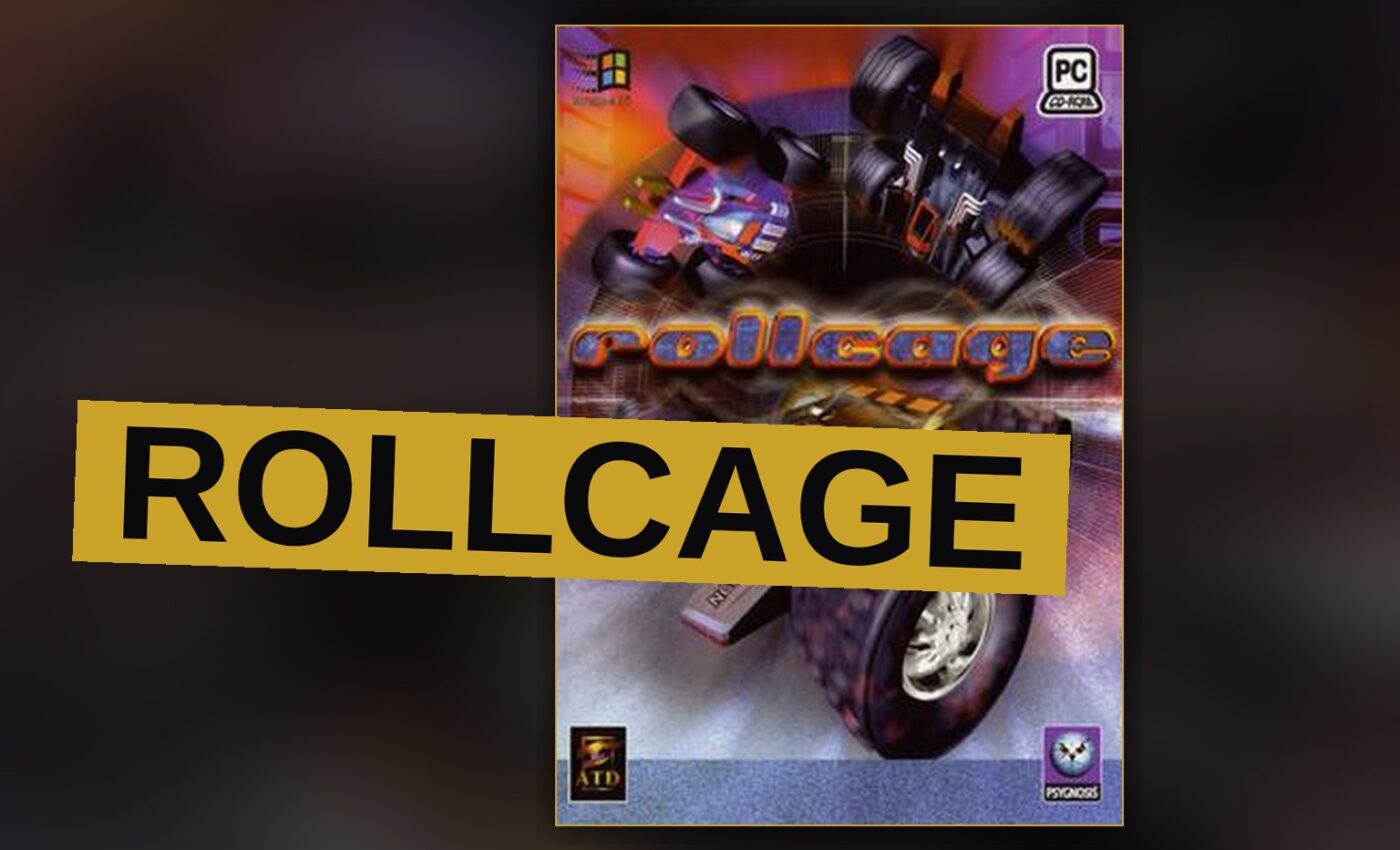
Rollcage arrived in 1999 with a promise that sounded like a dare: cars that drive on walls. Attention To Detail built the game around a physics engine where airflow over a car at extreme speed pins it to any surface it touches, so the ceiling is just another lane. Psygnosis published it for the PlayStation and for PC. The Windows version launched in the UK on March 24, 1999.
Fatboy Slim on the soundtrack
The game’s second selling point sits in the audio. Rollcage shipped with an original soundtrack by Fatboy Slim, a booking that in 1999 gave a racing game a name-brand score. That combination — a physics gimmick and a big-name soundtrack — is the whole pitch. Everything else in the game is in service of those two things, or it is filler.
Driving on the ceiling
Here is the mechanic, stated plainly. Cars in Rollcage can drive on walls or ceilings because of the airflow passing over them at extreme speeds. That is the entire design thesis, and it is a good one. A racing game needs a reason to exist beyond a new set of tracks, and this is a real reason.
The consequence is that a track is not a ribbon of road. It is a tube, and the tube has an inside surface. Corners can be vertical. A straightaway can be a loop. The camera, in third person, has to keep up with a car that might be upside down relative to the player’s last memory of it.
The camera problem
Third person is the right call and also the risky one. A chase camera has to communicate orientation, and orientation is the thing Rollcage constantly takes away. When the car flips onto a wall, the player needs to know which way is down without being told, because there is no time to be told.
The game leans on speed to cover the gap. At the velocities Rollcage demands, the airflow that holds the car to the surface is also the thing that keeps the player from thinking too hard about the surface. You are not driving on a ceiling. You are driving fast, and the ceiling happens to be where the road is.
That is a clever bit of misdirection, and it is the difference between a gimmick and a mechanic.
Split screen and the second player
The game supports single player and multiplayer, including split screen. Split screen is the correct choice for a 1999 console racer, and it is the mode where Rollcage’s design pays off most obviously. Two players on one screen, both fighting the same physics, both occasionally upside down, is a better advertisement for the engine than any single-player mode can be.
Multiplayer also exposes the weakness. When one player has learned the ceiling and the other has not, the race is over before it starts. Rollcage rewards the player who internalizes its rules.
A sequel followed
Attention To Detail did not stop here. Rollcage was followed by a sequel titled Rollcage Stage II. That is the clearest evidence that the first game did its job. A publisher does not commission a follow-up to a racing game with a strange physics engine unless the strange physics engine found an audience.
The sequel’s existence also tells you something about the first game’s limits. Rollcage Stage II exists because there was more to do with the idea, which means the original left something on the table.
Release schedule
| Version | Publisher | Platform | Release |
|---|---|---|---|
| Rollcage | Psygnosis, Brasoft Produtos de Informática | PC (Microsoft Windows) | UK release March 24, 1999 |
| Rollcage | Psygnosis, Brasoft Produtos de Informática | PlayStation | 1999 |
| Rollcage Stage II | — | — | Sequel |
The Windows version launched in the UK on March 24, 1999. The PlayStation release came the same year. Brasoft Produtos de Informática handled publishing in its territory alongside Psygnosis.
What the 7.7 means
The published critical score for Rollcage is 7.7 out of 10. That number is about right, and it is right for a specific reason. Rollcage is a game with one excellent idea executed with real commitment, wrapped in a package that does not quite have the depth to match the idea’s promise.
The physics engine is the reason to play. It is genuinely novel, and it is not a marketing line — the cars really do drive on walls and ceilings, and the airflow explanation is the game’s own. Fatboy Slim’s soundtrack is a genuine asset, and it is the kind of booking that dates the game in a good way. You can hear 1999 in it.
Where Rollcage falls short is in what surrounds the trick. A racing game lives on its tracks and its cars, and the material here does not give Rollcage a roster or a circuit list worth naming. That absence is telling. The game is remembered for its engine and its soundtrack, not for a particular track or a particular car. When a game’s reputation rests on a mechanic, the content around that mechanic was probably thin.
The third-person camera is the right perspective and the hardest one to pull off under these conditions, and Rollcage’s speed is what saves it. But speed is also a crutch. The game is at its best when it is too fast to question, and that is a fragile kind of best.
Split screen is where Rollcage earns its keep. A single-player racing game with a physics gimmick can feel like a tech demo. Two players on a couch, both learning the ceiling, turns it into a competition. That is the version of Rollcage worth remembering, and it is the version that justifies the sequel.
The 7.7 is not a knock. It is an accurate description of a game that did one thing nobody else was doing, did it well, and did not build enough around it. Rollcage is worth playing for the walls. It is worth keeping for the soundtrack. It is not worth playing for the tracks, because the tracks are not the point — and a racing game where the tracks are not the point is a racing game with a ceiling on how good it can be.
That ceiling, appropriately, is drivable.
Get the Notebook.
The day's best stories and every fresh verdict, in plain English, in your inbox by seven. One email a day, no more.