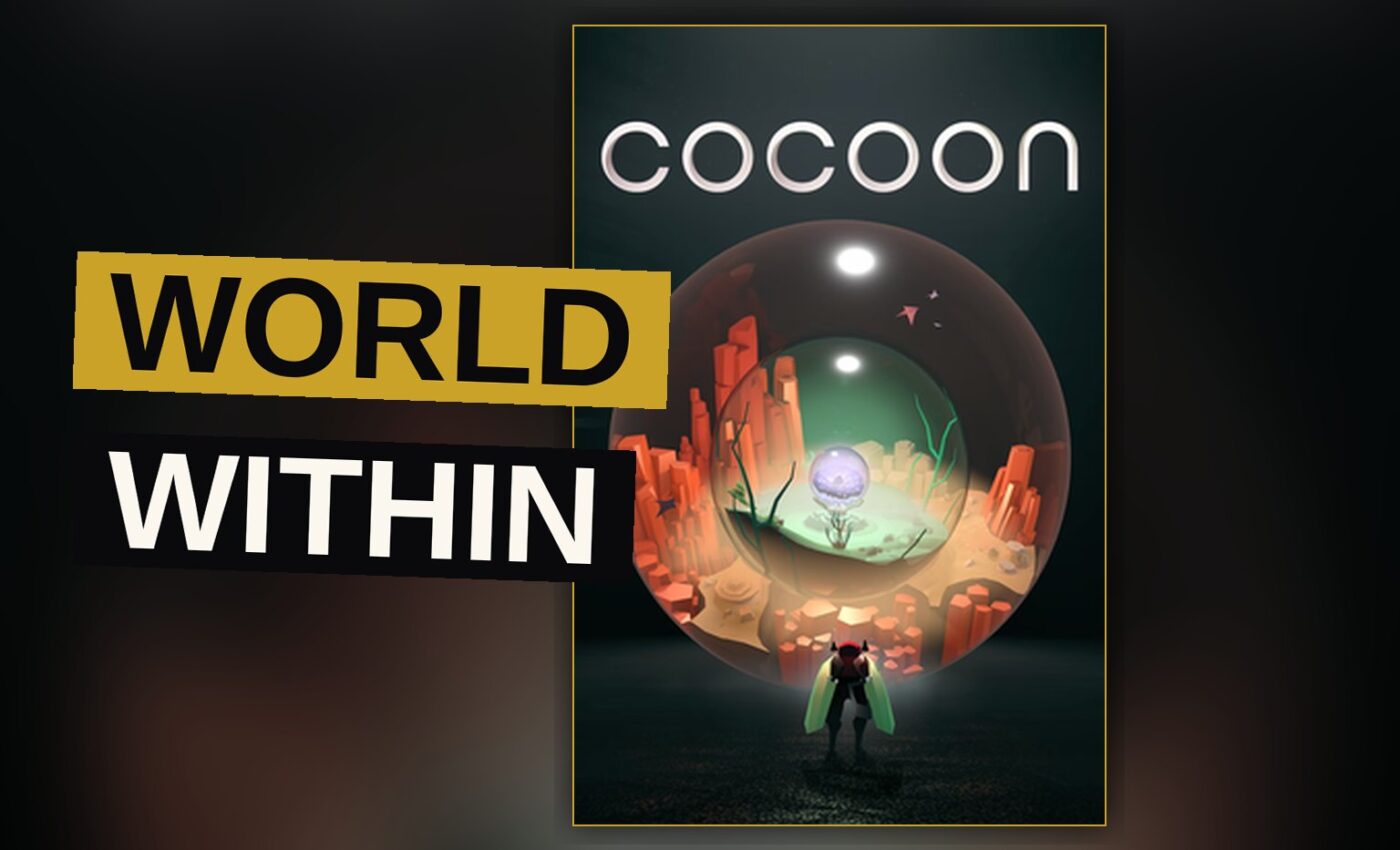
Cocoon is a puzzle game that asks you to carry the world on your back — sometimes two worlds, stacked inside each other like a set of impossible nesting dolls. It is a game of quiet genius, and it earns every bit of its reputation.
Developed by Geometric Interactive and published by Annapurna Interactive, Cocoon launched in 2023 for PC, PS4, PS5, and Xbox Series X|S. It is the debut game from Jeppe Carlsen, the lead gameplay designer behind Limbo and Inside, and it shows. This is a puzzle game with no text, no dialogue, and no hand-holding. It trusts you to figure things out, and it rewards that trust with some of the most satisfying “click” moments in recent memory.
Trailer, via Annapurna Interactive.
Carrying Worlds Inside Worlds
The core mechanic is simple: you control a small beetle-like creature in a surreal alien landscape. Scattered around are glowing orbs, each one containing an entire world. You can pick an orb up and carry it. You can step into it and explore that world. You can place it on a pedestal to activate switches, or you can use it as a key to unlock doors.
The trick is that worlds can be nested. You can carry an orb into another orb, then pick up that second orb and carry both. The game builds its entire logic around this stacking system. A puzzle might require you to carry a world into another world, use the inner world’s mechanics to solve a problem in the outer one, and then carry the combined structure somewhere else entirely.
It sounds abstract. In practice, it is precise, tactile, and deeply logical. Every solution feels earned because the rules are consistent and legible. The game never cheats, and it never changes the rules mid-puzzle.
Boss Fights Without Combat
Cocoon is not just a puzzle game. It has bosses, and they are remarkable. Each one is a massive creature that you must defeat not with combat, but with the same orb mechanics you have been using all along.
Each boss fight is a puzzle in itself. You have to figure out how to use your worlds to damage the creature, and the game gives you no explicit instruction. You watch, you experiment, and you learn. When the final blow lands, it feels like a revelation.
The bosses are also visually stunning. They are organic, alien, and slightly terrifying, but they move with a grace that makes them feel alive. The scale is enormous — you are a tiny beetle facing a creature the size of a mountain — and the game uses that scale to create real tension.
Sound, Sight, and Silence
The sound design in Cocoon is a masterclass. There is almost no music in the traditional sense. Instead, the game uses ambient drones, pulses, and rhythmic clicks that respond to your actions. When you move, the world hums. When you solve a puzzle, a chord resolves. It is a soundtrack that is felt more than heard.
The visual design is equally striking. The game uses a limited palette of oranges, purples, and teals, and it creates environments that feel both alien and familiar. There are deserts, caverns, and strange mechanical ruins. Each area has its own identity, but they all share a coherent visual language.
The art direction is by Erwin Kho. Carlsen’s previous work leaves a clear mark here too. Cocoon shares that same sense of melancholy and mystery, but it is brighter and more hopeful. It is a world you want to explore, not escape.
Puzzle Design That Respects You
The puzzles are the heart of Cocoon, and they are exceptional. The game is divided into four main worlds, each with its own mechanic:
- One world has teleporters that shift your position instantly.
- Another has gravity-shifting platforms that flip your perspective.
- A third has beams of light that activate dormant mechanisms.
- The final world combines all of these systems at once.
The difficulty curve is near perfect. Early puzzles teach you the basics. Mid-game puzzles combine mechanics in new ways. Late-game puzzles require you to think several steps ahead, often holding three or four variables in your head at once.
The game never holds your hand. There are no hints, no tutorials, and no glowing arrows. When you are stuck, you are genuinely stuck. But the game is also fair. Every puzzle has a solution that follows logically from the rules you have already learned. When you finally see it, you wonder how you missed it.
The pacing is also excellent. The game runs a modest length, and it never overstays its welcome. Just when a mechanic starts to feel familiar, the game introduces a new twist. Just when you think you have mastered the stacking system, it throws a puzzle at you that makes you rethink everything.
Every puzzle has a solution that follows logically from the rules you have already learned.
Hidden Areas and the Final Level
Cocoon has secrets. There are hidden areas in each world, and finding them is not required to finish the game. But they are worth finding. Some contain additional puzzles. Some contain lore fragments that hint at a larger story.
The story itself is told entirely through imagery. There is no text, no voiceover, and no cutscenes that explain anything. You piece together the narrative from the environments, the creatures, and the final sequence. It is open to interpretation, but it feels intentional. This is not a game that hides its story because it has nothing to say. It hides its story because it wants you to find it.
The final level is a triumph. It pulls together every mechanic you have learned and asks you to use them all simultaneously. It is challenging, but it is also elegiac. The game ends on a note that is both conclusive and ambiguous, and it stays with you long after the credits roll.
That is rare.
Technical Performance and Reception
Cocoon runs smoothly. The controls are simple and responsive. You move with the left stick, you interact with a button, and you carry orbs by walking into them. There is no combat, no jumping, and no failure state. You cannot die. This is a pure puzzle game, and it is better for it.
The absence of fail states means there is no frustration. If you get stuck, you can put the controller down, think, and come back. The game is patient, and it rewards patience.
The critical consensus was overwhelmingly positive. The IGDB critic aggregate, drawing on five outlets, gives Cocoon a score of 8.9/10. That score is earned. Cocoon is a game that understands its own mechanics better than almost any puzzle game in recent memory.
It is not a long game, and it is not a difficult game in the traditional sense. But it is a smart game, and it is a beautiful game, and it is a game that respects your time and your intelligence.
Cocoon is a masterwork of puzzle design. It takes a single, elegant idea and explores it to its logical conclusion, and it does so with confidence, clarity, and grace. The bosses are thrilling, the visuals are stunning, and the sound design is immersive.
It is a game for anyone who enjoys thinking. It is a game for anyone who appreciates craft. It is a game that will be studied and admired for years to come.
Cocoon is a rare thing: a puzzle game that is both accessible and profound, both simple and deep. It is a game that you will finish, and then you will want to play it again.
Get the Notebook.
The day's best stories and every fresh verdict, in plain English, in your inbox by seven. One email a day, no more.