
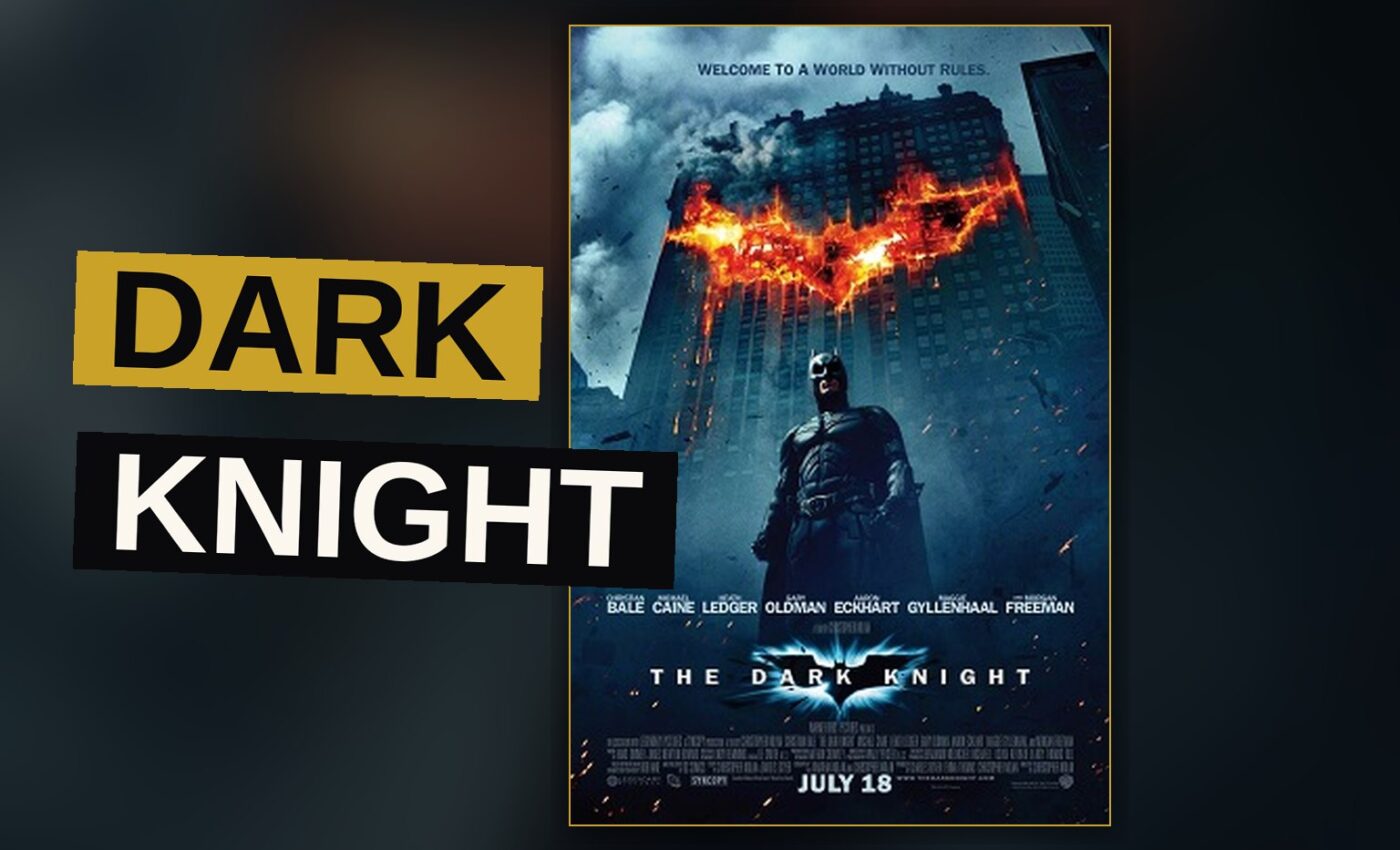
The bank job that opens The Dark Knight tells you almost everything about what Christopher Nolan was after. A gang of masked men rob a mafia-owned bank, then betray and kill one another until only the Joker is left standing. He escapes with the money. It is a heist, a massacre and a joke at once, and it announces a villain who is not chasing cash or power.
Nolan directed the 2008 film and co-wrote the screenplay with his brother Jonathan, working from story elements developed with David S. Goyer. It runs 152 minutes on a $185 million budget, and it remains the high-water mark of the trilogy it launched.
Trailer, via Warner On Demand.
The alliance that Gotham bets on
The plot is a war story dressed as a crime film. Batman, police lieutenant Jim Gordon and district attorney Harvey Dent form an alliance to dismantle organized crime in Gotham City. Bruce Wayne, Batman’s true identity, publicly backs Dent as the city’s legitimate protector, believing Dent’s success will let him retire the cape and pursue his childhood friend Rachel Dawes, even though she is with Dent.
That is the engine. Batman wants out. Dent is the way out. Gordon is the cop who makes it work.
Christian Bale plays Wayne as a man worn down rather than powered up. He has said the character changed from the young, naive, angry man of Batman Begins into a hero burdened by the realization that his war on crime is seemingly endless. You can see it in how little pleasure he takes in the suit.
The Joker’s offer, and what it costs
Gotham’s mafia bosses gather to talk about protecting themselves from the Joker, the police and Batman. The Joker walks in and offers to kill Batman for half the fortune their accountant, Lau, hid before fleeing to Hong Kong to avoid extradition. With help from Wayne Enterprises CEO Lucius Fox, Batman finds Lau and brings him back to Gotham police custody. Lau’s testimony lets Dent apprehend the crime families.
The bosses accept the Joker’s offer. He then kills high-profile targets tied to the trial, including the judge and police commissioner Gillian Loeb. Gordon saves the mayor, but the Joker threatens more attacks until Batman reveals his identity.
He targets Dent at a fundraising dinner and throws Rachel out a window. Batman rescues her. Bruce struggles to understand the Joker’s motives, and his butler Alfred Pennyworth gives him the line the film is built on: “some men just want to watch the world burn.”
That is the whole thesis, and Nolan never blinks from it. The Joker is not a man with a plan. He is a test.
A running order of the damage
| Sequence | What happens | Who pays |
|---|---|---|
| Bank robbery | Gang kills itself off; Joker escapes with the money | The mafia’s own bank |
| Mob meeting | Joker offers to kill Batman for half of Lau’s hidden fortune | The crime bosses |
| Hong Kong | Batman finds Lau and returns him to GCPD custody | The families, via Lau’s testimony |
| Trial killings | Judge and commissioner Loeb are killed | The city’s institutions |
| Fundraiser | Joker throws Rachel from a window; Batman saves her | Dent’s personal life |
| Convoy attack | Dent claims to be Batman to lure the Joker out | The police escort |
Read that table again and the shape of the film is obvious. Every move the Joker makes is aimed at the alliance, not at Batman alone. He is not trying to win a fight. He is trying to prove the fight is pointless.
Ledger’s Joker, and the scrutiny around it
Heath Ledger plays the Joker as a criminal mastermind and anarchist determined to sow chaos and corruption throughout Gotham. Nolan knew Jack Nicholson’s popular take on the character would invite comparisons, and he wanted an actor who could handle the scrutiny. Ledger’s casting in August 2006 drew criticism from some industry professionals and members of the public.
That criticism looks foolish now. Ledger’s Joker is the reason the film holds up. He is funny in a way that makes you uncomfortable, and he never once asks you to like him.
The rest of the cast does the quieter work. Aaron Eckhart plays Harvey Dent, Gotham’s noble district attorney turned violent vigilante. Gary Oldman’s James Gordon is one of the few honest officers in the Gotham City Police Department, the force known as the GCPD. Maggie Gyllenhaal’s Rachel is Gotham’s assistant district attorney, divided between Wayne and Dent. Morgan Freeman’s Lucius Fox supplies the technology for Batman’s campaign. Michael Caine’s Alfred is the father figure and the conscience.
The supporting roster is deep. Eric Roberts, Michael Jai White and Ritchie Coster appear as crime bosses Sal Maroni, Gambol and the Chechen. Chin Han plays Lau. Colin McFarlane is commissioner Gillian B. Loeb. Monique Gabriela Curnen plays rookie detective Anna Ramirez, Ron Dean is detective Wuertz, and Néstor Carbonell is mayor Anthony Garcia. Cillian Murphy returns as the Scarecrow.
Practical stunts, IMAX, and the cost of realism
Nolan avoided computer-generated imagery unless it was necessary and insisted on practical stunts. The film was made from April to November 2007, with shooting in Chicago and Hong Kong and on sets in England. It was the first major motion picture filmed with high-resolution IMAX cameras, a format that captures a far larger and sharper image than standard 35mm.
That matters more than it sounds. The IMAX photography gives the city a physical weight that a fully digital production would not have, and the practical stunts keep the action legible. You always know where Batman is and what he is doing, which is not true of most films in this genre.
The new Batsuit let Bale be more agile, so he did not build as much muscle as he had for Batman Begins. Nolan had deliberately obscured combat in the previous film because he wanted to show Batman from the criminals’ point of view. The improved suit let him show more of Bale’s Keysi-fighting training. The fights still are not the point, but they are no longer a blur.
What The Dark Knight actually gets right
The film’s real subject is escalation. Batman raises the stakes in his war on crime, and the city pays for it in ways he did not plan. The Joker exists because Batman exists, and the movie is honest enough to say so without turning it into a lecture.
Where it stumbles is in the middle. The Hong Kong sequence is a detour that stops the momentum cold, and the film’s 152 minutes are not all earned. Nolan also has a habit of explaining his themes through dialogue when the images already did the job. Alfred’s line about watching the world burn is perfect. Some of the other speeches are not.
Those are small complaints against what works. The Dark Knight takes a superhero premise and treats it as a crime drama with real consequences, and it trusts the audience to keep up. That was rare in 2008 and it is rarer now.
The film is not a puzzle box and it is not a mood piece. It is a well-built machine about a man who cannot stop, a city that will not be saved, and a villain who only wants to watch. It earns its reputation.
Get the Notebook.
The day's best stories and every fresh verdict, in plain English, in your inbox by seven. One email a day, no more.


