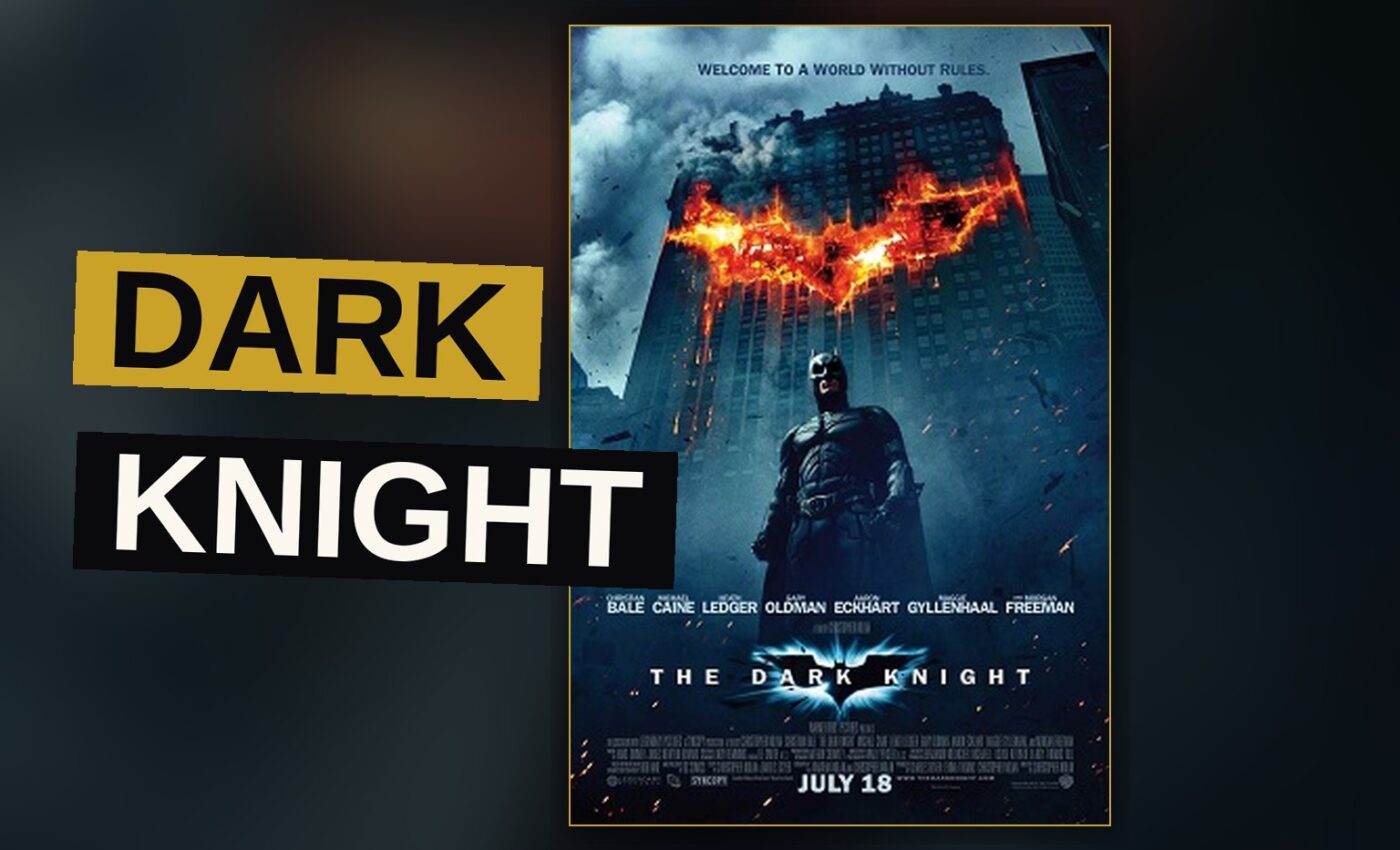
Christopher Nolan’s The Dark Knight is not a superhero movie. It is a crime epic that happens to feature a man in a bat suit. Released in 2008, the film took the comic book genre and bent it into something heavier, darker, and more serious than anything that had come before. It is a story about order, chaos, and the thin line between heroism and obsession. The film remains the benchmark for every superhero picture that followed, and it still holds up as a tense, smart, and visually stunning piece of cinema.
Trailer, via Warner On Demand.
Ledger’s Joker Upends the Genre
At the center of The Dark Knight is Bruce Wayne, played by Christian Bale. Wayne is no longer just a vigilante finding his footing. He is a man exhausted by his own mission. The film opens with Batman disrupting a bank heist staged by the Joker, but the real conflict is philosophical. Batman believes in rules. The Joker believes in nothing. That clash drives every scene.
Bale’s performance is coiled and intense. His Batman voice is gruff, almost parody-level at times, but it works in context. He is playing a man who has become a symbol rather than a person. The film makes that explicit when Harvey Dent, played by Aaron Eckhart, is introduced as Gotham’s “White Knight.” Batman sees Dent as the future — a legitimate hero who can do the work without the mask. That hope gets destroyed in the film’s most brutal stretch.
A Performance That Defines the Film
Heath Ledger’s Joker is the reason The Dark Knight is still discussed so feverishly. Ledger died before the film’s release, and his performance carries a morbid weight because of it. But even without that context, the work is staggering. His Joker is not a prankster. He is a force of nature, a terrorist who wants to prove that anyone can be broken. His face is scarred, his hair is greasy, and his voice is a lilting, unpredictable drawl.
The Joker’s schemes are elaborate and cruel. He pits two ferries against each other — one carrying civilians, one carrying prisoners — and forces each to decide whether to blow up the other before it is blown up itself. He also corrupts Harvey Dent into a monster. Ledger’s performance earned him a posthumous Academy Award for Best Supporting Actor, and it is hard to argue with that choice. He is magnetic in every scene, whether he is threatening a mob boss or telling a story about how he got his scars.
Corruption Runs Through Gotham
The plot of The Dark Knight is dense. It involves mob money, a corrupt accountant, a copycat Batman, and a plan to kill a vigilante. But the through-line is simple: Gotham is a city that cannot be saved by one man. The Joker tells Batman that he will never be rid of him, and that line is the thesis of the film. Batman’s presence creates the Joker. The Joker’s presence creates chaos. And the city suffers for it.
Harvey Dent’s arc is the tragic core. He is a district attorney with a real chance to clean up Gotham legally. He is also in love with Rachel Dawes, played by Maggie Gyllenhaal. The Joker kidnaps both Dent and Rachel, and Batman arrives too late to save her. The explosion scars Dent’s face and breaks his mind. He becomes Two-Face, flipping a coin to decide who lives and who dies. Eckhart sells that transformation with a quiet, grieving fury.
IMAX Cameras Make the Action Feel Huge
Nolan shot The Dark Knight with IMAX cameras for several sequences, and that choice pays off. The opening bank robbery is a masterclass in tension. The mid-film chase, where Batman flips a semi-truck with a cable, is still one of the best action scenes ever put on screen. The sound design is crushing. Hans Zimmer’s score, particularly the Joker’s two-note motif, is instantly recognizable.
The film is not without flaws. The third act is overstuffed, and the resolution — Batman taking the blame for Dent’s crimes to preserve Dent’s legacy — is a stretch. The movie also drags in the middle, with a subplot about a Hong Kong accountant that feels like filler. But those complaints are minor next to what works. The dialogue is sharp. The pacing is mostly tight. And the moral questions are real.
Lasting Influence on the Genre
The Dark Knight changed the industry. It proved that a comic book film could be a serious awards contender. It set a box office record on its opening weekend in the United States. It also set a tone that many studios tried to copy, with mixed results. The film’s influence is everywhere, from the grim realism of later Batman films to the self-seriousness of other franchises.
But the film’s greatest strength is that it works as a standalone piece. You do not need to have seen Batman Begins to understand what is happening. The characters are clear. The stakes are clear. The ending is bleak but earned. When Batman runs from the police, chased by dogs, the image is iconic. He is a fugitive, but he is also a savior. That contradiction is the whole point.
Hard Numbers on the Film
- Title: The Dark Knight
- Director: Christopher Nolan
- Release Year: 2008
- Runtime: 152 minutes
- Box Office: Over $1 billion worldwide
- Awards: Two Academy Awards, including Best Supporting Actor for Heath Ledger
- Audience Score: 8.5/10 on TMDB, based on 36,656 votes
Elements That Still Work
- Heath Ledger’s Joker — a performance that defines the character for a generation
- The IMAX action sequences — the truck flip and the bank heist are still thrilling
- The moral argument — the film asks hard questions about sacrifice and truth
- Hans Zimmer’s score — the Joker’s theme is a perfect piece of tension
The film is not perfect. The middle sags, and the final act leans on a coincidence that feels convenient. But The Dark Knight earns its place as a classic. It is a blockbuster with a brain, a tragedy disguised as entertainment, and a portrait of a hero who loses more than he wins.