
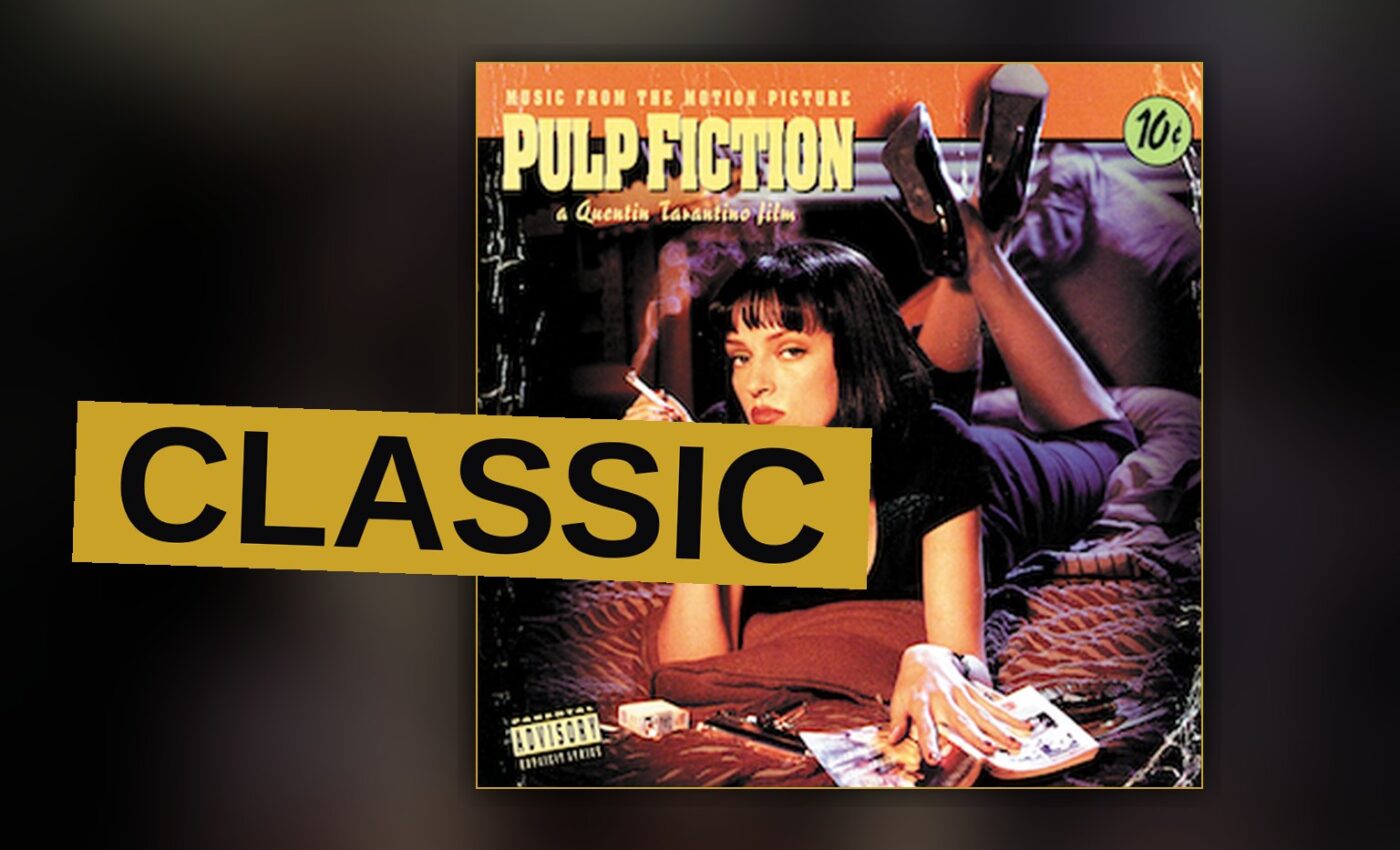
Pulp Fiction runs 154 minutes, and not one of them is a film score. Quentin Tarantino’s 1994 crime film has no traditional composer credit, no orchestra swelling under the violence. What it has instead is a jukebox — surf music, rock and roll, pop and soul — and a soundtrack album that treats dialogue as music. The film itself, written by Tarantino and Roger Avary, is a thriller, a crime story and a comedy at once, and it remains the clearest argument that structure can be a punchline.
Trailer, via Miramax.
Vincent Vega and Jules Winnfield
The plot is a tangle on paper. A burger-loving hit man, his philosophical partner, a drug-addled gangster’s moll and a washed-up boxer converge across three stories that trip back and forth in time. John Travolta plays Vincent Vega, Samuel L. Jackson plays Jules Winnfield, Uma Thurman plays Mia Wallace, Bruce Willis plays Butch Coolidge, and Ving Rhames plays Marsellus Wallace. The tagline promises: “You won’t know the facts until you’ve seen the fiction.”
That is not marketing noise. The film’s three stories refuse to sit in order, and the refusal is the point. Vincent and Jules walk into an apartment, talk about hamburgers and foot massages, and then do the job they came to do. Later — or earlier, depending on where you stand in the timeline — Butch Coolidge takes a payoff and then breaks the deal.
Tarantino casts himself as Jimmie Dimmick. Harvey Keitel appears as The Wolf, a fixer summoned to clean up a mess. Eric Stoltz plays Lance, a drug dealer with a bad attitude and a worse memory. Tim Roth and Amanda Plummer open the film as Pumpkin and Honey Bunny, two small-time robbers planning a diner heist. Christopher Walken shows up as Captain Koons to deliver a monologue about a watch. Maria de Medeiros plays Fabienne.
A Soundtrack With No Score
No traditional film score was commissioned for Pulp Fiction. The soundtrack, released September 27, 1994, by MCA Records, is as untraditional as the film. It holds nine songs from the film, four tracks of dialogue snippets followed by a song, and three tracks of dialogue alone. Seven songs that appear in the film were left off the original 41-minute album.
The album reached No. 21 on the Billboard 200. Urge Overkill’s cover of the Neil Diamond song “Girl, You’ll Be a Woman Soon” peaked at No. 59 on the Billboard Hot 100.
This is the rare case where the missing material is a feature. The dialogue tracks turn the album into a radio play with gaps, and the gaps are where the film’s voice lives. A traditional score would have told you how to feel. The surf guitar does not tell you how to feel. It just keeps playing.
You won’t know the facts until you’ve seen the fiction.
Three Stories That Refuse to Sit Still
The chronology is the film’s real special effect. Characters die and then reappear because the story loops backward. A scene that seems to close a chapter turns out to open one. Tarantino and Avary wrote a script that treats time as a tool rather than a fact, and the result is a crime caper that rewards a second viewing more than most films reward a first.
The comedy is not decoration. Jules and Vincent argue about what a foot massage means in Paris. Butch negotiates for his life and his watch. The Wolf arrives with a plan and a time limit. Each story is funny in a different register, and the registers never clash. That is harder than it looks.
The cast is doing the heavy lifting. Jackson gives Jules a calm that makes his violence worse. Travolta gives Vincent a looseness that makes his competence surprising. Thurman’s Mia is a performance built on timing — she is funny, then she is in danger, then she is something else. Willis plays Butch as a man who keeps making the wrong call for the right reason.
What Holds Up and What Doesn’t
The film’s weakest stretch is its longest. At 154 minutes, Pulp Fiction sometimes mistakes its own rhythm for momentum. The Butch Coolidge story runs long, and the film’s cool starts to feel like a pose rather than a method.
But the structure holds. The dialogue tracks on the soundtrack are not filler — they are the film admitting that its talk is its action. Vincent and Jules talking about hamburgers is not a pause before the violence. It is the violence, arriving in a different costume.
The film’s influence is now so total that it can be hard to see. Every soundtrack that leans on needle drops instead of score, every hit man who talks about fast food — the lineage runs through here, and the album is the proof of it. That is not the same as the film being flawless. It is the film being impossible to ignore.
What matters most is the refusal. No score. No order. No clean moral. Pulp Fiction does not resolve its three stories so much as let them overlap, and the overlap is the meaning. A washed-up boxer, a pair of hit men, a gangster’s wife and two diner robbers all share a world where the rules are made up and the timing is everything.
The TMDB audience score sits at 8.5 out of 10 across 30,827 votes. That is a fair number. Pulp Fiction is not a perfect film, but it is a film that changed what a crime movie could sound like and how it could be built. The burger talk, the watch, the diner heist, the surf guitar — they add up to something that still works, decades after its release.
Get the Notebook.
The day's best stories and every fresh verdict, in plain English, in your inbox by seven. One email a day, no more.


