
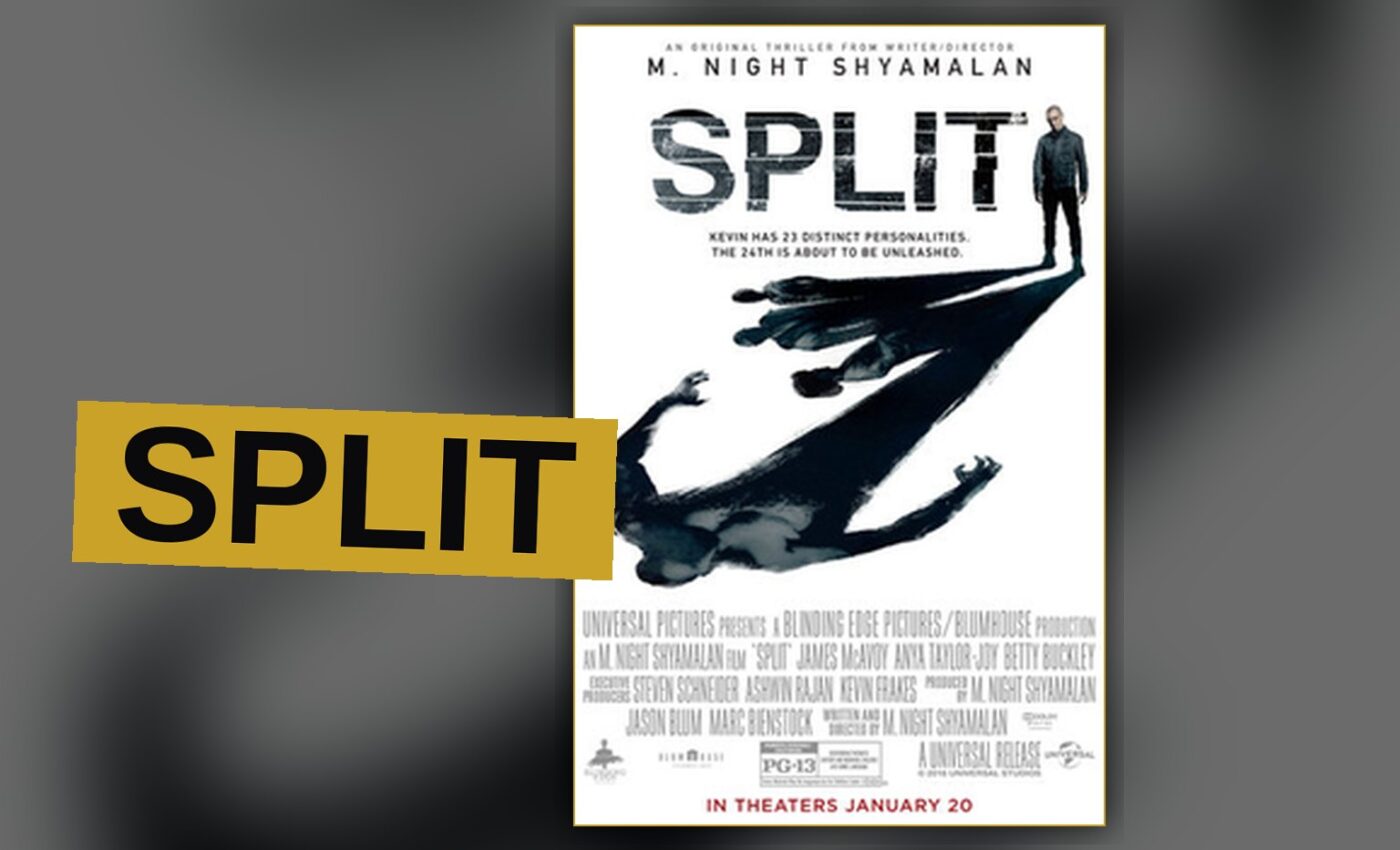
Kevin Wendell Crumb has 23 people living inside him, and a 24th is on the way. That is the whole engine of Split, M. Night Shyamalan’s 2017 psychological thriller, and it is enough to carry 117 minutes.
The film stars James McAvoy as Kevin, a man with dissociative identity disorder rooted in childhood abuse and abandonment. Anya Taylor-Joy plays Casey Cooke, one of three teenage girls he abducts and locks in an underground facility outside Philadelphia. Betty Buckley is Dr. Karen Fletcher, the therapist who has spent years treating him and who believes he is managing.
Split premiered at Fantastic Fest on September 26, 2016, and was released in the United States on January 20, 2017. It is the second installment in the Unbreakable trilogy and a stealth sequel to Unbreakable (2000). Universal Pictures distributed it, not Touchstone, which went defunct in 2016.
Trailer, via Universal Pictures.
James McAvoy Does the Heavy Lifting
McAvoy plays Dennis, Patricia, Hedwig, The Beast, Kevin Wendell Crumb, Barry, Orwell and Jade. That is eight credited parts in one body, and the film asks him to switch between them without warning, often mid-scene.
He is the reason to watch. The alters are not costumes — Dennis is coiled and watchful, Patricia is composed and certain, Hedwig is nine years old and wants to be taken seriously. McAvoy keeps them separate enough that you can track who is driving.
The tagline tells you the premise outright: “Kevin has 23 distinct personalities. The 24th is about to be unleashed.” Shyamalan, who wrote, directed and produced, does not hide the threat. He lets it build.
A Kidnapping Outside Philadelphia
The film opens with three girls — friends Claire and Marcia, and their classmate Casey — waiting in the car of Claire’s father after her birthday party. A man takes them. They wake in an underground lair.
Claire Benoit is played by Haley Lu Richardson, Marcia by Jessica Sula. Neither gets much to do beyond panic, and the script does not pretend otherwise. This is Casey’s story.
Casey is the willful, observant one. She watches the alters, tests them, tries to work out which one can be moved. Through flashbacks, the film reveals she is herself a survivor of childhood sexual abuse. Izzie Coffey plays Casey at five; Brad William Henke is Uncle John.
That backstory is the film’s smartest structural choice. It gives Casey a reason to read her captor instead of just screaming, and it sets up the ending without cheating.
Barry, Dennis, Patricia and the Beast
Kevin’s system has been running for years. Barry has been deciding which personalities get control of the body. Lately he has blocked Dennis and Patricia — Dennis because he harasses young women, Patricia because she believes in The Beast.
Patricia believes the 24th alter will rid the world of the “impure” — those who have not suffered. She protects the captives from Dennis, but only to save them for The Beast. She and Dennis manipulate Hedwig, the nine-year-old, to shut out the other alters.
Dr. Fletcher is pleased Kevin has held down a good job. She questions him about an incident involving two teenage schoolgirls. She does not know how far the system has gone.
The Escape Attempts Keep Failing
The captives try three times. Once through an air vent. Once by attacking the man with a chair. Once by finding a walkie-talkie and calling for help.
All three fail. The punishment is solitary confinement — each girl locked in a separate room. The film does not drag these out, and it does not let them work, which is the right call. Every failed attempt narrows the space.
Shyamalan shoots the facility as a set of compartments, and the title does double duty. The man is split. So is the building. So is the film’s attention, which keeps cutting back to Dr. Fletcher in her office while the girls run out of time.
What the Trilogy Built
Split sits between Unbreakable and Glass, and the connective tissue is deliberate. Shyamalan appears as Jai, a part he reprises in Glass (2019). Bruce Willis has an uncredited cameo as David Dunn from Unbreakable, and later joins the main cast of Glass.
Here is how the three films line up:
| Film | Year | Distributor | Role in the trilogy |
|---|---|---|---|
| Unbreakable | 2000 | Touchstone Pictures | First installment |
| Split | 2017 | Universal Pictures | Second installment, stealth sequel |
| Glass | 2019 | — | Combines casts and characters, concludes the trilogy |
The 2019 film Glass combined the casts and characters of both previous films and closed the series. Split is the middle chapter, and it works because it does not spend its runtime explaining the first one.
The Numbers Behind Split
Split cost $9 million and grossed $278 million worldwide. It became Blumhouse Productions’ highest-grossing film, a title it held until 2023, when Five Nights at Freddy’s overtook it.
Reviews were generally positive. Critics praised McAvoy and welcomed Shyamalan’s direction. Some mental health advocates criticized the film for stigmatizing mental illness — a charge this paper thinks the film earns, since it links DID to violence and monstrosity.
TMDB’s audience score sits at 7.3 out of 10 across 18,607 votes.
Where the Film Actually Wins
The verdict here is that Split is a good thriller with a great performance and a thin idea, and the performance is doing more work than the script.
What matters is Casey. Taylor-Joy plays her as a person running calculations, not a victim waiting to be saved. The flashbacks to her childhood are not decoration — they are the mechanism that makes the final act land, and they are why the film’s treatment of suffering as a kind of power reads as something other than a gimmick.
What is noise is the pseudoscience. Dr. Fletcher’s sessions gesture at real trauma and then hand it over to a supernatural reveal. The film wants credit for seriousness without sitting with it.
The mental health criticism is fair and, in this paper’s view, the film does not answer it. That is a real cost, and it should be weighed against the craft.
Split is not Unbreakable. It is smaller, meaner and less interested in its own ideas. But McAvoy’s eight-part turn is the reason to watch. Watch it for him.
Get the Notebook.
The day's best stories and every fresh verdict, in plain English, in your inbox by seven. One email a day, no more.


