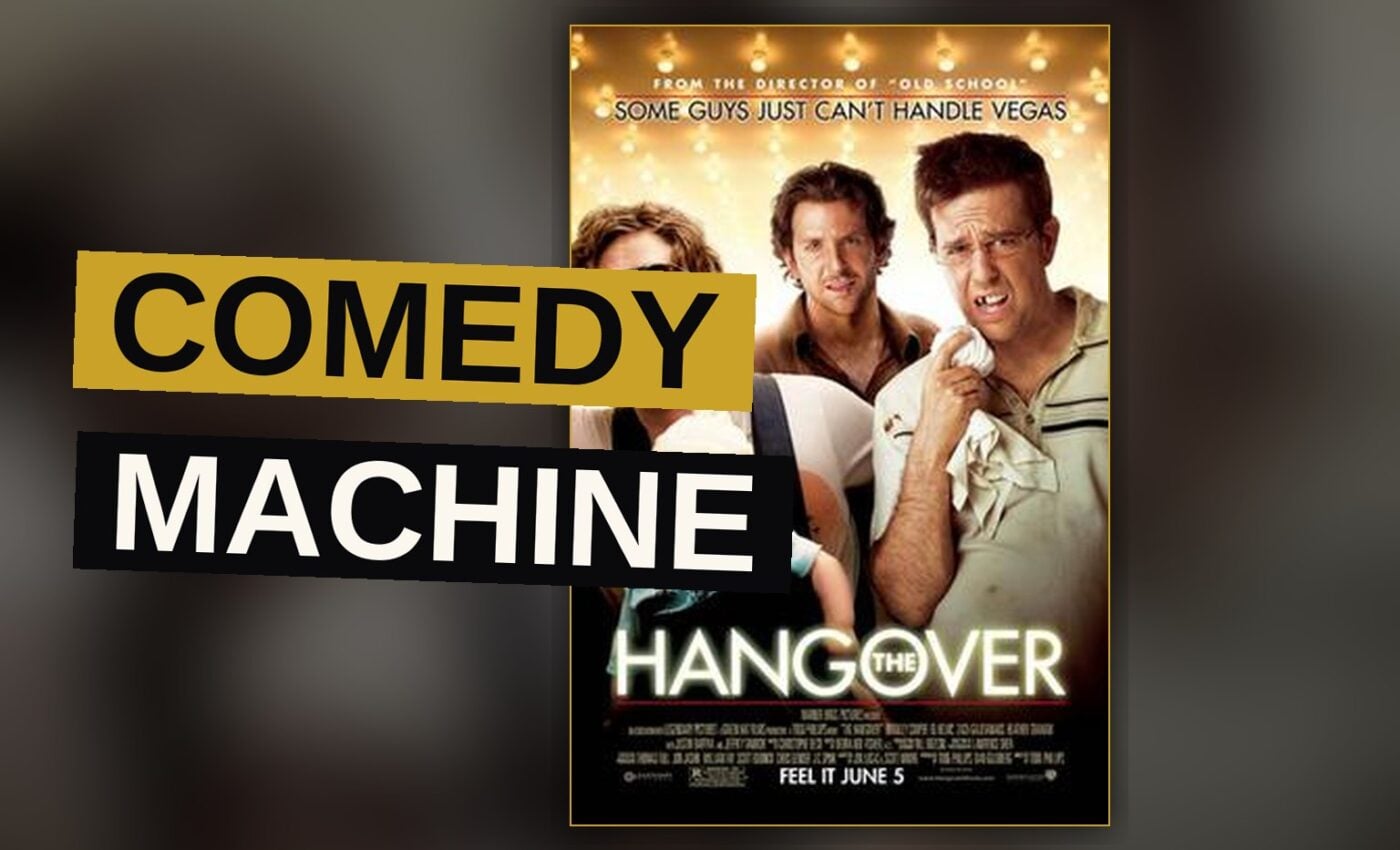
The Hangover is a movie about four men who go to Las Vegas for a bachelor party and wake up with no memory of the night before. Their hotel room is trashed. A tiger is in the bathroom. A baby is in the closet. And the groom is missing. The film, directed by Todd Phillips and released in 2009, became one of the biggest comedies of its decade. It still holds up as a precise, brutal machine of comic escalation.
The premise is simple. Doug, played by Justin Bartha, is getting married. His friends Phil, Stu, and his future brother-in-law Alan take him to Vegas for one last night of freedom. They toast on the roof of the Caesars Palace hotel. Then the film cuts to the next morning. The four men are in a wrecked suite. Phil has a hospital bracelet. Stu is missing a tooth. Alan has a tattoo on his face. Doug is gone. The rest of the movie is a frantic search to piece together what happened.
Trailer, via Warner Bros..
Clues from a Lost Night
The central engine of The Hangover is the amnesia device. The men have no memory of the night, so the audience learns the details at the same pace they do. Each clue is a new punchline. A receipt for a wedding chapel. A parking ticket. A photo on a digital camera that shows them partying with a stranger named Leslie Chow, played by Ken Jeong. The movie never cheats. It plants the evidence early and pays it off with mechanical precision.
The search for Doug takes the trio through a series of escalating disasters. They steal a police car. They find a stolen police cruiser and use it to chase down a lead. They run into a naked man in a trunk who turns out to be a gangster. They discover they have a baby, whom they name Carlos. Every scene adds a new layer of absurdity without breaking the internal logic of the night. The film trusts the audience to follow the trail of receipts and photos, and it rewards that trust with a finale that recontextualizes everything.
Bradley Cooper, Ed Helms, and the Man in the Trunk
The cast is the reason The Hangover works. Bradley Cooper plays Phil, the smooth-talking schoolteacher who is the closest thing to a leader. Cooper gives Phil a confident surface and a panicked interior. He is the one who pushes the group forward, even when he has no idea what he is doing. Ed Helms plays Stu, the dentist with a controlling girlfriend. Stu is the nervous center of the film. His missing tooth and his frantic attempts to explain his injuries to his girlfriend over the phone provide some of the movie’s best moments. Helms plays him with a wide-eyed desperation that never tips into whining.
The breakout performance belongs to Zach Galifianakis as Alan. Alan is the odd brother-in-law, a man with no social filter and no sense of consequence. He is the one who suggests the rooftop toast. He is the one who drugs the group with a roofie-laced drink. And he is the one who bonds with the tiger, the baby, and a stolen police car with equal enthusiasm. Galifianakis plays Alan as a man who is not stupid, but who operates on a completely different set of rules. His deadpan delivery and his willingness to go anywhere the script takes him make him the film’s secret weapon.
“We’re the three best friends that anybody could have.”
That line, delivered by Alan at the wedding in the film’s final scene, is the emotional anchor. It is also a lie in the best possible way. The three men are not best friends. They are a teacher, a dentist, and a man who lives with his mother. But the night in Vegas binds them in a way that only shared trauma can. The film earns that line because it shows the bond forming through chaos, not through sentiment.
Leslie Chow and the Wedding Crashers
Ken Jeong’s Leslie Chow is the film’s wild card. Chow is a Chinese gangster who joins the men on their night out, and he is the source of much of the destruction. Jeong plays him with a manic energy that is both terrifying and hilarious. He appears in a trunk, naked and screaming. He later appears at the wedding, having escaped from prison. Chow is not a fully drawn character, but he does not need to be. He is a force of nature, and the film knows better than to explain him.
The supporting cast is filled with memorable turns. Heather Graham plays Jade, a stripper who is also a single mother. She is the one who gives the men the baby, and her warmth provides a brief respite from the chaos. Mike Epps plays Black Doug, a man the group mistakes for the missing groom. His brief appearance is a reminder that the film is willing to go anywhere for a laugh. Jeffrey Tambor plays Doug’s future father-in-law, and his quiet disapproval of Alan is a running joke that pays off in the final scene.
Payoff in the Photo Montage
The Hangover is built on a classic comedic structure: setup, escalation, payoff. The setup is the amnesia. The escalation is the series of clues the men uncover. The payoff is the photo montage at the end of the film. The montage, which plays over the credits, shows the actual events of the night. It reveals that the men stole a police car, fought Mike Tyson, and lost Doug on the roof. The montage is the film’s final punchline, and it is a masterclass in comedic timing.
The film also knows when to slow down. The scene where the men find the baby is played for laughs, but it also has a strange tenderness. The scene where Stu sings a song about his missing tooth is a moment of pure character comedy. The film never lets the pace become frantic. It gives the audience room to breathe between the big set pieces, which makes the big set pieces land harder.
Why the Comedy Still Lands
The Hangover was a cultural event when it was released. It grossed hundreds of millions of dollars worldwide. It spawned two sequels, neither of which matched the original. It made stars out of its three leads. And it changed the way Hollywood thought about R-rated comedies. The film proved that a comedy could be both raunchy and smart, both chaotic and precise. It is a template that many films have tried to copy, and none have done it as well.
The film’s success is not accidental. Director Todd Phillips had previously made Road Trip and Old School, both of which were solid comedies. But The Hangover is his best work. He takes a simple premise and executes it with ruthless efficiency. Every scene serves the plot. Every joke serves the character. There is no fat on the film. It runs 109 minutes, and it never drags.
A Darker Edge in Vegas
The Hangover is not a gentle comedy. It has a dark edge that sets it apart from the buddy comedies of the 1980s and 1990s. The men are not lovable losers. They are adults who make terrible decisions. Phil is a teacher who steals a police car. Stu is a dentist who lets his girlfriend control his life. Alan is a man who drugs his friends without understanding the consequences. The film does not judge them, but it does not excuse them either. It simply shows them dealing with the consequences of their actions.
The film also has a mean streak. The scene where the men discover a stolen police car with a man inside is played for laughs, but the man is a real gangster who threatens to kill them. The scene where they confront Mike Tyson is tense, even as it is funny. The film never lets the audience forget that the stakes are real. Doug is missing, and the men have to get him back to the wedding on time. That tension gives the comedy a weight that most comedies lack.
A Comedy Built to Last
The Hangover is a comedy that works because it takes its premise seriously. It never winks at the audience. It never breaks character. It commits fully to the absurdity of the situation, and that commitment is what makes it funny. The film is a well-oiled machine, built to deliver laughs with precision and efficiency. It is not a deep film, and it does not pretend to be. It is a comedy about four men who have the worst night of their lives, and it is one of the best comedies of its era.
The film earns its reputation. It is funny on first viewing, and it is still funny on repeat viewings. The jokes land because they are earned. The characters are memorable because they are specific. The structure is tight because it is disciplined. The Hangover is a comedy that knows exactly what it is doing, and it does it perfectly.