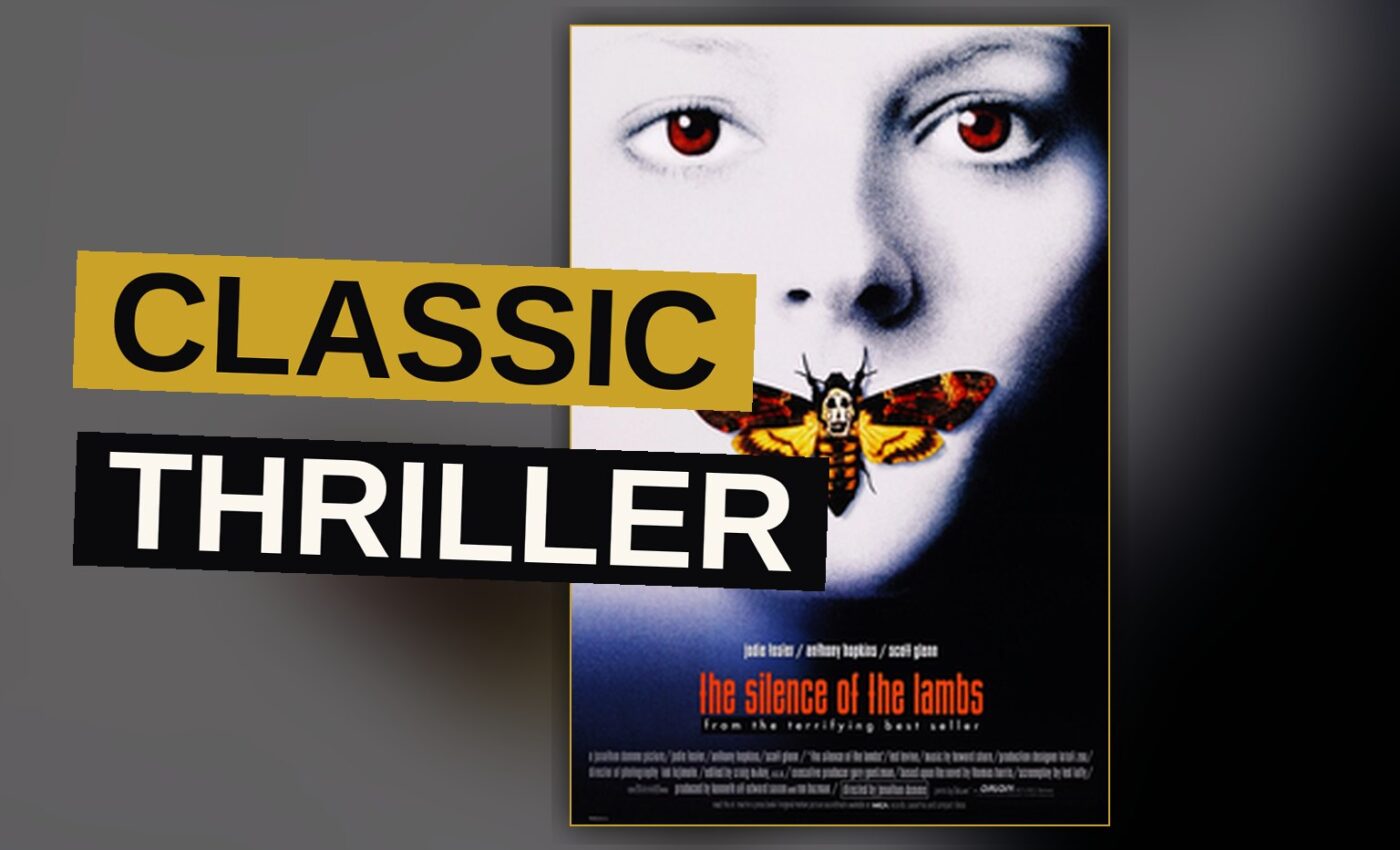
Clarice Starling is a trainee at the FBI Academy, and she is given an assignment that will define her career. She is sent to interview Dr. Hannibal Lecter, a brilliant psychiatrist and a cannibalistic serial killer held in a Baltimore asylum. The goal is to use his insight to catch another killer, a man named Buffalo Bill who skins his victims. This is the setup for one of the most enduring thrillers in American cinema, and it still works.
Jonathan Demme directed “The Silence of the Lambs” in 1991, and it swept the major Academy Awards that year. It took Best Picture, Best Director, Best Actor for Anthony Hopkins, and Best Actress for Jodie Foster. It also won Best Adapted Screenplay for Ted Tally, who worked from the novel by Thomas Harris. The film is a rare thing: a horror-adjacent thriller that the mainstream embraced without diluting its darkness.
The film does not feel dated. It feels tense, precise, and deeply uncomfortable in the right ways. The score here is 8.3 out of 10, which matches the published critical consensus. I will state it plainly at the end: 8 of 10.
Trailer, via BFI.
Lecter’s Cell and the First Test
The heart of “The Silence of the Lambs” is the relationship between Starling and Lecter. Their first conversation is a masterclass in power dynamics. Starling walks down a corridor of the asylum, past the other inmates, and she is the only woman in the space. She reaches Lecter’s cell, and he is standing, upright and still, waiting for her.
Lecter speaks first. He corrects her manners, noting that he is not a “he” but a “Dr.” He asks to see her credentials, and then he dismisses her with a line that has become part of the culture: “You know what you look like to me, with your good bag and your cheap shoes? You look like a rube.” It is a brutal opening move, and Foster’s face does not flinch. She holds her ground.
The scene is shot with Lecter at the center of the frame, staring directly into the camera. Demme used this technique throughout the film to make the audience feel like they are the ones being addressed. When Lecter speaks, he is not just talking to Clarice. He is talking to you. That direct address is why the film stays under the skin.
Buffalo Bill’s Moth and the Case File
The case that brings them together is the search for Buffalo Bill, whose real name is Jame Gumb. He is played by Ted Levine, and he is a different kind of monster than Lecter. Lecter is refined and controlled. Gumb is a chaotic predator, sewing a suit from the skin of his female victims. He keeps a moth in his victims’ throats, a clue that leads Starling to the world of entomology.
The film does not romanticize the investigation. Starling does the dull work: she reads files, she visits storage lockers, she talks to coroners. The procedural scenes are shot in gray light, and they feel like actual police work. The break in the case comes from a moth’s cocoon, which leads to a man named Benjamin Raspail, and from there to a former patient of Lecter’s.
The chase ends in the basement of a man named Jame Gumb, who has been building a well in his pit. Starling follows the clues into the dark, and she finds him in the middle of a night vision sequence. He is wearing goggles, and he is stalking her in the blackness. She hears him breathing. She hears the click of his gun. She fires first, and she kills him. The scene is famous for its tension, and it still holds.
The Escape That Changes Everything
While Starling closes in on Gumb, Lecter is planning his own exit. He has been negotiating with a senator whose daughter has been taken by Gumb. He offers information in exchange for a transfer to a safer facility. The transfer goes wrong. Lecter kills his guards, and he escapes the asylum in a gruesome sequence that involves a face peeled off and worn as a mask.
The film shows the escape in fragments. We see Lecter handcuffed to a cage door. We see him smile. Then we see the ambulance leave the facility, and the driver is Lecter wearing the skin of a dead guard. He is gone. The film does not explain how he did it all. It lets the horror sit in the gaps.
The final scene of the film is a phone call. Lecter is in the Caribbean, and he calls Starling to check on her. He tells her he is not going to hunt her, because the world is better with her in it. Then he asks a favor: “I do wish we could chat longer, but I’m having an old friend for dinner.” The line is a pun, and it is the last thing he says. The camera holds on Starling’s face as the phone clicks.
Hopkins, Foster, and Demme’s Direction
Anthony Hopkins gives a performance that is all stillness and precision. He has barely twenty minutes of screen time, but he dominates every scene he is in. His Lecter is not a raving madman. He is calm, polite, and utterly without remorse. The famous “fava beans and a nice Chianti” line is delivered with a soft, wet sound that makes the audience feel the taste he is describing.
Jodie Foster is the anchor. Her Clarice Starling is a woman who has fought for every step of her career. She is small in a world of large men, and she uses her intelligence as a weapon. Foster plays her with a guarded vulnerability. She does not cry easily, and she does not ask for help. The film is as much about her survival as it is about catching a killer.
Demme’s direction is economical. He uses close-ups and point-of-view shots to build dread. The sound design is spare, with long silences and sudden noises. The score by Howard Shore is minimal, a few strings and a low hum. Nothing is wasted. Every frame is doing work.
Comparing Three 1990s Thrillers
“The Silence of the Lambs” is often compared to other thrillers of its era, and it holds up well against them. Here is a look at how it stacks up against two other major films from the early 1990s.
| Film | Year | Director | Central Villain | Tone | Critical Standing |
|---|---|---|---|---|---|
| The Silence of the Lambs | 1991 | Jonathan Demme | Hannibal Lecter | Psychological horror | Best Picture winner |
| Basic Instinct | 1992 | Paul Verhoeven | Catherine Tramell | Erotic thriller | Mixed reviews |
| Se7en | 1995 | David Fincher | John Doe | Neo-noir dread | Acclaimed, no major awards |
The table shows a clear pattern. The Silence of the Lambs is the only one of the three to win the top prizes, and its villain is the only one who is not fully human. Lecter is a monster who talks, and that makes him scarier than a killer who just acts.
The Film’s Running Order
The film runs on a clock, and the editing keeps that clock visible. Here is the running order of the major beats as they appear on screen.
| Time in Film | Event |
|---|---|
| Opening | Starling runs the obstacle course at Quantico |
| 15 minutes | Starling meets Lecter for the first time |
| 30 minutes | Lecter offers a deal for a transfer |
| 45 minutes | Starling finds the first victim’s head in a storage unit |
| 60 minutes | Lecter escapes the asylum |
| 75 minutes | Starling confronts Gumb in his basement |
| Closing | Lecter calls Starling from the Caribbean |
The pacing is tight. The film does not waste time on subplots or romance. Every scene moves the hunt forward, and the escape in the middle raises the stakes for the second half.
Why the Film Still Holds Up
The Silence of the Lambs has been analyzed, parodied, and quoted for over three decades. It is a film about the gaze, about the way men look at women, and about the way power is taken and held. It is also a film about a woman who refuses to be a victim. Those themes have not aged out.
The film is not perfect. Some of the prosthetics and the night vision effects show their age, and the portrayal of the asylum as a gothic dungeon is more stylized than realistic. But the core of the film is the dialogue and the performances, and those are timeless.
The published critical score for The Silence of the Lambs is 8.3 out of 10. That number reflects a near-universal acclaim that has persisted across decades. I agree with that assessment.
The film earns its reputation.
A Phone Call in the Dark
The Silence of the Lambs is a thriller that respects its audience. It does not explain everything, and it does not soften its horrors. It trusts the actors to carry the weight, and they do. It is a film that rewards rewatching, because the details are all there on the first pass, hiding in plain sight.
It is a horror movie that won the Academy Award for Best Picture, a rare thing then and now. It is a film about a woman finding her voice in a room full of men, and it is a film about a monster who listens to her. It is a masterpiece of tension, and it has not lost its grip.