
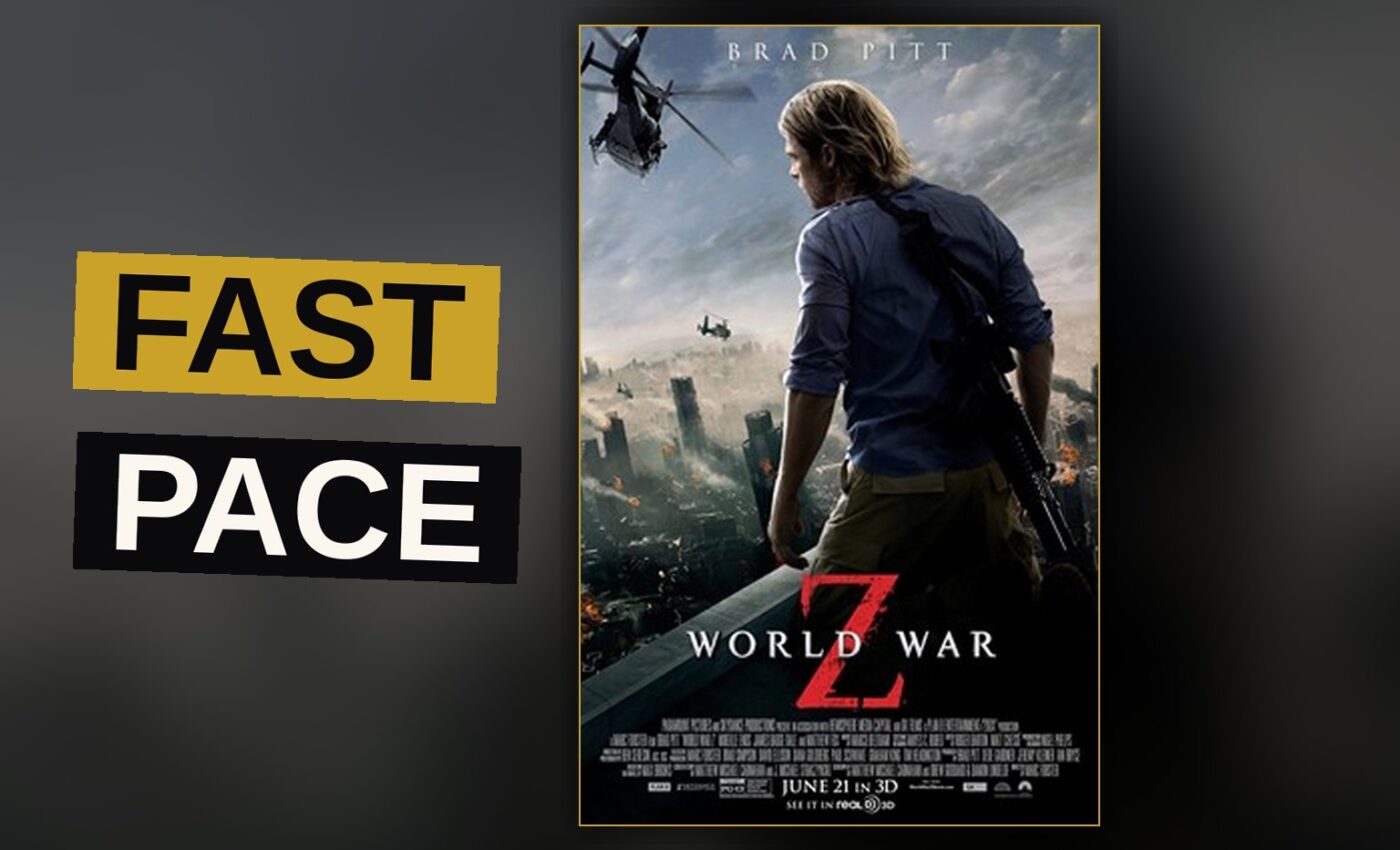
World War Z arrived in 2013 with a movie star, a best-selling novel behind it, and a production history messy enough to fill its own disaster film. Brad Pitt plays Gerry Lane, a former United Nations investigator pulled back into service when a zombie outbreak tears through Philadelphia and spreads across the globe. The film runs 116 minutes. Marc Forster directed it from a screenplay by Matthew Michael Carnahan, Drew Goddard, and Damon Lindelof, working from a story by Carnahan and J. Michael Straczynski. It holds a 63/100 on Metacritic.
Trailer, via Paramount Pictures.
Philadelphia to the Atlantic
The opening moves fast. Gerry, his wife Karin, and their daughters Rachel and Connie are caught in downtown Philadelphia traffic when the outbreak hits. They escape, reach Newark, and rescue a boy named Tommy whose family refused to leave their apartment. A helicopter sent by Thierry Umutoni, the UN deputy secretary-general, carries them to a US Navy vessel in the Atlantic.
On that ship, virologist Andrew Fassbach argues the plague is caused by a virus and that finding its origin is the only route to a vaccine. Gerry’s family faces eviction from the vessel. He agrees to help.
The mission goes wrong almost immediately. At Camp Humphreys in South Korea, zombies attack. Fassbach panics, slips on the plane ramp, and shoots himself dead. It is a blunt, almost comic death, and the film never quite recovers its footing from there.
A Wall in Jerusalem
An imprisoned ex-CIA officer points Gerry toward Israel, where the Mossad has built a secure zone. In Jerusalem he meets Jurgen Warmbrunn, a high-ranking Mossad official. Warmbrunn says intercepted communications of Indian troops fighting zombies pushed Israel to build defenses. The city has raised a massive wall and let Israeli and Palestinian refugees shelter inside.
The refugees’ loud celebrations draw zombies. The dead instinctively form massive castells, climbing over one another to scale the wall. It is the film’s biggest set piece and its clearest idea: safety built on a wall is only as good as the noise on the other side.
Where the Cast Lands
The supporting roster is deep on paper and thin on screen. Several strong actors get little to do.
| Character | Actor | Role in the film |
|---|---|---|
| Gerry Lane | Brad Pitt | Former UN investigator leading the search for a cure |
| Karin Lane | Mireille Enos | Gerry’s wife, stranded on the Navy vessel |
| Segen | Daniella Kertesz | Israeli soldier who joins Gerry’s mission |
| Captain Speke | James Badge Dale | US Army Ranger at Camp Humphreys |
| Jurgen Warmbrunn | Ludi Boeken | High-ranking Mossad official in Jerusalem |
| Ex-CIA Agent | David Morse | Prisoner at Camp Humphreys who points Gerry to Israel |
| Parajumper | Matthew Fox | Navy vessel crew member, most scenes cut |
| Thierry Umutoni | Fana Mokoena | UN deputy secretary-general who recruits Gerry |
Matthew Fox is credited as Parajumper, a crew member on the Navy vessel, but most of his scenes were cut from the final film. That is the shape of the whole production: too many pieces, not enough of them landing.
The Budget That Kept Growing
Pitt’s Plan B Entertainment secured the rights to Max Brooks’ 2006 novel in 2007. Straczynski was approached to write and Forster to direct. Carnahan was hired to rewrite in 2009. Filming began in July 2011 in Malta, moved to Glasgow in August, and reached Budapest in October.
Then the setbacks piled up. In June 2012 the release date was pushed back and Lindelof was hired to rewrite the third act. He ran out of time, so Goddard finished the rewrite. The crew returned to Budapest for seven weeks of additional shooting in September and October 2012. The budget, projected at $125 million, ballooned to a reported $190 million. Some publications have listed it as high as $269 million.
The film premiered in London on June 2, 2013, and Paramount released it in the United States on June 21.
What the Film Gets Right
World War Z is at its best when it treats the outbreak as a logistics problem. Gerry is not a fighter. He is an investigator, and the film is most alive when he is reading a room, asking the right question, moving through a crowd of the dead with a plan. The Jerusalem sequence works because it stages the collapse as a failure of systems, not a failure of courage.
The zombie mechanics are the film’s real invention. These are not slow, shuffling dead. They run, they swarm, and they form castells to reach the uninfected. That single image — bodies stacking into a tower against a wall — does more work than any line of dialogue.
Where the film stumbles is in its middle. The South Korea stop ends with Fassbach’s accidental death and little else. The film keeps moving Gerry from country to country, but the investigation never builds. Each location resets rather than compounds. By the time Gerry reaches the W.H.O. doctors in Wales, the film has spent its momentum on travel.
The third act, the one rewritten twice, is the smallest and quietest stretch. Gerry moves through a research facility with a small team, and the film finally slows down. It is the most controlled section, and also the least thrilling. That tension — between scale and suspense — is never resolved.
What Holds the Film Together
World War Z is an expensive film that behaves like a cheaper one. It has one great set piece, a strong central performance from Pitt, and a premise that should generate dread but mostly generates motion. The supporting cast is wasted. The plot is a series of stops. The rewrites show.
What saves it is that the film knows what it is. It is a disaster film about a man trying to get home to his family, with zombies as the weather. Pitt plays Gerry as tired and competent, which is the right register. The film’s tagline — “There will come a day when the world we know will end” — promises apocalypse. What it delivers is a competent, expensive chase.
The comparison that matters is between the film’s ambition and its execution. The novel spans continents and decades. The film spans 116 minutes and one man’s itinerary. That is not a failure of adaptation. It is a failure of nerve. World War Z wanted to be a global epic and settled for a road movie with a budget.
It is worth watching once, for the wall. It is not worth watching twice.
Get the Notebook.
The day's best stories and every fresh verdict, in plain English, in your inbox by seven. One email a day, no more.


