
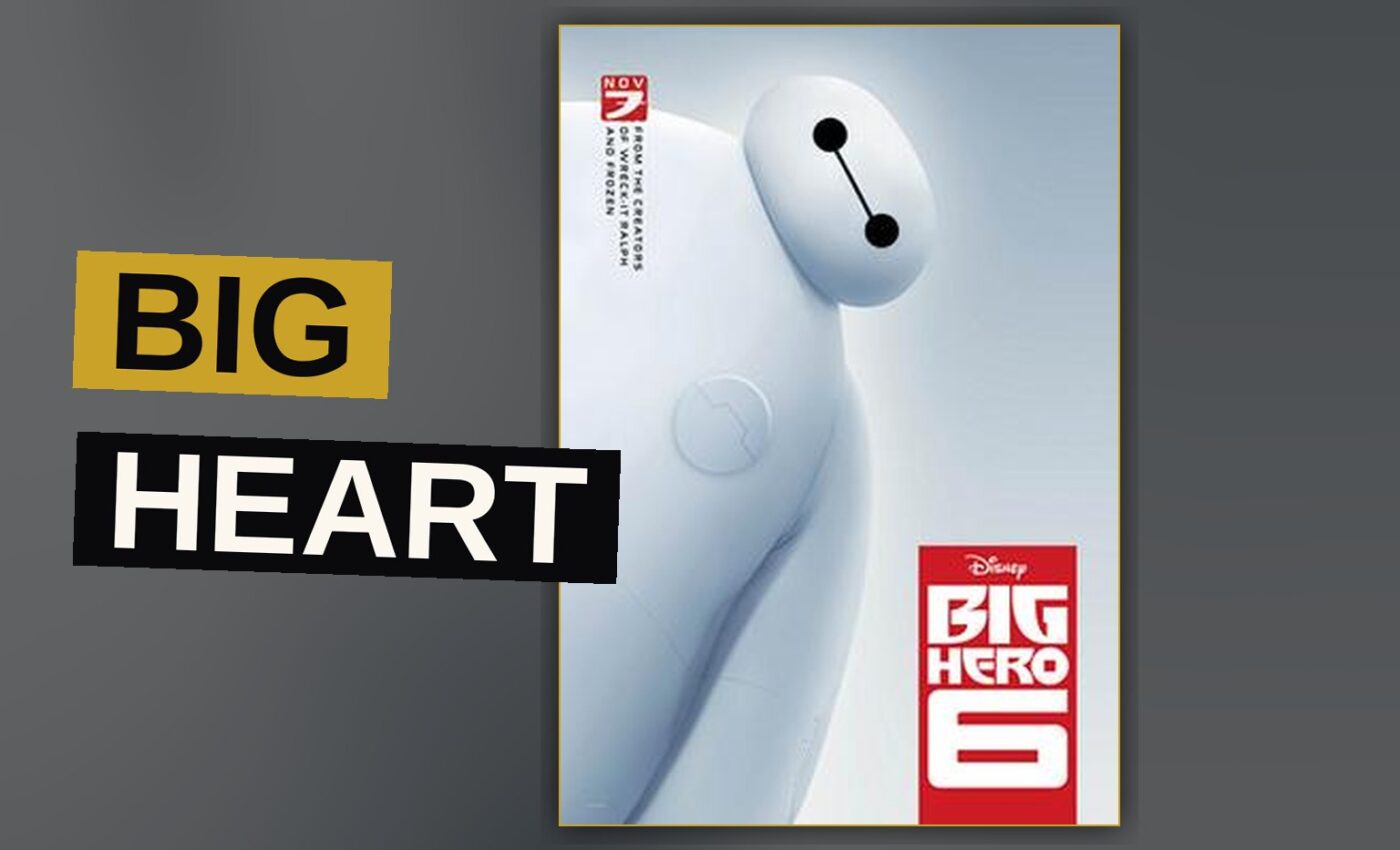
Disney bought Marvel in 2009. Five years later, Big Hero 6 became the first Disney animated feature to use Marvel Comics characters, debuting at the 27th Tokyo International Film Festival on October 23, 2014 before a U.S. release on November 7.
It grossed $658 million and finished as the highest-grossing animated film of 2014. At the 87th Academy Awards, it won Best Animated Feature. The numbers say franchise. The film says something smaller and stranger, and the smaller thing is the reason to watch it.
Trailer, via Disney UK.
Hiro Hamada Bets on Robots Before He Builds One
Hiro Hamada is 14, a high school graduate, and a robotics prodigy in the futuristic city of San Fransokyo. He spends his time in illegal underground betting on robot fights. His older brother Tadashi wants him out of that life and takes him to the San Fransokyo Institute of Technology, where Hiro meets Tadashi’s friends: Go Go Tomago, Wasabi, Honey Lemon and Fred.
Tadashi also shows him Baymax, an inflatable artificially intelligent healthcare robot. Hiro applies to the university and wins over the showcase with microbots — tiny machines that link into any configuration through a neural transmitter. He gets in.
Then a fire breaks out while Professor Robert Callaghan is still inside. Tadashi runs back in to save him. The building explodes and kills them both.
That is the hinge of Big Hero 6, and it is a hard one for a family film. Two weeks later Hiro activates Baymax by accident. His last remaining microbot starts moving on its own, so Hiro and Baymax follow it to an abandoned warehouse. There they find the microbots being mass-produced by a Kabuki mask-wearing supervillain called Yokai. He tries to kill them. They escape.
Hiro figures Yokai set the fire. He weaponizes Baymax, and Tadashi’s friends — who Baymax contacted — join up. Yokai chases them through the streets. Baymax saves them. At Fred’s residence, Hiro upgrades Baymax and the group weaponizes its own inventions. They believe Yokai is Alistair Krei, the tech mogul who wanted to buy the microbots at the showcase, and they track him to an abandoned Krei Tech laboratory.
Scott Adsit Gives Baymax the Only Voice That Works
The cast is deep and mostly used well. Scott Adsit voices Baymax, and the performance is the film’s best idea: a healthcare robot with no irony in him at all. Ryan Potter carries Hiro from betting-ring hustler to grieving brother without the script ever letting him say the plain thing. Daniel Henney is Tadashi, and the film earns the loss because it spends real time on the brothers first.
T.J. Miller, Jamie Chung, Damon Wayans Jr. and Genesis Rodriguez fill out Fred, Go Go, Wasabi and Honey Lemon. James Cromwell voices Callaghan, Alan Tudyk voices Krei, Maya Rudolph voices Aunt Cass. Abraham Benrubi and Katie Lowes round out the voice cast as the General and Abigail.
The screenplay comes from Robert L. Baird, Joseph Mateo, Jordan Roberts and Daniel Gerson. Don Hall and Chris Williams directed. It runs 102 minutes, and it moves.
Walt Disney Animation Studios built new software technology to produce the animation, and you can see where the effort went. San Fransokyo is the best thing in the movie — a city that is Tokyo and San Francisco at once, and the film treats the mashup as a place people live rather than a joke.
What the Microbots Actually Cost the Movie
Here is the problem. Big Hero 6 has one great emotional engine and one very good robot, and it keeps interrupting both to be a superhero movie.
The team forms because Baymax contacted Tadashi’s friends. That is a plot convenience, not a choice, and the film never makes the group earn its place the way it makes Hiro earn his. Go Go, Wasabi, Honey Lemon and Fred get one trait each and a weapon. Fred’s residence gives the movie its funniest stretch, and then the story needs them to be a squad.
The Yokai mystery is thinner than it looks. The film points at Krei early and loudly, and the mask does the work the writing should. A masked villain with a grudge against a tech mogul is a fine engine for a chase. It is a weak one for grief.
And grief is what this movie is about. The microbots, the neural transmitter, the Kabuki mask — all of it is scaffolding around a 14-year-old who lost his brother and got a nurse instead. When Big Hero 6 remembers that, it is very good. When it forgets, it is a well-animated team-up with a $658 million gross and an Oscar.
The Hard Numbers Behind Big Hero 6
- Release: November 7, 2014 (U.S.), after an October 23, 2014 debut at the 27th Tokyo International Film Festival
- Directors: Don Hall and Chris Williams
- Writers: Robert L. Baird, Joseph Mateo, Jordan Roberts, Daniel Gerson
- Runtime: 102 minutes
- Gross: $658 million
- Academy Awards: Best Animated Feature, 87th Academy Awards
- Tagline: “Drop everything. Save the world.”
- Score: 7.7/10
From San Fransokyo to Three Television Series
| Date | Event |
|---|---|
| October 23, 2014 | Debut, 27th Tokyo International Film Festival |
| November 7, 2014 | U.S. release |
| 2014 | Highest-grossing animated film of the year |
| 87th Academy Awards | Won Best Animated Feature |
| 2017 | Big Hero 6: The Series premiered |
| 2018 | Baymax Dreams premiered |
| 2022 | Baymax! premiered |
The sequels came as television: Big Hero 6: The Series in 2017, Baymax Dreams in 2018, Baymax! in 2022. That is the right size for this property. The film’s best asset was never the team or the mask. It was a balloon-shaped robot who cannot tell a lie and a kid who needed one.
Big Hero 6 also picked up a Golden Globe nomination and seven Annie Awards nominations, winning one. The awards record is real. So is the gap between what this movie is praised for and what it is actually good at.
Get the Notebook.
The day's best stories and every fresh verdict, in plain English, in your inbox by seven. One email a day, no more.


