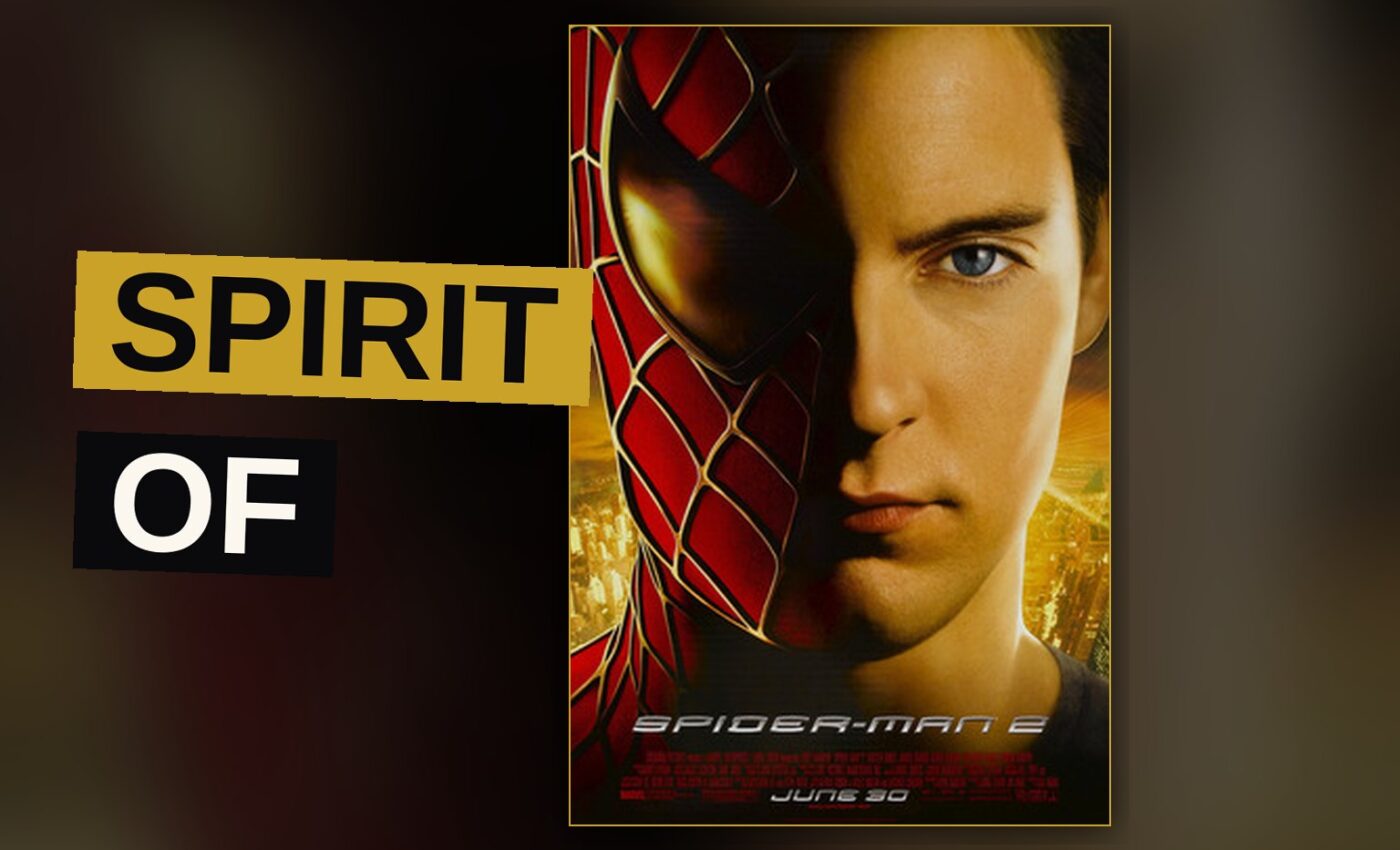
Spider-Man 2 is the rare sequel that improves on its predecessor. Sam Raimi’s second outing with Tobey Maguire as Peter Parker and Mary Jane Watson picks up after the events of the first film and finds Peter at his lowest point. The result is a darker, more human story about responsibility, failure, and the weight of being a hero.
Trailer, via Sony Pics at Home.
Peter Parker’s Descent
The film opens with Peter Parker losing his job at Queens Electronics, unable to pay his rent, and failing to keep his promise to Mary Jane. He has become the kind of man he once despised, and the weight of his responsibilities as Spider-Man is crushing him. This is not a story about a superhero with a new villain to fight. It is a story about a man who is falling apart.
Maguire delivers a performance that is both vulnerable and powerful. His Peter is exhausted, defeated, and desperate to hold his life together. The scenes where he struggles to make ends meet, to help his Aunt May, and to support Mary Jane are some of the best acting he has ever done. The film lets Peter’s personal failures drive the plot, and that choice pays off.
Doc Ock’s Origin
Alfred Molina plays Doctor Octopus, a brilliant scientist whose experiment goes wrong and fuses four mechanical arms to his spine. Unlike the villains in the first film, Doc Ock is not a cartoonish menace. He is a tragic figure whose intelligence and ambition have been twisted by circumstance. Molina gives him a quiet menace, a calm ruthlessness that makes him far more frightening than any scream or roar.
Doc Ock’s plan is simple: he wants to harness enough energy to open a portal to another dimension. To do this, he needs to steal a device from S.H.I.E.L.D., and he targets Peter’s lab at Queens University. The film spends time establishing his background, his grief over the loss of his wife, and his obsession with the project. These details make him feel like a real person, not just a plot device.
The Train Scene
The train scene is the moment everyone remembers. After a brutal fight with Doc Ock, Spider-Man is left hanging from a train while a crowd watches in horror. Peter’s mask slips off, and the crowd sees his face. The scene is tense, beautifully shot, and emotionally devastating. It is a moment that shows the cost of being a hero, and it sets up the film’s central question: can Peter be Spider-Man without destroying himself?
This scene is a masterclass in visual storytelling. The camera holds on Peter’s face, the train roars past, and the crowd reacts in shock and fear. It is a moment that could have been a cheap gimmick, but Raimi and his team treat it with genuine care. The scene earns its place in the film because it comes from a place of character, not spectacle.
Mary Jane and Peter’s Relationship
Mary Jane Watson is Peter’s anchor, and Kirsten Dunst plays her with warmth and strength. Their relationship is tested throughout the film as Peter’s absence takes a toll on their marriage. She supports him, forgives him, and loves him despite his flaws. The film also introduces Peter’s best friend Harry Osborn, played by James Franco, who returns with a grudge against Peter for the death of his father.
The relationship between Peter and Mary Jane is central to the film’s emotional core. Their scenes together are tender and honest, showing a couple who love each other deeply but are struggling to make it work. The film does not sugarcoat the difficulties of their marriage. It shows the fights, the silences, and the moments of doubt. This honesty makes their eventual resolution feel earned.
The Action Sequences
The action sequences are spectacular. The film opens with a chase through New York City, and the sequence is a dazzling display of stunts and practical effects. The final confrontation between Spider-Man and Doc Ock is a brutal, physical battle that feels real and exhausting. The film uses motion capture to animate the mechanical arms, and the effect is seamless.
The action is not just about explosions and destruction. It is about the characters. Spider-Man fights Doc Ock because he has to protect the city, but he also fights to save his own soul. The final battle is a metaphor for Peter’s struggle to regain control of his life. He cannot let Doc Ock win, and he cannot let himself win either.
The Darker Tone and The Musical Score
Spider-Man 2 is darker than its predecessor. The film deals with themes of failure, guilt, and the cost of being a hero. Peter’s descent is not just a physical one. It is a moral one. He has failed to live up to his responsibilities, and the film forces him to confront those failures head-on.
This tone is not a flaw. It is a strength. The film is not afraid to show Peter’s weaknesses, and that makes him more relatable. He is not a perfect hero. He is a flawed man who tries to do the right thing, even when it is difficult. That relatability is what makes the film work.
Hans Zimmer’s score is a driving force behind the film’s emotional intensity. The music swells during the climactic battles, and it pulls back during the quieter moments. The main theme is a soaring melody that captures the spirit of the heroism on screen. The score helps to elevate the film beyond its technical achievements.
The music is used sparingly, but it is always effective. Zimmer knows when to hold back and when to push forward. The score is not overwhelming. It supports the story without drowning it out. It is a subtle touch that adds depth to an already strong film.
The Technical Achievements
The film is a technical marvel. The visual effects are top-notch, the stunts are impressive, and the cinematography is beautiful. The film was shot in New York City, and the city itself becomes a character. The streets, the buildings, and the skyline are rendered with a sense of scale and grandeur.
The film also features a cameo from William Shatner as a diner patron. The cameo is a fun nod to the larger Marvel universe, but it is not essential to the story. It is a small touch that fans will appreciate, but it does not detract from the film’s overall quality.
Comparing the Two Films
| Aspect | Spider-Man | Spider-Man 2 |
|---|---|---|
| Tone | Light-hearted, adventurous | Darker, more serious |
| Villain | Green Goblin | Doc Ock |
| Peter’s arc | Becoming a hero | Struggling with heroism |
| Central conflict | Defeating the villain | Saving his own soul |
The table shows how the two films differ in their approach. Spider-Man 2 is a more mature film, willing to explore the consequences of being a hero. It is a better movie because it takes its subject seriously.
The Final Word
Spider-Man 2 is a masterpiece of the genre. It is a film that understands its characters, its themes, and its audience. It is a story about a man who is trying to do the right thing, even when it is hard. It is a story about love, responsibility, and the price of greatness.
The film is not perfect. Some critics have noted that the pacing drags in the middle, and that the supporting characters are underdeveloped. These are minor complaints, however. The film is still a triumph.
Spider-Man 2 is a film that rewards repeated viewings. Each time you watch it, you see something new. You see a different angle on Peter’s journey, a different interpretation of the villain, a different understanding of the stakes. It is a film that stays with you.
The film ends with Peter regaining his confidence and his power. He defeats Doc Ock and saves the city, but the victory is hollow without the people he loves. The final scene shows Peter and Mary Jane together, happy and hopeful. It is a bittersweet ending, one that acknowledges the cost of the victory.
Spider-Man 2 is a film that deserves its reputation. It is a film that stands alongside the best superhero movies ever made. It is a film that captures the spirit of its source material and elevates it to new heights.
It is a film that you should see, if you have not already. It is a film that you should revisit, if you have seen it before. It is a film that you should recommend to others, if you care about great storytelling.
Spider-Man 2 is a 8.3 out of 10.