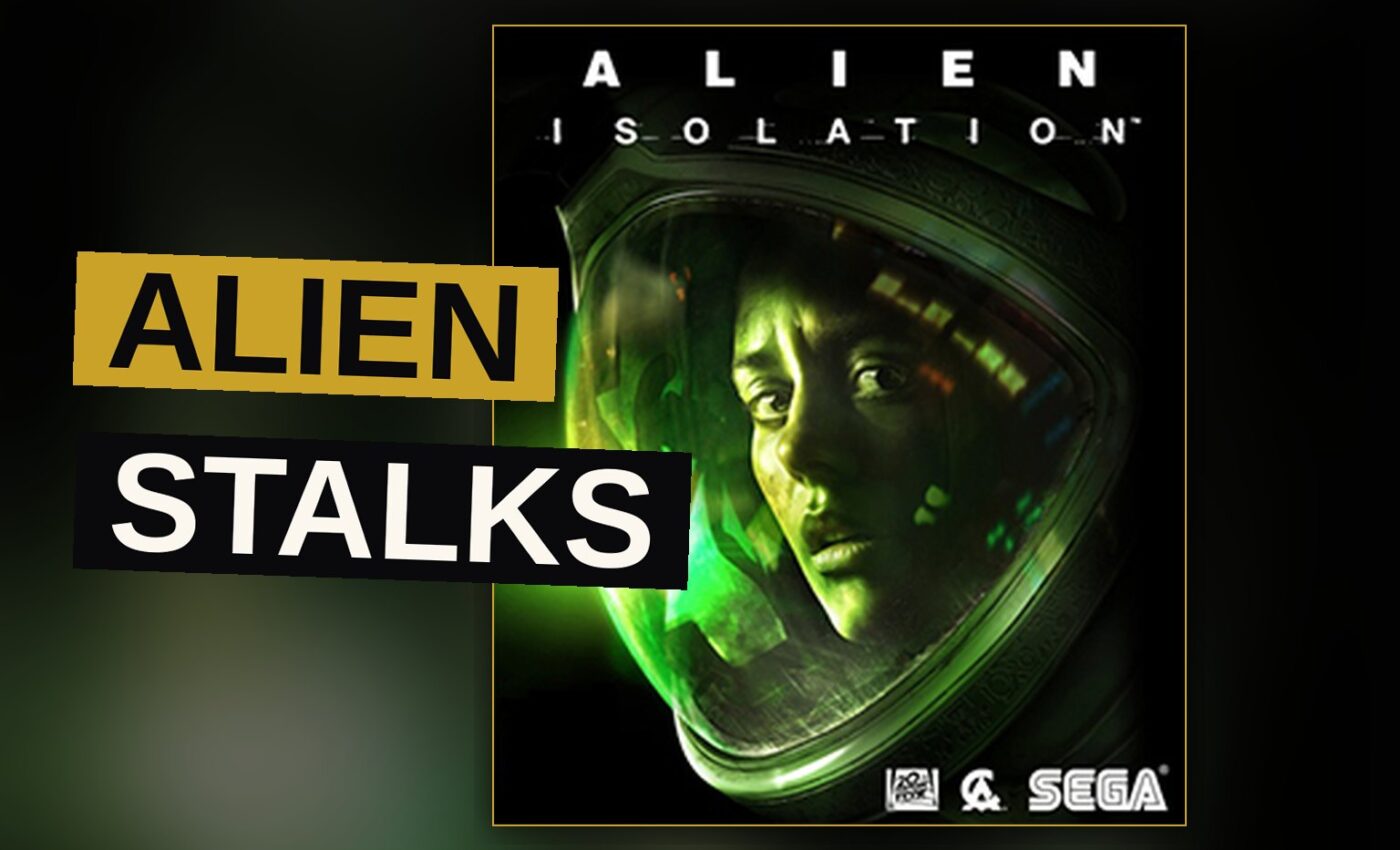
Alien: Isolation strands you on a broken space station with a creature you cannot kill. That is the whole pitch, and it is enough.
Creative Assembly built a survival horror game that pulls against the action direction the series took in 1986. Amanda Ripley, daughter of Ellen Ripley, has no weapon that ends the threat, no mech suit, no last-act rescue. She has a motion tracker that beeps too loud, a flashlight that paints her position, and a station full of people who have already lost.
The game came out in 2014 for PlayStation 3, PlayStation 4, Windows, Xbox 360, and Xbox One. Later it reached Linux, Mac, and Nintendo Switch through Feral Interactive. It sold over two million copies by May 2015. Nineteen outlets put the critic aggregate at 8.6 out of 10.
Trailer, via Alien: Isolation 2.
A Flight Recorder on Sevastopol
The setup is clean. In 2137, fifteen years after Ellen Ripley vanished with the Nostromo, Amanda learns the ship’s flight recorder has been recovered. Weyland-Yutani android Christopher Samuels brings her the news. The recorder is aboard Sevastopol, a station owned by Seegson Corporation, orbiting the gas giant KG-348 in the Zeta Reticuli system.
Samuels offers Amanda a seat on the retrieval team. She takes it, for closure. She travels with Samuels and Weyland-Yutani executive Nina Taylor aboard the Torrens, captained by Diane Verlaine.
The station is too damaged to dock. The trio go in by spacewalk. An explosion severs the line and Amanda is cut off from the others.
That separation is the game’s real opening. Everything after it is Amanda alone, working through a station that has fallen apart from years of corporate negligence and one very bad guest.
A Creature That Investigates
The alien does not patrol a scripted route. It investigates. It hunts by sight and by sound. It cannot be killed, so the player’s only tools are avoidance and misdirection.
Amanda can run, climb ladders, crawl into vents, crouch behind objects to break line of sight, and peek over or lean around cover. She can hide under tables or inside empty lockers and cabinets. She has a flashlight and a motion tracker. Both help. Both raise the odds the alien finds her. If the creature is close enough, the tracker’s own noise draws it in.
That tension is the design. Every tool that makes the alien legible also makes Amanda locatable.
The alien appears briefly across the first four missions. After mission five, “The Quarantine,” it pursues continuously.
Nineteen Missions, Androids, Survivors
The alien is not the only threat. Sevastopol holds hostile human survivors and androids, and the player can kill them or slip past them. Objectives shift across nineteen missions — activating computers, talking to NPCs, collecting items, reaching specific areas.
Creative Assembly originally intended Alien: Isolation as a third-person game. The team switched to first person to make the experience more intense. The engine was built around the alien’s behavior and around atmospheric and lighting effects, and the art direction deliberately echoes the 1979 film rather than the action-oriented 1986 sequel. The result is a lo-fi, 1970s idea of the future.
That choice does more work than nostalgia. A station built from old technology feels used and repaired and barely holding. Sevastopol is not sleek. It is a place where things have been failing for a long time.
Marlow, Waits, and a Corrupted Recorder
Amanda does find the flight recorder. Its data is corrupted. The answer she came for is not in it.
She retrieves medical supplies for an injured Taylor and meets Marshal Waits, who brings her to his bureau. There she meets Henry Marlow, imprisoned captain of the Anesidora. Marlow recovered the recorder himself. He went to LV-426. His wife was impregnated by a facehugger and died giving birth to the creature now loose on Sevastopol.
Waits talks Amanda into luring the creature into a station module so it can be ejected into space. Then Waits ejects the module with Amanda still inside. She space-jumps back to Sevastopol in a suit and returns to the bureau to confront him. She does not get there before the station’s service androids start killing the remaining humans.
The Alien cannot be defeated, requiring the player to use stealth tactics in order to survive.
Survivor Mode and the Downloadable Packs
Beyond the main story, Alien: Isolation ships a Survivor mode. The player escapes a specially designed map, completes secondary objectives along the way, and is hunted aggressively by the alien the entire time. The mode includes online leaderboards.
Several downloadable content packs followed. Some of them relive scenes from the original film.
Survivor mode is the purest version of the game’s argument. Strip the story, strip the characters, keep the creature and the map and the clock. What remains is the part Creative Assembly got right.
Where the Game Drags
Length is the complaint that holds up. Nineteen missions is a lot of station, and the middle stretch asks the player to repeat the same loop of sneak, scan, hide, and move. The alien stays frightening, but the pacing around it does not always justify the hours.
The praise lands where it should. The retro-futuristic art direction, the sound design, and the alien’s artificial intelligence are the reasons this game is remembered. The creature’s ability to genuinely search rather than follow a track is the technical achievement, and it is the reason the stealth still holds up.
Alien: Isolation is considered one of the best games ever made. That reputation rests on a single decision: making the player weak on purpose.
The Numbers
- Release year: 2014
- Developer: Creative Assembly
- Publishers: Sega; Feral Interactive
- Platforms: PlayStation 3, PlayStation 4, Windows, Xbox 360, Xbox One, Linux, Mac, Nintendo Switch
- Genre: Survival horror, adventure
- Modes: Single player; Survivor mode with online leaderboards
- Setting: Sevastopol station, 2137, fifteen years after Alien
- Protagonist: Amanda Ripley, voiced by Andrea Deck
- Copies sold: over two million by May 2015
- Critic aggregate: 8.6 out of 10, from 19 outlets
What Alien: Isolation Gets Right
The best thing Alien: Isolation does is refuse to let Amanda win in the way the franchise usually lets people win. She cannot kill the creature. She cannot outgun the station. She can only move quietly, spend resources carefully, and accept that the thing hunting her is smarter than a script.
That is why the motion tracker matters so much. It is a tool that gives information and takes safety at the same time. Few games build a single object that carries their entire thesis, and this one does.
The corrupted flight recorder is the second smart choice. Amanda’s mission is to learn what happened to her mother, and the game answers her with nothing usable. The truth arrives through Marlow instead — a man who went to LV-426 and lost his wife to the same organism. The horror is not a mystery solved. It is a pattern repeating.
Where the game stumbles is stamina. The alien’s artificial intelligence deserves its reputation, but the campaign asks the player to stay tense for longer than the tension can carry. The middle missions blur. The station stops feeling like a place and starts feeling like a corridor.
Survivor mode fixes that by cutting the runtime and keeping the pressure. It is the version of Alien: Isolation that best understands what the game is.
Years on, the design still holds. An enemy that cannot be beaten, only avoided, remains the most convincing version of the idea — a creature that listens and searches rather than follows a track.
The game’s flaws are real. Its length is a genuine cost. But the core is intact, and the core is what people still talk about.
Get the Notebook.
The day's best stories and every fresh verdict, in plain English, in your inbox by seven. One email a day, no more.