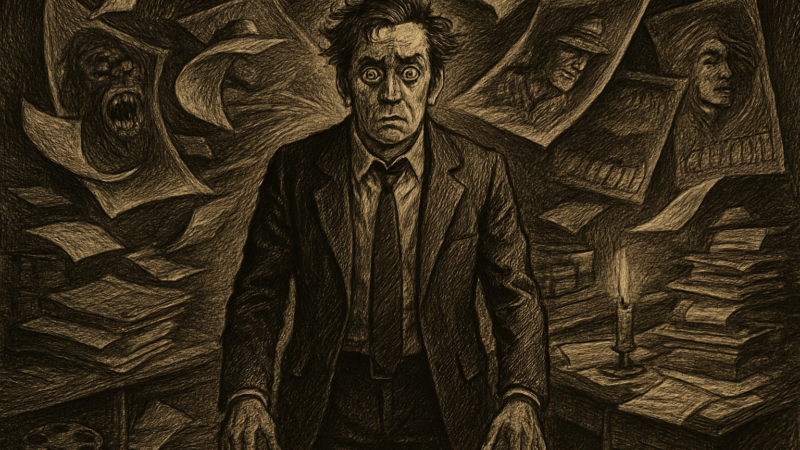
Netflix’s Evil Genius is a true crime docuseries that asks viewers to sit with a case that refuses to resolve cleanly. The story centers on Brian Wells, a pizza delivery driver who died in August 2003 after a device attached to his neck detonated. What follows is a slow-burn investigation into a conspiracy that involves a widow, a con artist, a corrupt lawyer, and a bank robbery that never quite happened. The series is a masterclass in withholding answers while keeping the audience hooked.
Trailer, via Netflix.
The Collar Bomb
The series opens with the grisly death of Brian Wells. Wells walked into a bank wearing a vest rigged with explosives. When he was told to leave the premises, he tried to flee. The device exploded, killing him instantly. The case became known as the “collar bomb” or “pizza bomber” incident, a nickname that stuck because the device was attached to his neck.
“This baffling true crime story starts with the grisly death of a pizza man who robs a bank with a bomb around his neck – and gets weirder from there.”
The series does not rush to explain the mechanics of the device. Instead, it spends its early episodes building a portrait of Wells, his family, and the community that knew him. Kevin G. Calkins plays himself as a state trooper, providing the official perspective on the investigation. Marjorie Diehl-Armstrong appears as herself in archive footage, her presence looming over the narrative even before her role in the conspiracy becomes clear.
Trey Borzillieri narrates the series as himself, offering a steady, calm voiceover that guides the audience through the labyrinthine plot. Bill Rothstein and Brian Wells appear in archive footage, their faces frozen in moments that would later define the case. Jason Wick plays himself as an ATF special agent, bringing a sense of bureaucratic gravity to the proceedings.
The Widow
The heart of the series is Marjorie Diehl-Armstrong. The series describes her as a widow who manipulated those around her. The series suggests she was the mastermind behind the entire operation.
The series does not present Diehl-Armstrong as a sympathetic figure. Instead, it shows her as a woman capable of cruelty, manipulation, and a willingness to use others for her own gain. The archival footage of her is chilling, and her interviews with investigators are rendered in a way that feels almost performative. The series suggests that she orchestrated the bank robbery to draw attention away from her own legal troubles.
The Robbery That Never Happened
The bank robbery itself is the central mystery. Wells entered the bank with the device attached to his neck, but the money was never taken. The series raises the question of whether the robbery was ever meant to happen at all. Was it a publicity stunt? A test run? A trap?
The answer, when it comes, is less satisfying than the question. The series suggests that the robbery was a cover for Diehl-Armstrong’s larger scheme, but the details remain murky. The series leaves some threads dangling, which is a deliberate choice. It wants the audience to feel the frustration of the investigators, who spent years chasing a conspiracy that seemed to have no end.
The series also touches on the broader context of the case. The collar bomb incident drew national attention, and the investigation became a media spectacle. The series captures the moment when the case felt like a modern-day thriller, with all the trappings of a Hollywood script. The reality, as the series reveals, was far more mundane and far more disturbing.
The Investigation
The series devotes significant time to the investigation. The investigation was complex, involving multiple jurisdictions and a trail of evidence that seemed to lead nowhere. The series documents the frustration of the investigators, who were unable to find a motive or a clear path forward.
One of the most compelling aspects of the series is its use of archival footage. The series draws on police interviews, courtroom footage, and news reports to reconstruct the events of 2003. The footage is grainy and sometimes difficult to watch, but it adds a layer of authenticity that a dramatized version could not replicate. The series also includes reenactments, which are used sparingly and with care.
The series also touches on the psychological toll of the investigation. The families of the victims were left to grapple with questions that had no answers. The series captures the grief and anger of the survivors, who felt that justice had been denied. The series does not offer closure, but it offers a sense of the cost of the crime.
Reception and Streaming
The series premiered on Netflix on May 11, 2018, as a four-part series. It was well received by critics, who praised its pacing and its refusal to oversimplify the case.
The series is available for streaming on Netflix, where it remains a staple of the platform’s true crime catalog. It has been discussed in conversations about true crime storytelling, with critics noting its ability to balance drama with documentary rigor.
The series is not perfect. Some viewers may find the pacing slow, and the withholding of information can feel frustrating. The series also raises more questions than it answers, which some may see as a weakness. However, the strength of the series lies in its refusal to provide easy answers. It presents the case as a puzzle with missing pieces, and it trusts the audience to accept that uncertainty.
The Legacy
The case has since become a fixture of true crime lore, with the collar bomb incident serving as a cautionary tale about the dangers of manipulation and greed. The series has also inspired adaptations, including a film version. Both versions owe something to the case itself.
The series has also been credited with raising awareness about the case. It introduced a new generation of viewers to the story of Brian Wells and Marjorie Diehl-Armstrong. It also brought attention to the broader issues of corruption and institutional failure that underpinned the conspiracy.
The Final Word
Evil Genius is a strong entry in the true crime genre. It is well made, well acted, and well paced. It respects the intelligence of its audience and does not patronize them with cheap thrills. The series is a reminder that the truth is often stranger than fiction, and that the most compelling stories are often the ones that resist easy resolution.
The series is not a perfect crime story, but it is a very good one. It deserves its place among the best of the genre, and it is a worthy addition to any true crime collection. It is recommended viewing for anyone interested in the darker corners of American history.
The series is a reminder that the truth is often stranger than fiction, and that the most compelling stories are often the ones that resist easy resolution. It is a flawed masterpiece, a documentary that rewards patience and punishes haste. It is a story that deserves to be told, and it is a story that will linger in the mind long after the credits roll.
| Episode | Release Date |
|---|---|
| 1 | May 11, 2018 |
| 2 | May 11, 2018 |
| 3 | May 11, 2018 |
| 4 | May 11, 2018 |
Get the Notebook.
The day's best stories and every fresh verdict, in plain English, in your inbox by seven. One email a day, no more.