
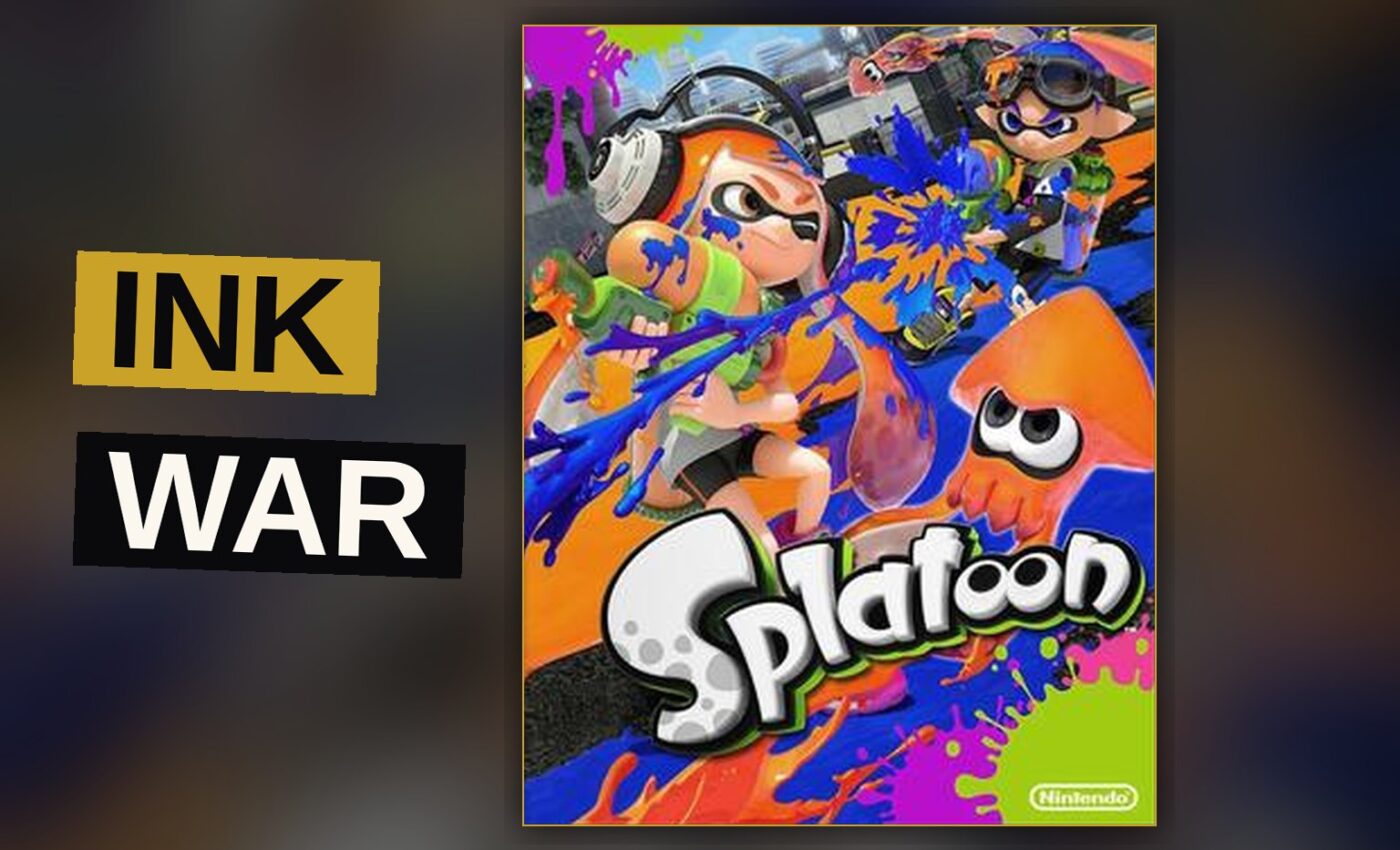
Splatoon arrived on the Wii U in 2015 as Nintendo’s first real swing at the team shooter, and it lands. The pitch is simple: four Inklings against four Inklings, each side armed with weapons that fire ink, and the winner is whoever covers the most ground. It is territory control dressed in neon, and it works because the ink does two jobs at once — it is your ammunition and your map.
Trailer, via Nintendo of America.
Inklings and the Squid Switch
You play an Inkling, a creature that flips between a humanoid form and a squid form at will. In humanoid form you shoot ink in your team’s color and “splat” opponents. In squid form you swim through your own ink, up walls and through grates, hiding from the enemy and refilling your supply as you go.
Enemy ink is the reverse. It slows you in humanoid form, blocks you in squid form, and deals damage over time. That single rule shapes every match. Pushing into hostile color is a cost, and every meter you claim is a meter you can move through.
Four-on-Four, and the Two-Player Exception
Splatoon’s main mode is online four-versus-four, up to eight players. It also ships with local one-versus-one matches and a full single-player campaign. In every mode except the two-player one, the Wii U GamePad shows a map of the surroundings, and you can tap a teammate to launch instantly toward their position. Optional gyroscopic controls handle aiming.
Loadouts run three deep: a primary ink weapon, a secondary like ink-filled balloons, sprinklers or disruptive fields, and a special attack charged by covering enough ground. Primary ink weapons range from those whose firing patterns resemble various types of firearms to melee weapons such as Splat Rollers, Inkbrushes and Sloshers, which are ink buckets. You buy weapon sets with money earned from matches.
| Element | What it does |
|---|---|
| Humanoid form | Shoot ink, splat opponents, walk slowly through enemy ink |
| Squid form | Swim through friendly ink, climb walls, refill ink, hide |
| GamePad map | View surroundings, launch to a teammate instantly |
| Special attack | Charged by covering ground with ink |
Cap’n Cuttlefish and the Great Zapfish
The single-player campaign has a real story. The Great Zapfish, the creature that powers Inkopolis, vanishes, and the Squid Sisters — Callie and Marie — cover it as a news report. An Inkling teenager follows an elderly man from a manhole in Inkopolis Plaza into Octo Valley.
That man is Cap’n Cuttlefish, former military captain of the Squidbeak Splatoon, who led the Inklings against the Octarians in the Great Turf War a century earlier. He recruits the teenager as Agent 3 of the New Squidbeak Splatoon and sends them to intercept Octarian forces and retrieve the Zapfish. Along the way Agent 3 fights the Great Octoweapons.
Cuttlefish accuses the Octarians of stealing the Zapfish in revenge for their defeat.
Sunken scrolls scattered through Octo Valley fill in the war. The Octarians dominated early battles, lost, and were forced into underground domes. Now their settlements are losing power. After the third Octoweapon falls, Cuttlefish is kidnapped mid-radio by an unseen figure. Agents 1 and 2 answer his distress call and guide Agent 3 to the arena, where DJ Octavio — Cuttlefish’s wartime arch-rival — is waiting with both captives.
Where the Design Earns Its Keep
The setting does more than decorate. Splatoon takes place 12,000 years in the future on a post-apocalyptic Earth after humans and nearly all mammals died out, implied to be from climate change. Marine animals evolved onto land and now hold Inkadia and the Splatlands. Inklings are terrestrial squids; Octarians are octopuses. Inkopolis sits in Inkadia.
That is a lot of lore for a game about painting floors, and it is the reason the sequel machine had somewhere to go. The Octarians are not faceless. They lost a war, got relocated underground, and are running out of power. The Zapfish theft reads as desperation, not villainy.
A Young Team’s Prototype
Splatoon came out of a young group inside Nintendo’s Entertainment Analysis & Development division, built from a competitive ink-based territory prototype. The first characters were anthropomorphic rabbits, chosen for their real-world territorial habits. Others at the company pushed back — rabbits shooting ink did not make inherent sense — so the team pivoted to squid-human hybrids and finally to characters that switch between wholly humanoid and wholly cephalopodic forms. The Inklings’ mannerisms came from skateboarders.
What the Ink Costs
The weaknesses are structural, not cosmetic. The campaign is short and its levels are thin next to the multiplayer, which is where the design actually lives. The two-player mode is a stripped-down version of the real thing, and the GamePad map and gyro aiming are only as good as the hardware they are bolted to.
Still, the core loop holds up a decade on. Splatoon’s best idea is that movement, ammunition and territory are one system, not three. Cover ground and you arm yourself. Hide in your own color and you reload. That economy is why the game survived its own novelty.
Nintendo entered a genre it had no business entering, with a new franchise, and shipped something nobody else had. The rabbits were the right call to abandon.
Get the Notebook.
The day's best stories and every fresh verdict, in plain English, in your inbox by seven. One email a day, no more.


