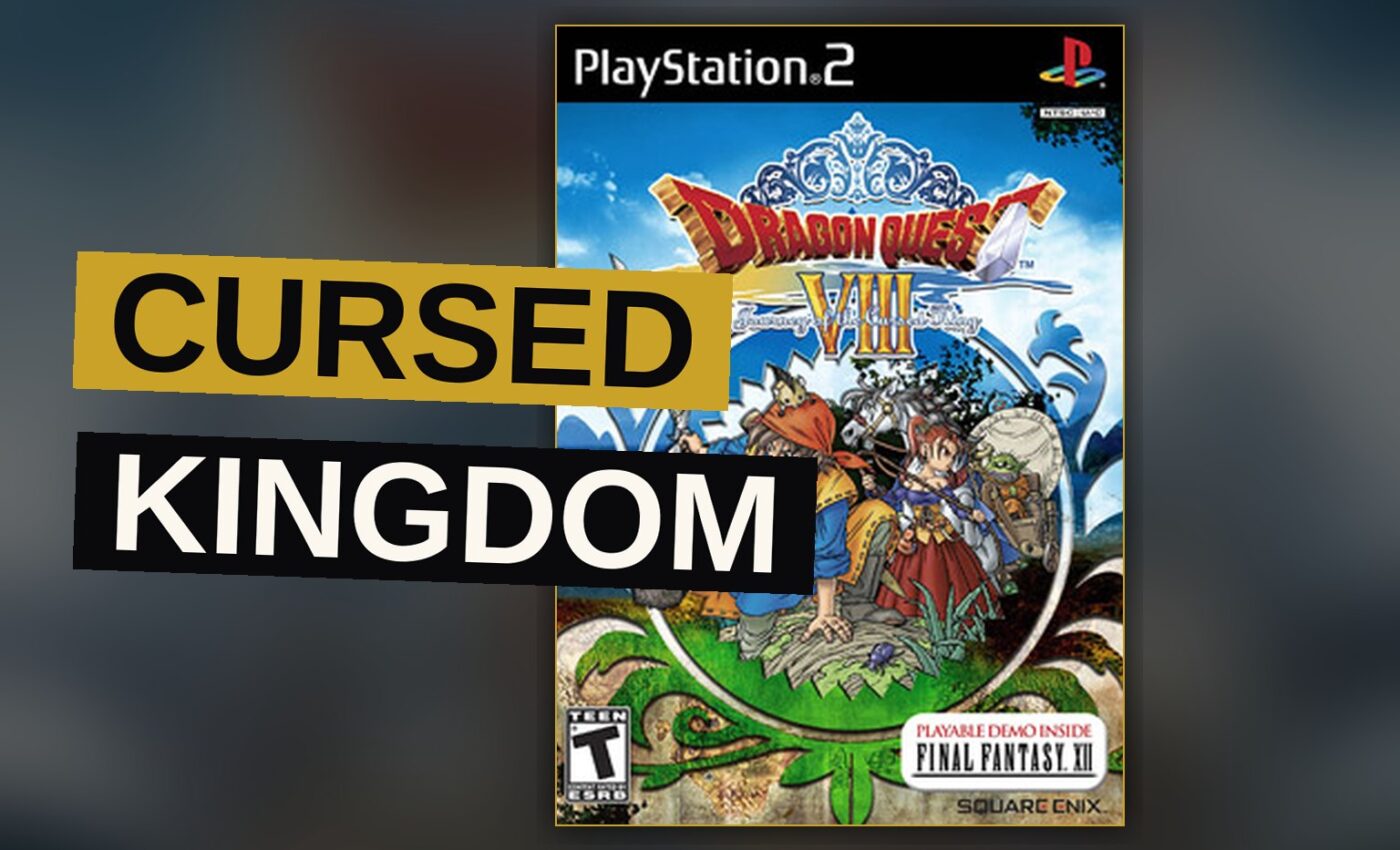
Dragon Quest VIII: Journey of the Cursed King arrived on the PlayStation 2 in 2004, built by Level-5 with Square Enix’s Product Development Division 9 and published by Square Enix. It is the eighth main entry in a series that had, until then, kept its world maps flat and its locations filed under icons. This one throws that out. The result is the most expansive traditional Japanese RPG of its era, and it earns its reputation.
Dhoulmagus and the Stolen Scepter
The story starts with a theft. Dhoulmagus, court jester of the kingdom of Trodain, took a powerful magical scepter sealed beneath the royal castle. He used it to destroy the castle and curse the kingdom and its people. King Trode became a troll. The princess became a horse.
A sole surviving castle guard sets out after the jester. He travels with the king, the princess, a reformed bandit named Yangus and a few other companions. The goal is the evil jester and a way to break the curse.
That premise is thin, and it knows it. The party is four characters, each belonging to a clearly defined class, and the game does not pretend otherwise.
A Continuous World, Not a Map of Icons
Most Japanese RPGs of the period sent players across a world map and dropped them into locations marked by icons. Dragon Quest VIII refuses. It builds a continuous world with fairly vast landscapes and integrated towns and dungeons.
Full camera rotation helps. So does an optional first-person view, which lets you look at the ground you are actually standing on.
Barrels You Can Pick Up and Break
The older Dragon Quest games let players interact with objects, and this one keeps that habit. Barrels can be physically lifted, carried and broken to reveal items hidden within.
It is a small thing. It is also the clearest statement of what the game values: a world where the props are real objects, not painted scenery.
Random Encounters and Four Classes
Combat is traditional. Enemies appear at random. The turn-based mechanics are simple. The party is four characters, each belonging to a clearly defined class.
None of that is a knock. Dragon Quest VIII is not trying to reinvent the battle system, and the systems it keeps are the ones the series had already proven.
A sole surviving castle guard journeys with the king, the princess, a reformed bandit named Yangus and a few other companions in search of the evil jester and a way to break the curse.
Where the Ambition Actually Sits
The scale is the point. A continuous world with integrated towns and dungeons costs more than a map of icons, and it changes how the journey feels. You walk the distance between places instead of watching it scroll past.
The trade is that the combat stays safe. Random encounters and simple turn-based turns were already old in 2004, and the game does not push them.
A 2015 Second Life on Nintendo 3DS
Square Enix later brought Dragon Quest VIII to the Nintendo 3DS in 2015, which kept the game reachable for players who never owned a PlayStation 2.
Its published critical score sits at 8.7 out of 10 across 12 outlets. That number is fair. The world-building is the reason to play it, and the battles are the price of admission.
8.7 of 10.
Get the Notebook.
The day's best stories and every fresh verdict, in plain English, in your inbox by seven. One email a day, no more.