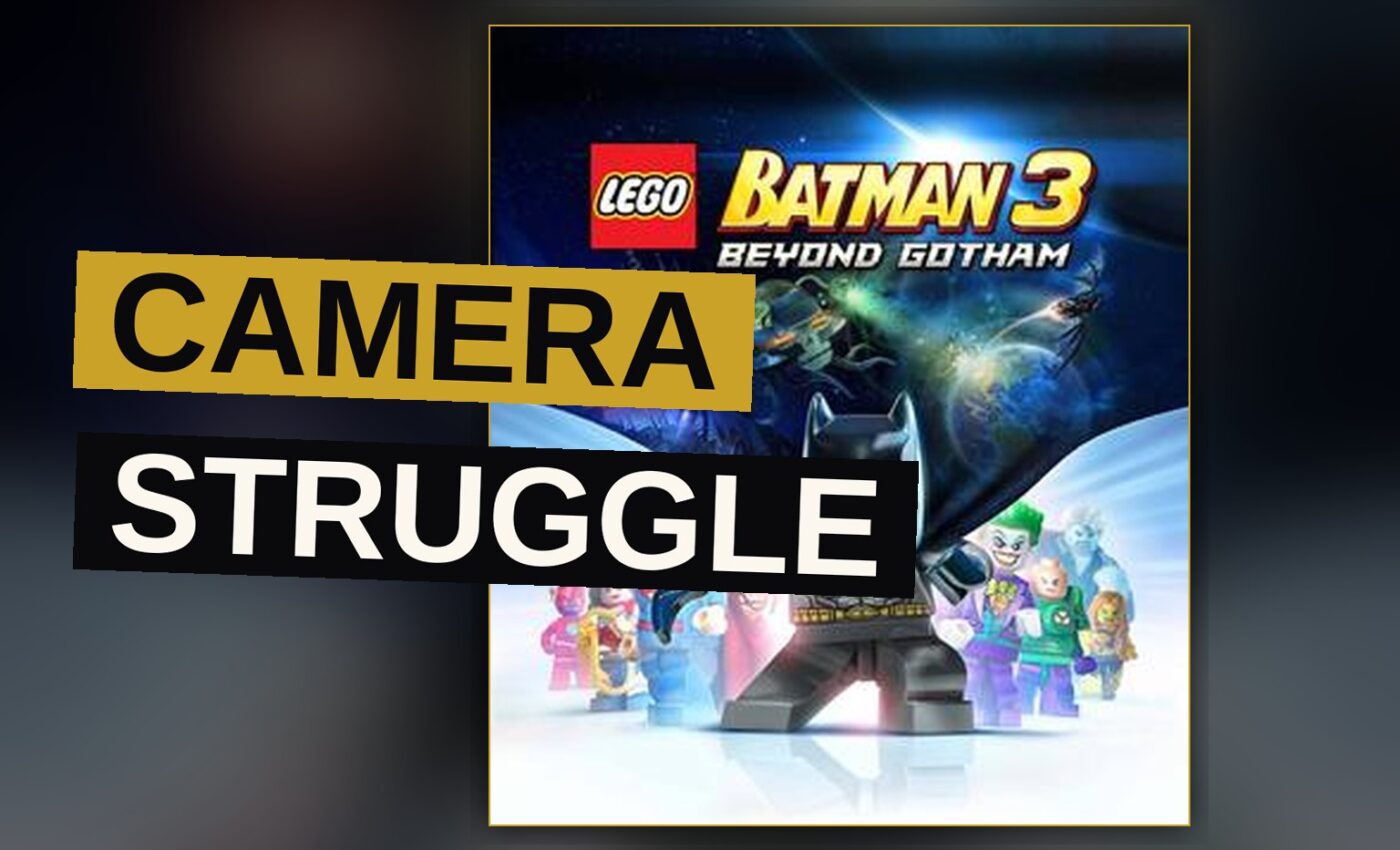
LEGO Batman 3: Beyond Gotham takes the brick-built Batman series off the streets of Gotham and throws it into deep space. Traveller’s Tales developed it, Warner Bros. Interactive Entertainment published it, and it landed worldwide in November 2014 for PlayStation 3, PlayStation 4, PC, Mac, Wii U, Xbox 360 and Xbox One. It is the third entry in the LEGO Batman line and a standalone sequel to LEGO Batman 2: DC Super Heroes.
The pitch is simple and a little mad. Brainiac attacks Earth, planning to shrink the planet and add it to his collection of miniature worlds. That forces the Justice League and the Legion of Doom into an unlikely alliance. Batman, Robin, Superman and a roster of DC heroes and villains blast off to stop him.
It works more often than it should. It also stumbles in ways that will feel familiar to anyone who has played these games before.
Trailer, via 2048Dan.
Brainiac Shrinks the Lantern Worlds
The story opens a year after LEGO Batman 2: DC Super Heroes. Brainiac captures six members of the seven Emotional Spectrum Lantern Corps, then heads to Earth to abduct the last one: Hal Jordan, the Green Lantern.
In Gotham City, Batman and Robin chase Killer Croc, who has stolen a map of the sewer system under the Hall of Justice. He escapes and reunites with the Joker, Cheetah, Firefly and Solomon Grundy. Meanwhile, Cyborg finishes the Slideways Teleporter linking the Hall of Justice to the Justice League Watchtower and sends Green Lantern through as a trial run, leaving the portal open.
While watching Brainiac’s approaching ship from the Batcave, Batman is exposed to its mind-control rays and goes berserk. Robin talks him out of the trance with a heartfelt speech. Batman credits the Batmobile’s defense system instead.
The villains use the stolen map to slip into the Hall of Justice, where they meet Lex Luthor. He posed as Hawkman to gain access. The group travels to the Watchtower through the teleporter, planning to use its fusion cannon to hold Earth at ransom until Luthor is elected “President of Earth.” They trigger the alarm. Martian Manhunter alerts the Justice League, minus Green Lantern, who was captured investigating Brainiac’s ship, and together they defeat the villains.
Then Brainiac arrives and lays out his plan: shrink Earth with a ray powered by the combined energies of the Lantern Corps’ power rings, and add it to his collection of miniature planets.
Over 150 Playable Characters, One Guide
The roster is the headline. The game includes over 200 characters from the DC Universe and the returning Batman series, with more than 150 playable. Conan O’Brien appears in a non-playable role as the game’s guide.
That cast is the reason to keep playing. Each character carries unique abilities, and the game leans on the deep bench of DC heroes and villains rather than just Batman and Robin. It is a shift from the earlier LEGO Batman games, and it is the right one.
The celebrity cameo is a different matter. O’Brien’s guide is a non-playable role, and it sits awkwardly against the rest of the package. It is one of the weaker uses of a famous voice in the series.
Six Lantern Planets and Three Hub Worlds
The core gameplay is close to the two previous LEGO Batman games. The player controls any one of the wide assortment of characters from a third-person perspective, mainly fighting enemies, solving puzzles and collecting LEGO studs, the game’s currency. Attack combinations in combat multiply the studs earned. Up to two players can play co-operatively, with split screen.
Levels are unlocked for Free Play once completed in Story Mode. Free Play lets the player replay any finished level with any unlocked character, which opens special areas holding additional collectables that were out of reach before. Story Mode limits the player to the preset characters in that scene.
There are several level hubs for the heroes: the Batcave, the Moon and the Hall of Justice. Players explore and complete puzzles to find, earn or unlock gold bricks and character tokens, access the main levels and finish side quests. The game also lets players enable red bricks, a form of cheat, and view collected mini kits. Players can build their own character from parts of unlocked characters, plus a limited array of weapons.
The six Lantern Planets are another type of explorable world, much the same gameplay-wise as the main hubs.
What the Two Modes Ask of You
| Feature | Story Mode | Free Play |
|---|---|---|
| Character choice | Preset characters in that scene only | Any unlocked character |
| Availability | From the start | After a level is completed |
| Collectables | Limited to what those characters can reach | Special areas with additional collectables |
| Best for | Following the plot | Cleaning up gold bricks, tokens and mini kits |
The table tells the real story of how these games are built. Story Mode is the guided tour. Free Play is the actual game, and it is where the hours go.
The Batcave, the Moon and the Hall of Justice
The hubs do more than bookend levels. They are where the game’s semi-open structure pays off, and where the collectable loop holds attention.
The stud economy is the engine. Combat multipliers turn a simple brawl into a running total, and the pull of one more gold brick is as strong here as it has ever been in a Traveller’s Tales game.
This is also where the game spreads itself thin. Six Lantern Planets that play much the same as the main hubs are six more versions of a thing you have already done. The variety is in the scenery, not the verbs.
A Big Cast Carries a Familiar Loop
LEGO Batman 3: Beyond Gotham was met with generally mixed reviews on release. Praise went to the amount of content, the humor and the characters. Criticism went to technical issues, poor AI, underwhelming celebrity cameos, conflicting gameplay aspects and the game’s overall direction.
That split is fair, and it is also the most interesting thing about the game. The content is genuinely enormous. Over 200 characters, three hub worlds, six Lantern Planets, Free Play across every level, character creation and a steady drip of collectables add up to a package few games in the series can match on sheer volume.
The technical side does not hold up its end. Poor AI is the one that bites hardest, because co-operative play is the point. A partner who cannot keep up or solve a simple puzzle turns a two-player session into one player doing the work and the other waiting.
The celebrity cameos are the most avoidable problem. The guide is non-playable, and the game does not give that role enough to do to justify the booking. It reads as a name on a box rather than a part of the game.
The conflicting gameplay aspects are harder to pin down but easy to feel. The game wants to be a broad DC Universe adventure and a Batman story at once, and the Lantern Planets want to be open worlds without committing to being open worlds. The result is a game that is always moving and rarely settles.
Where It Sits in the LEGO Batman Line
The comparison that matters is to its predecessor. LEGO Batman 2: DC Super Heroes already widened the lens from Batman and Robin to a large cast and added voice acting and semi-open environments. LEGO Batman 3: Beyond Gotham keeps that structure and pushes the cast wider still, then sends the whole thing into space.
That is an escalation, not a reinvention. The core loop, the studs, the puzzles, the co-op, the Free Play cleanup, is the same loop. What changes is the scale and the setting.
The series kept going. A spin-off, LEGO DC Super-Villains, was released on 16 October 2018. Another game, LEGO Batman: Legacy of the Dark Knight, was released on 22 May 2026.
Seen from that distance, LEGO Batman 3: Beyond Gotham reads as the moment the LEGO Batman games decided the roster was the attraction. That bet mostly pays off. The DC Universe is a better toy box than Gotham alone, and the game is at its best when it treats the cast as the content.
A Generous Game With a Low Ceiling
LEGO Batman 3: Beyond Gotham is a big, funny, generous game with a technical floor that does not match its ceiling. The Brainiac plot gives the cast a reason to assemble, the Lantern Worlds give the hubs a second life, and the Free Play loop is as compulsive as the series has ever made it.
The problems are real. Poor AI hurts the co-op that defines these games. The celebrity cameos are wasted. The Lantern Planets repeat the hubs instead of expanding them. And the game never quite decides whether it is a DC Universe adventure or a Batman story, so it ends up a little of both and fully neither.
What matters most is the roster. Over 200 characters, each with unique abilities, is not a marketing line here. It is the reason the game works, and it is the reason it still holds up as a co-op pick years later. The technical faults are the noise. The cast is the signal.
Fans of the series will find plenty to unlock and plenty to laugh at. Players who want a tight, polished action game will find the seams. Both are right.
Get the Notebook.
The day's best stories and every fresh verdict, in plain English, in your inbox by seven. One email a day, no more.