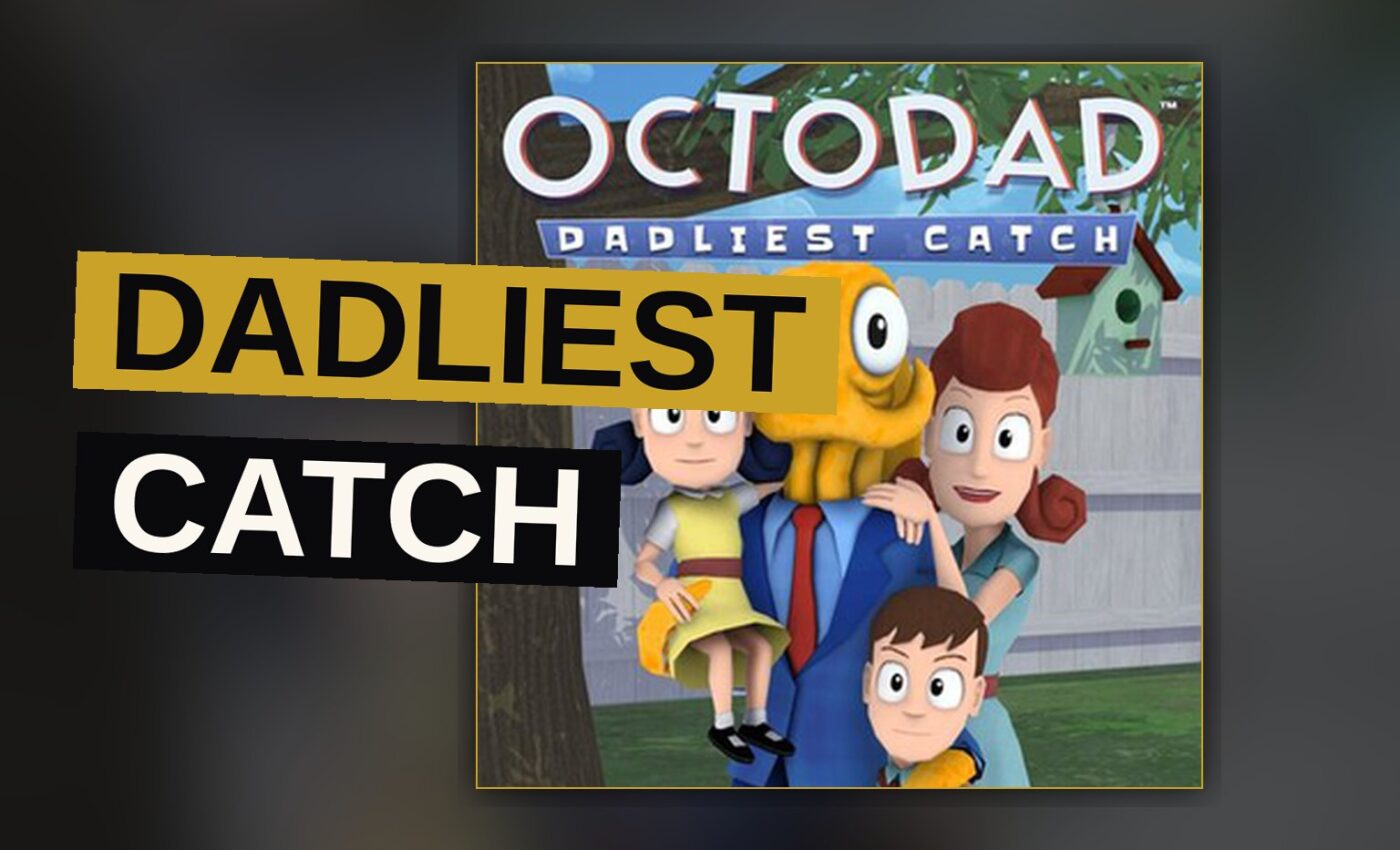
The first thing Octodad: Dadliest Catch asks you to do is walk through a door. You will fail. You will knock over a lamp, snag a curtain, and send a vase across the room. Then you will do it again, and somewhere in the wreckage you will start laughing.
Trailer, via IGDBcom.
A cephalopod in human clothing
Young Horses built its 2014 game on one joke and one problem. Octodad is an octopus in a suit, and he has a wife, a son, a daughter, and a mortgage. The player moves him through ordinary suburban life while a suspicion gauge fills every time a guard or a scientist watches him stumble.
That gauge is the whole design. Octodad: Dadliest Catch is not hard because the levels are complex. It is hard because the controls are honest about what an octopus would be like in a grocery store.
You steer two sets of tentacles, one standing in for arms and one for legs, and you switch between them with a single button. Loose items can be picked up and thrown, if you can get a grip on them. Mostly you cannot.
The supermarket, the aquarium, and Chef Fujimoto
The game runs through levels with clear objectives. In a supermarket you gather grocery items before the next task arrives. Around the house you do chores. Then Scarlet, Octodad’s wife, asks the family to visit the local aquarium, and the story turns.
Chef Fujimoto works there. He knows what Octodad is and wants to expose him and cook him. Fujimoto eventually throws Octodad into the shark tank and takes his family, trying to convince them their father is an octopus.
Octodad escapes, returns without the disguise, and tells them the truth. His daughter Stacy says she knew the whole time. Fujimoto tries to kill him, the family helps stop the chef, and Octodad forgives him. The two make amends. Tommy and Scarlet look ahead with what they now know.
Flashbacks fill in the rest: how Octodad took a human identity, met Scarlet, and married her. Two bonus chapters, released as “Octodad Shorts,” add a first date and a story Tommy and Stacy invent about their father working as a hospital nurse, a nod to Surgeon Simulator.
The pieces that carry the game:
- The suspicion gauge, which sets how fast guards and scientists catch on and sends you back to a checkpoint when it fills
- The two-tentacle control scheme, switched with one button
- The co-op mode, where up to four players each take a limb
- The aquarium trip, which turns a comedy about chores into a chase
- Chef Fujimoto, the one human who already knows
Four players, four limbs, one disaster
The co-op mode is the best argument for the game’s existence. Up to four players each control one limb, and the comedy stops being about a character and starts being about the people holding the controllers.
Single player keeps the joke on Octodad. Multiplayer hands it to the room.
There is a limit to how far that goes. The story levels are built around one player’s fumbling, and adding three more people to a supermarket run does not make the objectives richer. It makes them louder. That is fine for an evening. It is not a reason to keep the disc.
What the disguise is actually about
The best writing in Octodad: Dadliest Catch is not in the jokes. It is in the premise. A father hides what he is from the people who love him, and the game makes you feel that hiding in your hands, because every ordinary task is a struggle you are losing slowly.
Stacy knowing all along is the sharpest beat in the script. It turns the whole game’s anxiety inside out: the family was never fooled, only patient.
Fujimoto is thinner. He is a villain with a cleaver and a grudge, and the game asks him to carry the third act. The forgiveness ending lands softer than it should because the chef never gets a reason to want anything except octopus.
The score, and what it is worth
Octodad: Dadliest Catch holds a published critical score of 7.4 out of 10 across 11 outlets. That number is fair, and it is fair for a specific reason.
The game’s highs are high. The control scheme is a genuine idea, not a gimmick bolted onto a normal platformer, and the aquarium sequence pays off everything the first two hours set up. The co-op mode turns a solo comedy into a party game without much effort.
The lows are structural. Levels repeat their objectives, the suspicion gauge punishes you for the same mistake twice, and Fujimoto never becomes more than a threat. The bonus chapters are pleasant and slight.
The order of what matters here:
- The tentacle controls, which are the game
- The story’s turn at the aquarium, which gives those controls a point
- The co-op mode, which extends the life of the thing
- Fujimoto, who does not hold up his end
Octodad: Dadliest Catch is worth playing for the hour when the controls, the joke and the story all agree. That hour is real, and it is rare. The rest is a game that knows its premise is better than its levels and hopes you will not notice.
You will notice. You will also keep playing, because walking through a door as an octopus is funnier than walking through one as a person, and Young Horses knew that before anyone else did.
Get the Notebook.
The day's best stories and every fresh verdict, in plain English, in your inbox by seven. One email a day, no more.