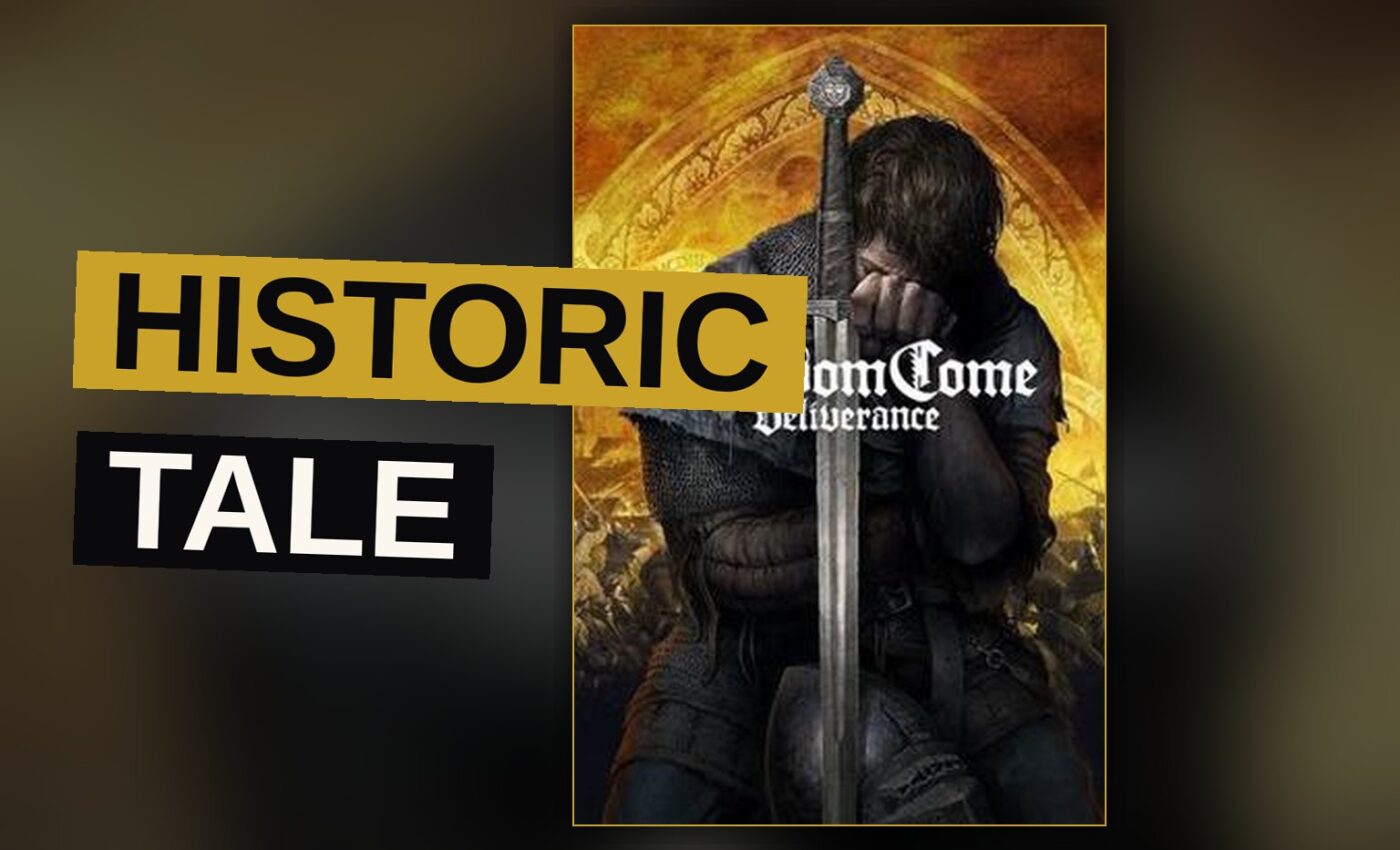
Kingdom Come: Deliverance asks a lot before it gives anything back. Warhorse Studios built a first-person, open-world role-playing game set in Bohemia in 1403, and it refuses to smooth the edges off that world. Combat is clumsy until it isn’t. Saving costs you. Your character, Henry, starts as nobody and stays close to nobody for hours. That stubbornness is the point, and it is also why the game lands short of the top tier.
Trailer, via Deep Silver.
Skalitz Burns, and Henry Picks Up a Sword
The setup is historical and specific. King Wenceslaus IV inherits Bohemia after Charles IV dies in 1378, proves an idle ruler, and gets kidnapped by his half-brother Sigismund, King of Hungary and Croatia, who then pillages the land. Henry is a blacksmith’s apprentice in the silver mining town of Skalitz. A mercenary army destroys his home and kills his family. He survives, joins Lord Radzig Kobyla, and the road to redemption starts there.
Henry is fictional. Most everyone around him is not. Hans Capon of Pirkstein, the heir to Rattay, becomes his companion. Istvan Toth is the antagonist. Radzig Kobyla is the liege lord of Skalitz. The cast includes Hanush of Leipa, Markvart von Aulitz, Jobst of Moravia, and the bandit leader Runt, with Tom McKay as Henry and Luke Dale as Hans.
The map is real ground. The playable region runs between Sázava and Rattay, and it folds in Ledečko, Mrchojedy, Přibyslavice, Samopše, Sázava Monastery, Stříbrná Skalice, Talmberk, Úžice and Vraník. This is what the game does better than almost anything else in its genre: it makes a place feel surveyed rather than designed.
A Classless System That Rewards Stubbornness
There are no classes. Skills grow from what you actually do. Talk your way through branched dialogue trees and your speech improves; swing a sword and your sword arm follows. Conversations run on a timer, and how long you take to answer shapes how people regard you. Reputation carries consequences, which means the game treats rudeness as a mechanic rather than a cutscene.
Clothing runs 16 slots and layers properly. A knight can wear a gambeson, then mail, then plate, with a tabard or surcoat over the top — four items on the chest alone. Each layer protects differently against different weapons. Gear wears, dirties and bloodies with use, and the character model shows it.
Weapons cover swords, knives, axes, hammers and bows. Horses matter. They run on their own AI, stepping or jumping around small obstacles, and they fight. You can swing from horseback, use the horse as extra inventory, and armor it across five slots. A warhorse is a combatant, not a vehicle.
Then there is the save system and the bugs. These are the parts that keep Kingdom Come: Deliverance out of the top tier.
Where the Game Fights Itself
The save system is the clearest example of a design choice that reads as punishment. It has been criticized since launch, and the criticism holds. Losing progress to a system that resists being used is not tension. It is friction, and friction is not the same thing as difficulty.
The technical state is the other problem. Reviews were generally positive for PC and mixed for consoles. Bugs and rough performance undercut the period detail the studio worked so hard to build. A game this committed to realism should not break its own illusion this often.
The realism itself divided people. Some praised the attention to detail; others found it tedious. Both reactions are reasonable. The combat, the clothing layers, the horses — every system asks for patience, and the game rarely rewards that patience quickly. Henry is weak for a long time. That is deliberate. It is also exhausting.
And the game’s portrayal of certain ethnic groups, particularly the Cumans, drew criticism from commentators, historians and scholars. That criticism is part of the record and belongs in any honest account of what this game is.
The Verdict on Kingdom Come: Deliverance
Here is what actually matters. Kingdom Come: Deliverance sold over 10 million units by May 2025. A sequel, Kingdom Come: Deliverance II, was released in February 2025, and a third game in the franchise is set to be released. A game that shipped this rough and still moved 10 million copies tells you the setting and the ambition carried it.
Ranked against what it tries to do:
- Setting and historical reconstruction — the best thing here, and genuinely unmatched in its detail.
- Character growth and the classless skill system — slow, earned, satisfying once it clicks.
- Horse AI and mounted combat — a real achievement, not a gimmick.
- Combat feel — clumsy early, workable later, never elegant.
- Save system and technical bugs — the reason this is not an 8 or a 9.
- Portrayal of the Cumans — a documented criticism, not a footnote.
The 2026 PlayStation 5 and Xbox Series X/S versions, following the 2024 Switch release, give the game another life. Whether they fix the old problems is not something this review can claim. The original release also came to PlayStation 4, Windows, and Xbox One.
Key facts
- Score: 7.4 of 10
- Released: 13 February 2018 (PlayStation 4, Windows, Xbox One); 15 March 2024 (Nintendo Switch); 13 February 2026 (PlayStation 5, Xbox Series X/S)
- Developer: Warhorse Studios
- Publisher: Deep Silver
- Units sold: over 10 million by May 2025
- Sequel: Kingdom Come: Deliverance II, February 2025
Kingdom Come: Deliverance is a game worth playing and a game worth arguing with. Its commitment to a real place and a real year is the reason it endures, and its refusal to make that commitment comfortable is both its signature and its ceiling. Warhorse built something nobody else was building, then left enough rough edges that it never quite becomes what it could have been. That is a game you respect more than you enjoy, and one you keep thinking about anyway.
Get the Notebook.
The day's best stories and every fresh verdict, in plain English, in your inbox by seven. One email a day, no more.