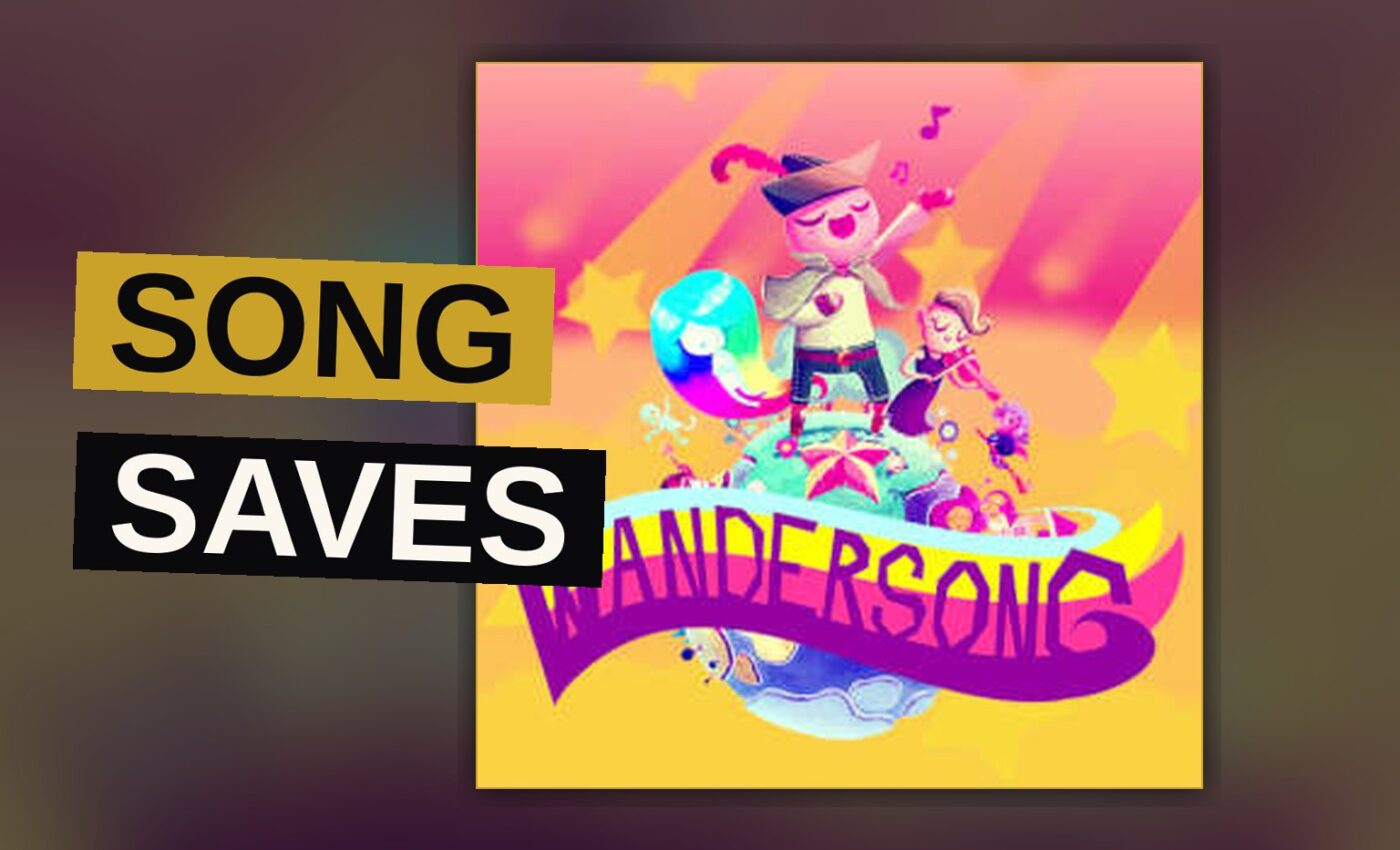
Wandersong is a game about a bard who cannot fight, and that is exactly why it works. You play as a cheerful, nameless singer who must stop the end of the world by using only song. It launched in 2018 for PS4, PC, Mac, and Xbox One, and it earned a critical score of 8.9 out of 10. This review matches that score.
The premise is simple. A cosmic being called the Overseer has decided to destroy the universe, and only a “song of unity” can change its mind. Your bard has no sword, no magic, and no special powers. He has a voice, a heart, and a stubborn refusal to give up.
What follows is a journey across a hand-drawn world that treats kindness as a mechanic, not a theme. It is a game about listening, and it asks you to do the same.
Trailer, via Greg Lobanov.
Meeting Miriam the Witch
The game opens with your bard waking up in a small village. A witch named Miriam tells you the world will end in a few days, and she sends you on a quest to find the Earth Song’s seven pieces. Each piece lives in a different region, guarded by a different culture, and each one requires you to sing in a new way.
The core control is a single button mapped to a musical note. You hold the stick to change pitch, and you press the button to sing. It sounds limited, and it is. But the game builds entire puzzles, conversations, and boss fights around that one input.
Early levels teach you to match melodies, echo patterns, and hold notes. The first region, a grassy valley, feels gentle and safe. The bard hums to flowers, wakes a sleeping giant, and befriends a grumpy mole. The tone is light, almost silly, and the writing leans into it.
The bard does not speak. He sings, and the game translates his songs into subtitles. Other characters respond to his melodies with their own words, and the result is a conversation system that feels alive. You are not choosing dialogue options. You are choosing how to sound.
The Queen Who Banned Music
The second region is an underwater kingdom, and it is where the game’s emotional range starts to show. A queen has banned music, and her people live in silence. Your bard must earn her trust by singing a lullaby her mother used to hum.
It is a quiet, sad sequence. The queen does not want to hear a song. She wants to remember one. The game does not rush this moment, and it does not undercut it with a joke. It lets the melody sit.
The desert region follows, and the tone shifts again. A tribe of nomads treats song as a weapon, and they train you to sing loud, fast, and sharp. This is where the game introduces rhythm-based combat, though calling it combat undersells it. You are not attacking. You are overpowering.
Each region ends with a boss, and each boss is a conversation. You sing against a giant sand worm, a stone golem, and a jealous spirit. The game never lets you hurt them. You can only harmonize, and the fight ends when you find the right note.
Confronting the Overseer
The Overseer is not a monster. It is a lonely, ancient being that has watched countless worlds end, and it has concluded that nothing matters. The game does not make it evil. It makes it tired.
Your bard’s final confrontation with the Overseer is the best scene in the game. You do not fight it. You sing to it. You tell it, through melody, about the small joys of the world: the taste of bread, the warmth of a fire, the sound of a friend’s laugh.
The game is honest about what it is doing here. It is not trying to defeat the Overseer with power. It is trying to convince it to stay. The sequence lasts nearly an hour, and it earns every minute.
A lesser game would have made this a quick cutscene. Wandersong makes it a full level, and you are the one singing the argument.
Music Boxes and Desert Drums
The soundtrack is a collection of folk tunes, chants, and gentle electronic pads. It is not a score of grand orchestral pieces. It is a score of small melodies, and each region has its own instrument palette. The ocean uses music boxes. The desert uses drums and flutes. The final region uses a full choir.
The art style is hand-painted and colorful, with thick outlines and soft shading. Characters have simple faces and expressive bodies. The bard’s default walk is a skip, and his idle animation is a little dance. The game is never ugly, and it never tries to be grim.
The writing is sharp and funny. A running gag involves a group of bards who think they are rock stars. Another involves a town that has banned singing because one bad performance went viral. The game knows it is silly, and it leans into that without breaking its own heart.
Fog Mazes and Rushed Mountains
The game is not perfect. Its middle section drags. The third region, a swamp, introduces a mechanic where you must sing to navigate a maze of fog, and it overstays its welcome. The puzzles repeat, and the jokes thin out.
The fourth region, a mountain, is shorter but feels rushed. A whole culture of bird people is introduced and resolved in under an hour, and their story deserved more room. The game’s final act, however, pulls everything back together.
The game’s length is part of its charm. It runs about eight to ten hours, and it never wears out its welcome overall. But the middle chapters could have been trimmed without losing anything.
Why There Are No Fail States
The game’s real innovation is its approach to conflict. Every enemy can be befriended. Every problem can be solved with a song. There is no fail state in the traditional sense. You cannot die, and you cannot lose.
This sounds like it would remove tension, and it does. But the game replaces tension with curiosity. You are not worried about failing. You are worried about missing a melody, about singing the wrong note, about hurting someone’s feelings.
The game’s best side quests are about listening to strangers. A man who lost his wife asks you to sing her favorite song. A child who is afraid of the dark asks you to hum until she falls asleep. A lonely robot asks you to sing a duet with it.
None of these quests have rewards. They have moments. The game trusts you to care, and it trusts its writing to make you care.
Watching the Sunset
The ending is not a twist. It is a resolution. The Overseer hears your song, and it changes its mind. The world is saved, and the bard goes home.
But the game does not end there. It shows you what happened to every character you met. The queen learns to hum again. The nomads hold a festival. The bird people rebuild their nests. The bard sits on a hill and watches the sunset.
It is a simple ending, and it is the right one. The game is not about saving the world. It is about making the world worth saving.
Scoring Wandersong
Wandersong is a game that believes in the power of listening. It is not a game about winning. It is a game about understanding. The controls are simple, the art is lovely, and the writing is generous.
Its flaws are real but minor. The middle sags, and a few puzzles repeat. But the whole is greater than its parts, and the final hour is worth the journey.
The game is available on PS4, PC, Mac, and Xbox One. It runs about eight to ten hours. It has no difficulty settings, no combat, and no fail states.
If you want a game that asks you to fight, this is not it. If you want a game that asks you to listen, this is the best one there is.
Wandersong earns a score of 8.9 out of 10.
- Title: Wandersong
- Platforms: PS4, PC, Mac, Xbox One
- Release Date: 2018
- Runtime: 8–10 hours
- Score: 8.9/10