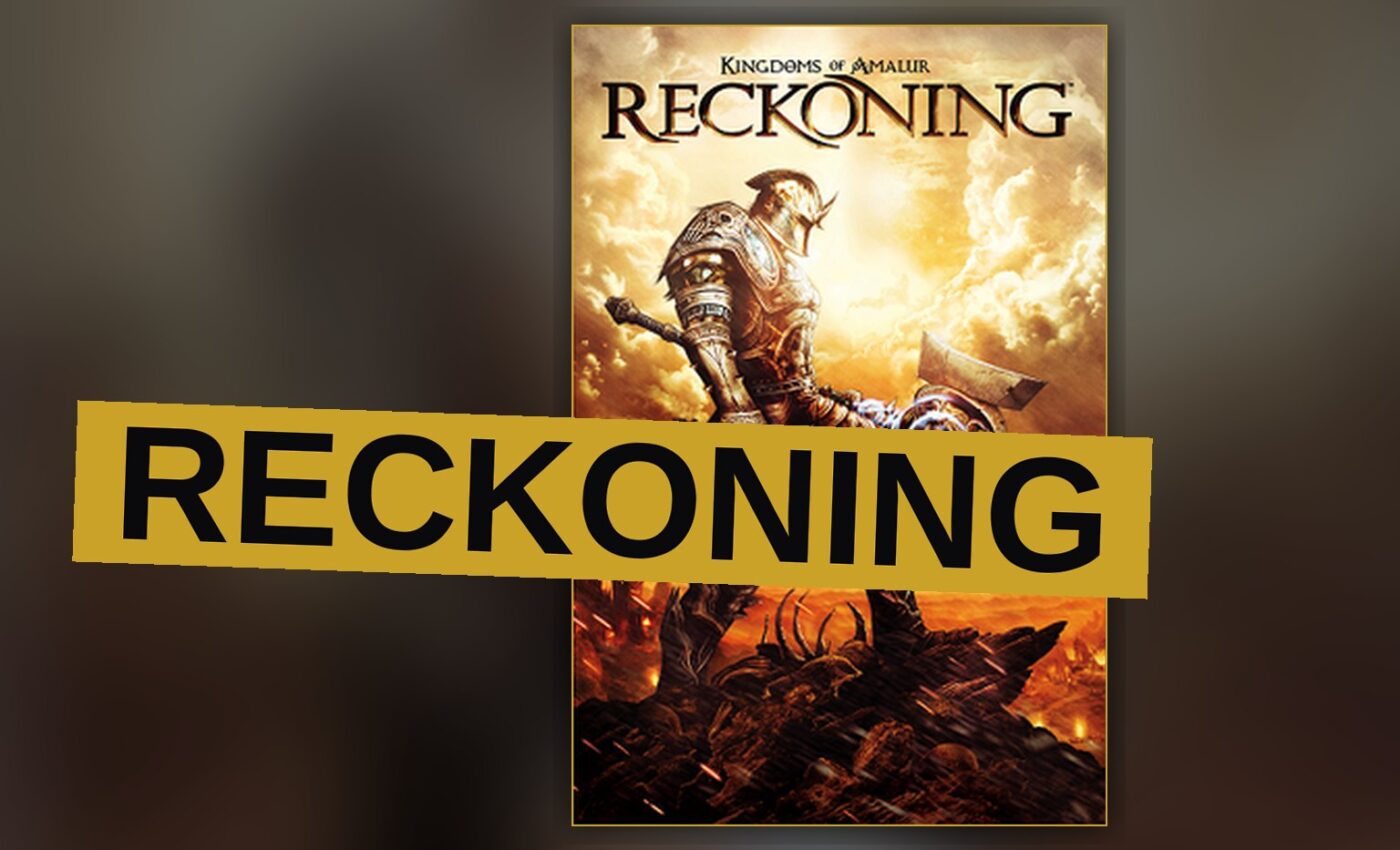
Kingdoms of Amalur: Reckoning arrived in 2012 as a bet on a new fantasy world. Big Huge Games developed it. 38 Studios and Electronic Arts published it. It shipped on PlayStation 3, PC and Xbox 360. The pitch was big: an open-world action RPG built on a setting by R. A. Salvatore, with art from Todd McFarlane and design from Ken Rolston. The combat delivered. Critics said the story and a lack of gameplay depth held the rest back.
Trailer, via IGN.
The Fateless One and the Well of Souls
You play the Fateless One. You are a dead person brought back by the Well of Souls, a gnome-made device meant to revive the dead. The resurrection cuts you loose from the Fate Weave — the destined path that binds everyone in the Faelands. You wake with amnesia. That is the hook, and it is a good one.
The Faelands are split into two territories by a great river. The Fate Weave dictates every life there. Fateweavers read and report that fate. Your character is the one person it cannot touch. The game states this plainly and then builds its quest structure around it.
Fomorous Hughes, the gnome who built the Well of Souls, revives you. The Tuatha Deohn attack the device almost at once. Hughes distracts them so you can escape, and sends you to find Agarth. Agarth is a warrior turned Fateweaver who drinks to cope with knowledge of his own death. He does not believe you at first.
A Cast That Carries the Plot
Agarth eventually takes you to a Fateweaver temple to find a Fae codex recording all of Amalur’s history. There you prevent Agarth’s fated death. You also meet Alyn Shir, a Dokkalfar assassin and diplomat who knew the Fateless One before. The Summer Fae king decodes the codex. It reveals your role in changing Amalur’s destined destruction.
Tilera ap Gwydion joins the group later. She is a disillusioned Ljosalfar general leading the mortal resistance against the Tuatha Deohn and their leader Gadflow. Alyn suggests you help Tilera retrieve an ancestral weapon and prepare an attack on a besieged city in the Winter Fae’s lands. The assault succeeds. Tilera dies in it.
That death lands. The game earns it because Tilera is written as tired and certain rather than noble. The same cannot be said for everyone in the cast. Alyn Shir is the most interesting figure in Kingdoms of Amalur: Reckoning, and the game keeps her at arm’s length for too long. She kills the gnome researcher Ventrinio later in the story.
The world itself is the strongest piece of the fiction. The Fae come in two courts:
- The Summer Court, representing new life
- The Winter Court, representing decay
Mortal races arrived more recently. There are two human tribes, the Almain and the Varani, and the Alfar split into the Ljosalfar and Dokkalfar tribes. Gnomes round out the population. The Tuatha Deohn are a hostile faction of Winter Fae who worship the god Tirnoch. They are destined to wipe out all life in the Faelands.
Combat Is Where Kingdoms of Amalur: Reckoning Wins
This is the part of the game that holds up. Combat is real-time and built on button timing. Different combinations trigger alternate attacks, and more options unlock as your level rises. You carry two equipped weapons and swap between them mid-fight.
The weapon list is broad. Two sword types. Two types of daggers. Bows. Hammers. Chakrams. Chakrams are the standout — a ranged weapon that behaves nothing like a bow and forces you to think about spacing.
You block with a shield accessory, and correct timing stuns an enemy. You dodge to avoid attacks. Some movement options are tied to specific character Abilities rather than being available from the start. Active skills come from skill trees and burn your magic point meter.
The Destiny system is the other half of the build. It works as a character class layer on top of your race and skill choices. It is flexible, and it is the reason two players can run the same weapons and end up with different characters.
| System | What it controls | How you get it |
|---|---|---|
| Race | Attribute boosts | Chosen at start |
| Patron deity | Further passive enhancements | Chosen at start |
| Skill trees | Active skills, MP cost | Unlocked by leveling |
| Destiny | Character class layer | Earned through quests |
Enemies lock to a specific level range when you enter an area. That keeps early regions from becoming trivial and keeps late ones from being impossible. It is a quiet design decision that does a lot of work.
Five Regions, Four Quest Types, One Problem
Players explore the Faelands across five regions, in field and dungeon environments. Navigation is walking or running through open areas. There are specific platforms for contextual jumps to lower areas, and you can swim through deep water. No climbing, no gliding. Movement is what it is.
Quests come in four shapes. There is the main scenario. There are self-contained quest lines for groups called Factions. There are non-repeatable side quests. And there are repeatable Tasks. All of them come from NPCs found across the world. Completing quests, discovering regions and finishing some in-game activities all award experience points, which raise your level and statistics.
The problem is depth, the same lack of gameplay depth critics flagged at launch. Faction quest lines are the best content in Kingdoms of Amalur: Reckoning, and they are still built on the same loop as everything else. Go here. Fight these. Return. The writing carries the Factions further than the mechanics do.
Character customization is solid at the start. You pick gender, appearance and race — the human Almain and Varani groups, and the Alfar Ljosalfar and Dokkalfar tribes. Each race gives unique attribute boosts. Choosing a patron deity adds more passive enhancements. It is a good opening hour.
Production and the Shadow of Project Copernicus
Production on Kingdoms of Amalur: Reckoning began in 2009. It was built on the Amalur setting that 38 Studios founder Curt Schilling and writer R. A. Salvatore created for their in-development MMORPG, Project Copernicus. The game used a reworked prototype that existed before 38 Studios acquired Big Huge Games.
Reckoning was meant to introduce the Amalur universe ahead of Project Copernicus. It was otherwise developed as a standalone project. That matters when you play it. The world is built to be expanded, and you can feel the edges where a larger game was supposed to continue.
The roster behind it is real. Todd McFarlane, the artist and Spawn creator, gave the game its visual style. Ken Rolston, a designer, worked on its systems. Grant Kirkhope composed the score. Salvatore built the setting. That is a serious group of people, and the game mostly justifies their presence.
It sold above expectations for a new intellectual property. It contributed to Electronic Arts’ fiscal profits. It still commercially underperformed.
What Holds Up and What Does Not
Kingdoms of Amalur: Reckoning is a 7.9 out of 10. That score reflects a game with a genuinely excellent combat system wrapped around a story that never reaches the height of its own premise.
The combat is the reason to play it now. Chakrams, the block-and-stun timing, the Destiny system, the enemy level locking — these are decisions made by people who understood action games. Very few RPGs from 2012 feel this good in the hands.
The story is the reason it is not higher. The Fateless One is a strong idea: a person cut loose from fate in a world where fate is a physical law. The game states that idea and then runs a standard quest chain through it. Agarth’s drinking, Tilera’s death, Alyn’s late turn — these are the moments where the writing reaches for something. They are not enough to carry five regions.
The depth problem is real and separate. Skill trees and weapon types suggest a build game. What you get is a game where the same loop repeats with better numbers. Faction quests are worth your time. Repeatable Tasks are not.
This paper’s own view is that the comparison that matters is not to other 2012 RPGs. It is to what Amalur was supposed to become. Kingdoms of Amalur: Reckoning was built as a doorway to Project Copernicus. The doorway is well made. The room behind it was never finished. That is the whole story of this game, and it is why it sits at 7.9 rather than higher. Play it for the combat. Stay for the Faelands. Do not expect the story to match the world that Salvatore and McFarlane built around it.
Get the Notebook.
The day's best stories and every fresh verdict, in plain English, in your inbox by seven. One email a day, no more.