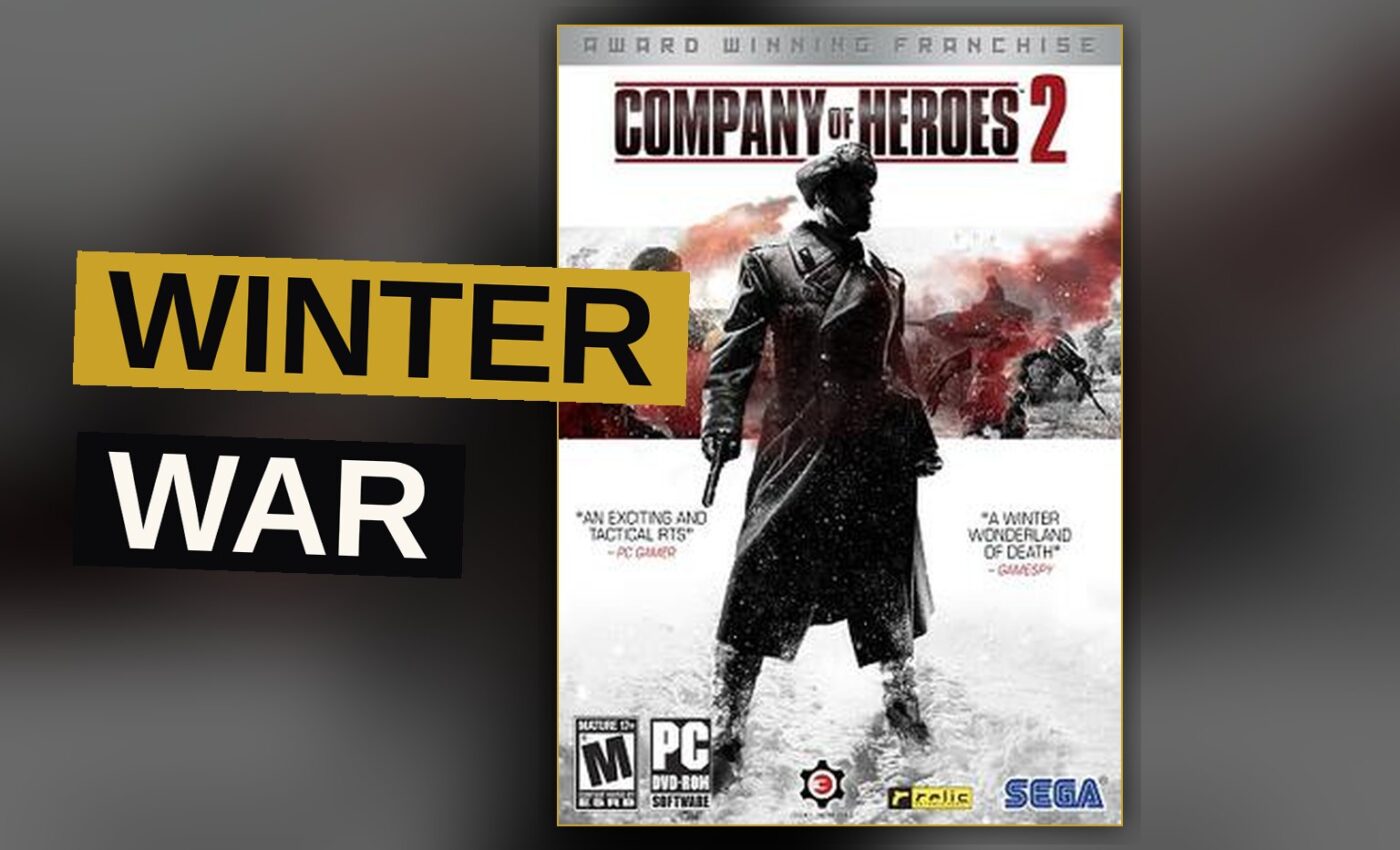
Company of Heroes 2 puts you in command of the Soviet Red Army on the Eastern Front, and it does not soften what that means. Relic Entertainment’s real-time strategy game runs from Operation Barbarossa to the Battle of Berlin, and its campaign frames the whole thing as a 1952 interrogation in a Siberian gulag.
The game launched on June 25, 2013, for Windows, Linux, and OS X. Sega published it, and it runs on Relic’s Essence 3.0 engine. Sega had picked up Relic and the Company of Heroes property from THQ in January 2013, months before release.
Trailer, via Company of Heroes.
A Colonel, a Journal, and a Gulag
The campaign’s spine is not the battles. It is Colonel Churkin of the Soviet secret police questioning Lieutenant Lev Abramovich Isakovich about the journal he kept during the Great Patriotic War. Churkin doubts Isakovich’s commitment to the Soviet cause. Isakovich answers by calling out how easily Churkin spends Soviet lives.
That argument carries the story. Isakovich moves from scorched-earth tactics outside Moscow to a counterattack at Mtsensk, then to Stalingrad, where he says Order 227 was the only thing driving the Soviets forward.
The Cost of Holding the Line
The Stalingrad chapter is where Company of Heroes 2 makes its point. Isakovich is trapped in a collapsed building. His men leave the line to pull him out. The punishment is execution for the men and a reassignment to war correspondent for Isakovich.
From there he hears the story of the Siege of Leningrad and Operation Iskra, then embeds with troops at Orsha and Lublin, where he uncovers the Majdanek concentration camp. He reports on the execution of Home Army partisans in Poland, and Churkin sends him to a penal battalion.
What follows covers the Battle of Poznań, the destruction of the German Ninth Army at the Battle of Halbe, and the Battle of Berlin. Isakovich tries to defect to expose the Eastern Front’s true nature. He is captured and sent to the gulag. In the end, Churkin kills a guard and lets him escape with the journal, having learned he will not survive Stalin’s next purge.
What the Package Contains
The base game is a platform, and the standalone expansions sit on top of it:
- The Western Front Armies
- Ardennes Assault
- The British Forces
You buy the base game, then upgrade as you go. Modes cover single player, multiplayer, and co-operative play, with an isometric, bird’s-eye view over the field.
Release Facts
| Item | Detail |
|---|---|
| Release date | June 25, 2013 |
| Developer | Relic Entertainment, Feral Interactive |
| Publisher | Sega, Feral Interactive |
| Platforms | Linux, PC (Microsoft Windows), Mac |
| Engine | Essence 3.0 |
| Genres | Real Time Strategy, Simulator, Strategy |
| Sequel | Company of Heroes 3, February 2023 |
The War Behind the War
Company of Heroes 2 is at its best when the interrogation scenes and the battlefield argue with each other. The gulag frame is not decoration. It turns every mission into evidence, and it gives the campaign a bitterness most World War II strategy games avoid.
The Eastern Front focus helps too. The source material is clear that this is Soviet ground, Soviet casualties, and a conflict that produced more than 14 million military casualties.
Where the game thins out is in the space between its set pieces. The campaign jumps from Mtsensk to Stalingrad to Leningrad to Orsha to Lublin to Poznań to Halbe to Berlin, and the journal device has to carry a lot of weight across those jumps. The standalone expansions add armies and fronts, but they also split the experience into purchases, which works against a story this tightly wound.
The sequel arrived in February 2023, about a decade after the original, and that gap says something about how hard this material is to follow.
What the Campaign Earns
Company of Heroes 2 earns its reputation as a serious World War II strategy game because it refuses to let the war be simple. The gulag frame, the Order 227 argument, and the Majdanek sequence give the campaign a moral weight that most entries in the genre never attempt. The Essence 3.0 engine and the isometric command view hold up the tactical layer, and the co-operative and multiplayer modes give the package a long tail beyond the story.
The weaknesses are real but secondary. The campaign’s structure leans hard on the interrogation to connect distant battles, and the expansion model asks players to keep paying for a war that should feel whole. Neither flaw breaks the game.
This is a strategy title that treats its subject as a tragedy rather than a power fantasy, and that is the part worth keeping.
Get the Notebook.
The day's best stories and every fresh verdict, in plain English, in your inbox by seven. One email a day, no more.