
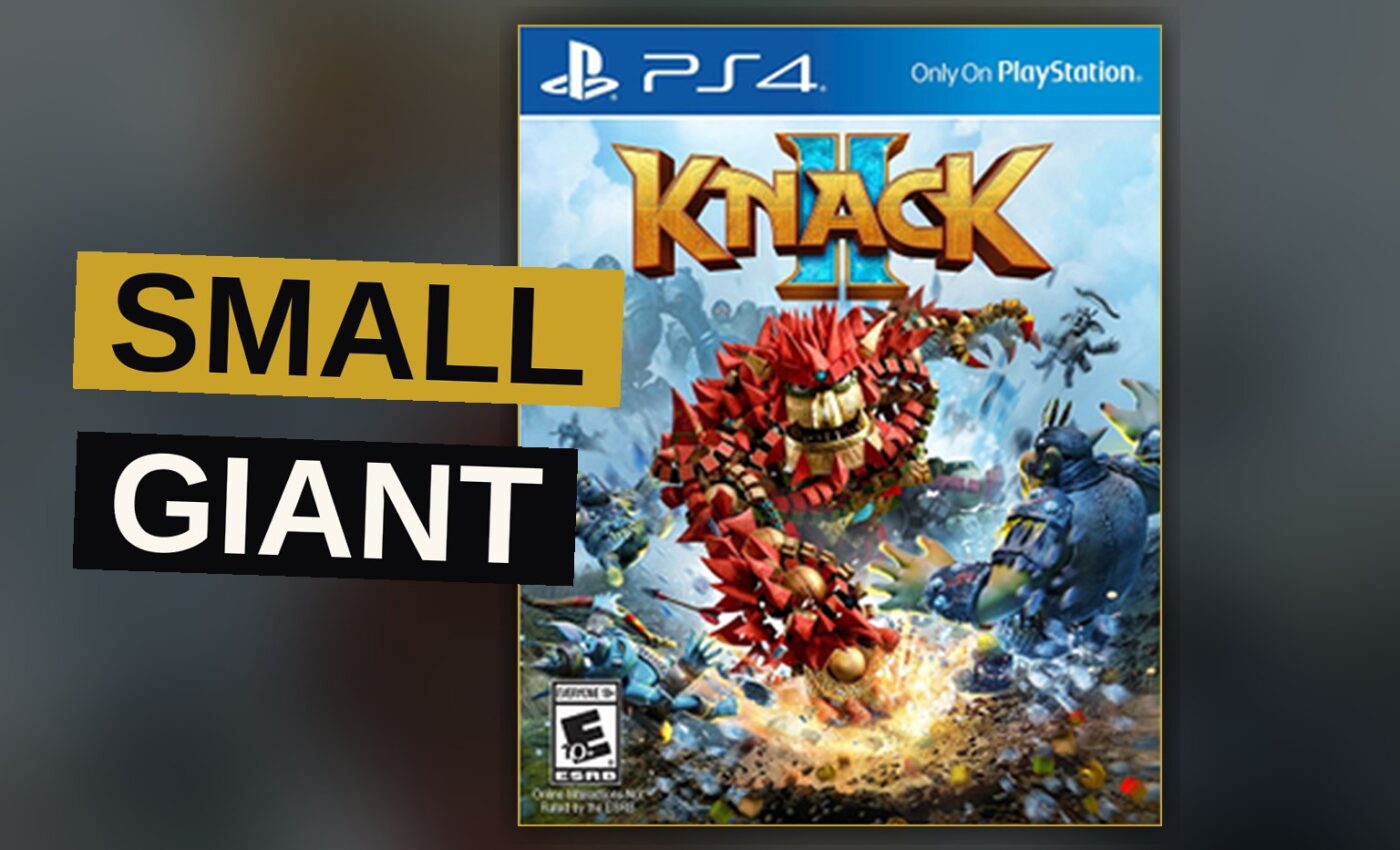
Knack II arrived in September 2017 as the sequel to a launch-window PlayStation 4 game that few people had asked to see again. Japan Studio developed it, Sony Interactive Entertainment published it, and it came to the PlayStation 4 alone. The pitch is unchanged: a small creature made of relics who can grow large, shrink back down, punch, kick, and take a hit that would flatten anything else on screen. The difference this time is that the game finally knows what it wants to be.
Trailer, via PlayStation.
A Relic That Grows and Shrinks
Knack is the character you control, and his abilities are the whole game. He punches. He kicks. He changes size. He can raise a shield to deflect projectiles. The size change is not a costume swap; it is the puzzle and the combat system at once, and Knack II leans on it harder than the 2013 game did.
The camera sits behind him in third person. You move through platforming sections, fight waves of enemies, and solve puzzles that require you to manipulate both the world and Knack’s own body to get through. None of this is novel. What matters is that the pieces fit together better than they did the first time.
The Skill Tree and the Relic Energy
Knack II adds a skill tree. You upgrade Knack’s abilities by collecting Relic Energy scattered through levels. Treasure chests turn up throughout the game and dispense either a Relic or a Crystal Part, both of which push the upgrades further. The system gives the combat a reason to keep going past the point where punching alone would wear thin.
There is also a teleporter, new to this game, which lets players move between pads inside their own levels. It is a small addition. It is also the kind of small addition that makes a level feel less like a corridor.
The abilities that change how Knack looks arrive through the story. Those are Iron, Ice, and Stealth. The rest of his special abilities unlock through upgrading him with Knack parts, Relics, and Crystal Parts. A player who ignores the upgrade path will find the later fights longer than they need to be.
Two Players on One Couch
The headline addition is offline multiplayer. A second player can join the main story and leave it whenever they like. That is the whole design: drop in, drop out, no lobby, no matchmaking, no account.
Knack II introduces offline multiplayer, allowing an extra player to join and leave the main story at their leisure.
That accessibility is the point. Knack II can be played by people of varying ages, and the couch cooperative play dynamic has been praised for exactly that reason. A parent and a child can share the same screen without either one holding the other back. It is the most convincing argument the game makes for itself.
The Crystal Wars and the High-Goblins
The setting reaches back two centuries before the events of Knack II, to the time of the Crystal Wars. The advanced civilization of the Goblins, then called the High-Goblins, feuded with humans and wanted energy-potent crystals, which existed only on human territory.
Yurick, a High Goblin leader and master engineer, built the Ancient Weapons — an army of powerful robots — to wipe out the humans. The High Goblin empire expanded as the onslaught continued, until the human leader and warrior Marius and his troops began defeating the Ancient Weapons in single combat using rock, vines, traps, and cunning. That string of victories carried them through the war.
Beaten, Yurick went back to his laboratory to build a control center for his robot forces and to make more powerful weapons, most notably the Titans, for a final battle. While Marius and Yurick fought with their armies, Marius sent a strike team that disabled the Ancient Weapon’s control center and defeated the High Goblins. Marius and his men lamented destroying the High-Goblins, becoming the very thing they wished to stop. He then found the order of the monks and led people to a new era of peace and wisdom.
Newhaven, Targun, and the Museum
Knack II opens with Newhaven under attack by four Titans. Lucas indicates that this was his undoing, and Knack fights to correct their unknown wrong-doings.
Six months earlier, Lucas is flying with his uncle Ryder and Knack to an island, through a Goblin infested forest, where they uncover a monument dedicated to Marius during the Crystal Wars. They find a battlefield from the Crystal War, desecrated with the bodies of the vanguards of the Goblin Army. The army rises from the dead and attacks. Knack protects them and they escape back to the plane, returning to Doctor Vargas and Charlotte at a monastery in Norcliff to recount what happened.
The group gathers at the monastery and meets two monks: Xander, their overseer, and Ava, their youth leader. They decide to seek a mountain pass in the morning to uncover Ancient Weapons in the area. Morning comes, the group parts ways at the mountain pass, and they find a burned, downed ruins of a village without uncovering the mystery.
Back with Doctor Vargas, Charlotte, and Xander, Lucas and Ava decide to ask Uncle Ryder to help them reach Targun, the High Goblin City, where Yurick originally created the robots. They arrive at Targun Ruins, traverse the walls, and find Yurick’s laboratory. Inside, they discover part of a map to the High Goblin empire and a remote for controlling the robots. They decide to travel to a museum in Atheneum to better understand Targun’s control center for the Ancient Weapons. They reach the museum and find the city invaded by robots and Goblins. Knack brings an artifact to the group.
Quick-Time Events and the Puzzles
Knack II uses Quick-Time Events during cutscenes. That is a choice, and it is the weakest one in the game. A cutscene that stops to ask for a button press is a cutscene that has decided you are not paying attention.
The puzzles hold up better. They require the player to manipulate the world and Knack’s abilities together, which is the only honest way to build a puzzle around a character whose defining trait is that he changes size. The teleporter pads feed into the same idea, moving Knack between points inside a level rather than out of it.
What Actually Improved
The 2013 Knack was a launch game with a launch game’s problems. Knack II is not. It is a beat ’em up platformer with a skill tree, a co-op mode, and a setting that reaches back two hundred years into a war between High-Goblins and humans over crystals.
Here is the order of what matters, from most to least:
- Offline co-op, because it changes who can play the game at all.
- The skill tree and Relic Energy loop, because it gives combat a spine.
- The size-changing mechanic, because it is the character and the puzzle system in one.
- The teleporter pads, because they quietly fix level pacing.
- Quick-Time Events, because they add nothing.
The story is the part that will divide people. The Crystal Wars backstory is told at length, and the present-day plot runs through Newhaven, Norcliff, Targun Ruins, and a museum in Atheneum, with a cast that includes Lucas, Uncle Ryder, Doctor Vargas, Charlotte, Xander, and Ava. It is a lot of machinery for a game whose best feature is that a second person can pick up a controller and join in.
Where Knack II Lands
Knack II received mixed reviews from critics, but was largely considered an improvement over its predecessor. That is the right read, and it undersells the co-op. The game is not ambitious in the way its backstory wants to be. The Crystal Wars material is dense and the Quick-Time Events are a drag.
What Knack II gets right is narrower and more useful. It takes a character built around one idea — a relic creature who grows and shrinks — and builds a full game around that idea instead of a demo. The skill tree gives the punching somewhere to go. The chests, the Relics, the Crystal Parts, and the Knack parts all feed the same loop. The teleporter pads fix a pacing problem nobody had named.
The co-op is the reason to play it. A second player can drop into the main story and leave whenever they want, and the game has been praised for that couch dynamic because it works. Very few games in this genre let a child and an adult share a screen without one of them waiting.
Knack II is a sequel that fixes the first game rather than outgrowing it. It is worth playing with someone else in the room. Alone, it is a competent platformer with a long memory and a short list of new ideas.
Get the Notebook.
The day's best stories and every fresh verdict, in plain English, in your inbox by seven. One email a day, no more.


