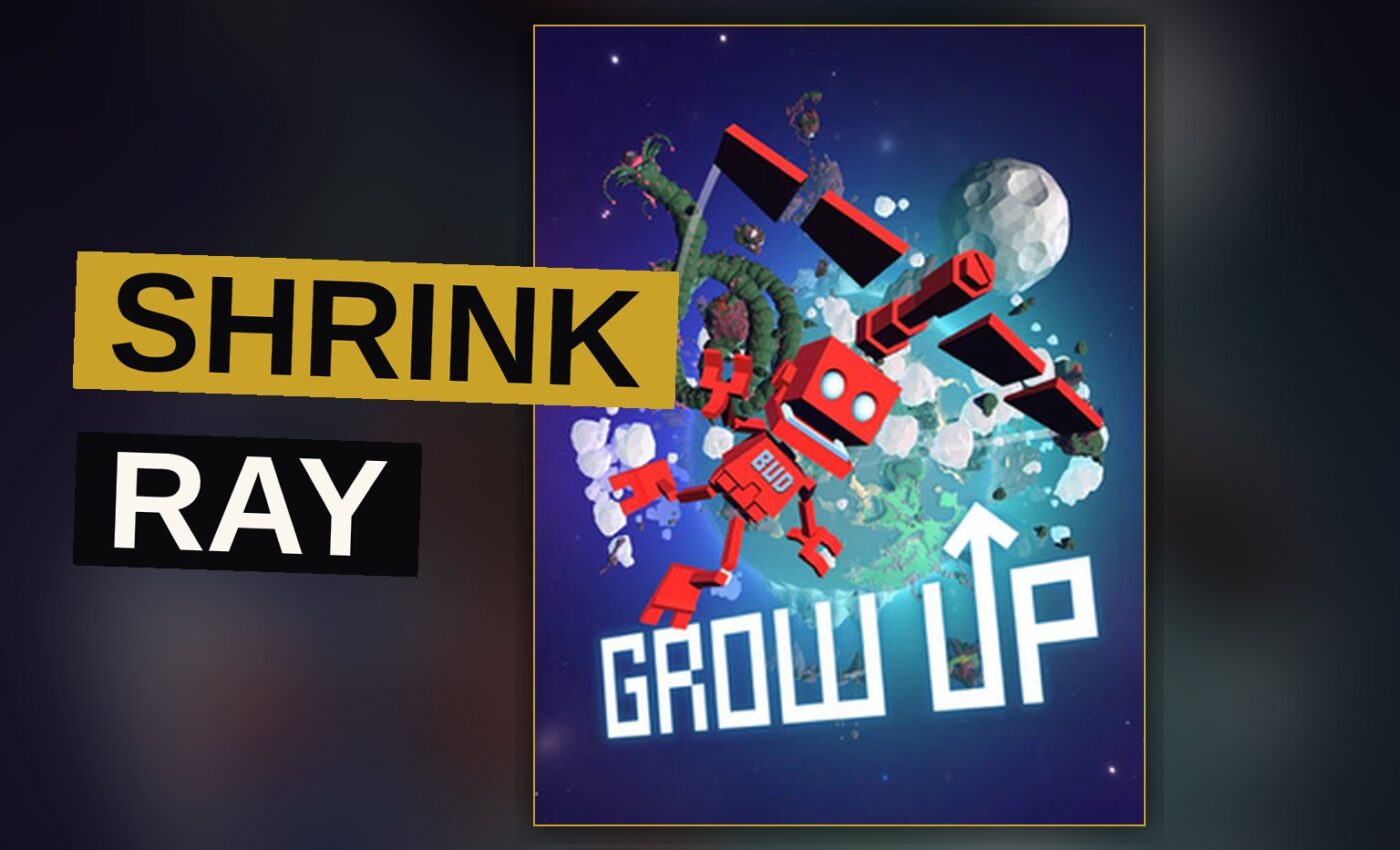
Grow Up asks players to stop being adults. That simple premise powers a game about shrinking down to insect size, exploring tiny worlds, and solving puzzles with the physics of a bug. It sounds like a gimmick. In practice, it becomes a genuinely clever way to look at familiar objects again.
The Shrink Mechanic
The core trick is a shrink ray. Players shrink themselves to millimeter scale, crawl through keyholes, ride water droplets, and climb inside everyday items. The effect is immediate. A wall becomes a cliff. A leaf becomes a forest floor. A soda can becomes a fortress.
It works because the game never stops inventing new uses for its own rules. One puzzle turns a clock face into a series of gears. Another turns a kitchen cabinet into a maze of drawers and hinges. The variety keeps the premise from wearing thin.
The World Around You
Grow Up is built around ordinary settings — a garden, a bedroom, a school hallway — rendered with surprising care. Objects are small enough to feel strange but large enough to read clearly. Water behaves like water. Light bends around glass. Dust particles drift in the air.
That attention pays off. Even when a puzzle stalls, the world itself stays interesting. Players spend time looking at wallpaper, examining cracks in the sidewalk, noticing the texture of a flower petal. The game rewards curiosity.
Puzzles and Difficulty
The puzzles are where Grow Up stumbles. Some are elegant, forcing players to think about scale and perspective in fresh ways. Others feel arbitrary, built around a trick that takes several tries to see. The game does not always explain its logic, and a few late-game challenges rely on patience more than insight.
The difficulty curve is uneven. Early levels ease players into the mechanics with gentle hints. Later levels pile systems on top of each other without much warning, leaving players scrambling to remember which button shrinks them and which button propels them forward.
The Camera Problem
Camera trouble plagues the game’s later stages. Shrinking into tight spaces means the view often fails to follow the player, leaving them lost inside a desk drawer or a ventilation grate. This is not a minor annoyance. It turns a clever idea into a source of frustration.
“The camera gap is real but the battery is what will decide this.”
That line sums up the tension at the heart of Grow Up. Its central mechanic is brilliant. Its execution, particularly with the camera, holds it back.
Sound and Style
The music is quiet and unassuming, letting the visuals do the talking. Voice acting is minimal, which suits a game about smallness. There is no grand score to overwhelm the intimacy of the setting. It feels deliberate.
The art direction carries the emotional weight. A garden viewed from a bug’s eye is full of wonder and dread in equal measure. A bedroom looks both cozy and alien. The game finds poetry in the mundane.
Length and Replay Value
Grow Up is a short game. Most players will finish it in under ten hours, depending on how much time they spend staring at a tricky platforming section. That brevity is both a strength and a weakness.
On one hand, the game respects the player’s time. On the other, there is little reason to return once the credits roll. The level design is linear, and while some puzzles reward experimentation, the game does not offer a second path to encourage replay.
Final Word
Grow Up is a game about seeing things anew. Its shrink mechanic is a genuine innovation, and the worlds it creates are some of the most imaginative in recent memory. The puzzles, while uneven, occasionally reach heights of creativity that few games manage. But technical problems, particularly with the camera, keep it from greatness.
It is a game worth playing for a few hours, then setting aside. The experience is memorable, but it does not ask for much more time after the credits.
Get the Notebook.
The day's best stories and every fresh verdict, in plain English, in your inbox by seven. One email a day, no more.