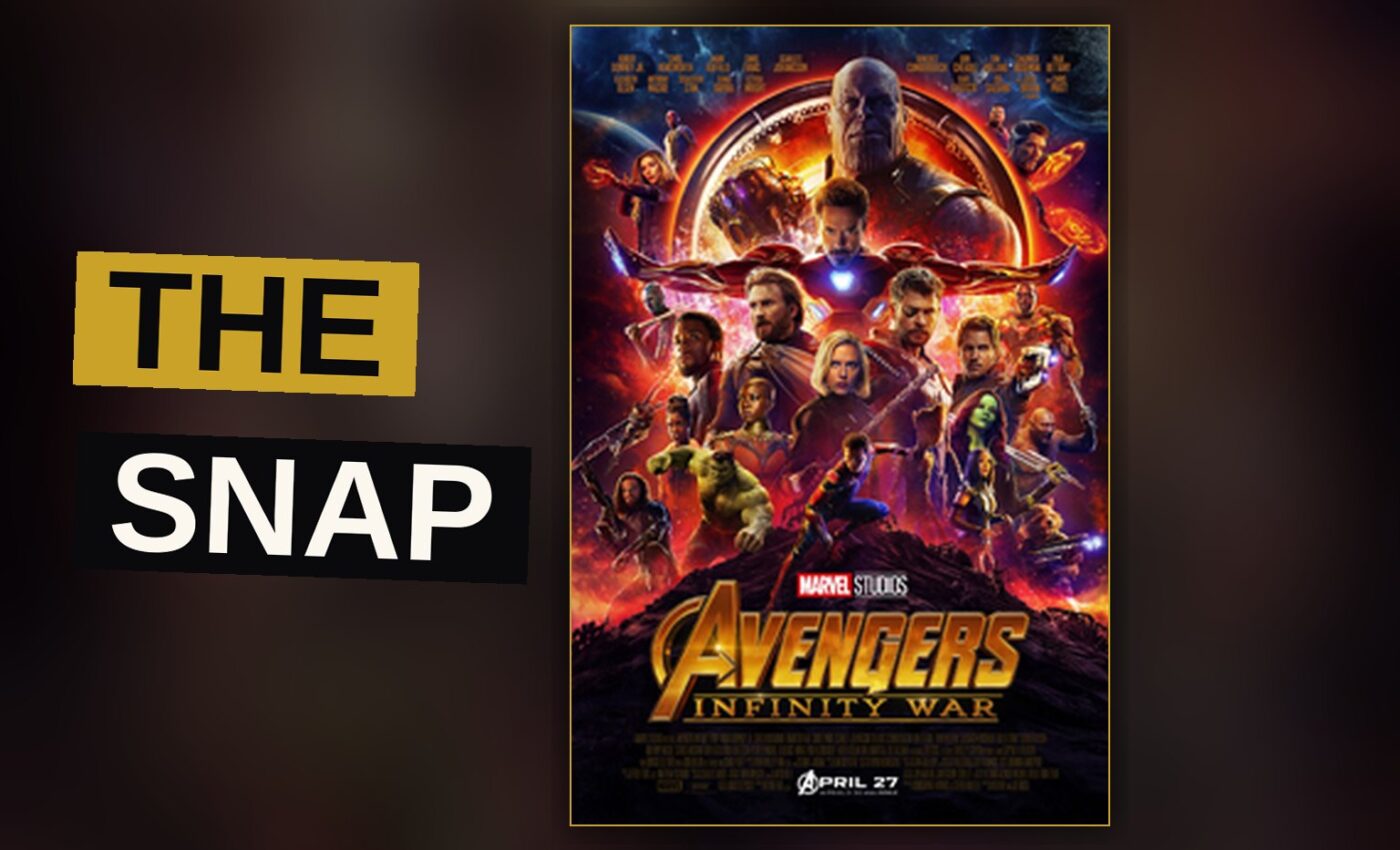
It is the rare blockbuster that earns its scale, but Avengers: Infinity War does more than that. It weaponizes its size, turning a decade of interconnected storytelling into a single, crushing narrative swing. Ten years after Tony Stark first declared himself Iron Man, the Marvel Cinematic Universe finally met a foe worthy of its collective might. The result is a film that plays less like a sequel and more like a reckoning. It is a story about the cost of heroism, and it does not blink.
Thanos, the Mad Titan, has arrived. He is not interested in conquest. He is on a mission to collect six Infinity Stones, artifacts of immeasurable power that, when united, grant their wielder the ability to reshape reality itself. His goal is simple: to wipe out half of all life in the universe with a snap of his fingers. He frames this as merciful salvation from the inevitable suffering of overpopulation. The Avengers, along with the Guardians of the Galaxy and the sorcerers of Kamar-Taj, must stop him.
Trailer, via Marvel Entertainment.
Thanos Makes His Argument
The film’s boldest move is making Thanos its most compelling character. He is not a snarling villain who cackles in the shadows. He is a zealot who believes his own propaganda. The script gives him a philosophical core, a twisted logic that he is willing to sacrifice everything to enact. He is a monster, but he is a monster with a thesis, and the film lets him argue it.
Josh Brolin’s performance, delivered through motion capture, is surprisingly restrained. He speaks in a low, gravelly monotone that suggests a man who has already made peace with the horror he plans to commit. His relationship with his daughter, Gamora, is the film’s tragic centerpiece. He claims to love her, and in his own broken way, he does. That love does not stop him from throwing her off a cliff to secure the Soul Stone. It is a scene of brutal efficiency, a moment that proves the film’s stakes are not abstract.
The heroes, for all their quips and powers, are reactionary. They spend the film scrambling, losing, and failing to communicate. The narrative splits them into three distinct groups, each facing a different facet of the threat. On Earth, a small team defends the Vision, whose forehead holds the Mind Stone. In space, Iron Man, Spider-Man, and Doctor Strange confront Thanos directly on his homeworld of Titan. And on the planet Knowhere, a mining colony built inside a severed celestial head, the Guardians — Star-Lord, Gamora, Drax, and Mantis — hunt for the Reality Stone.
Battle Plans on Titan
The battle on Titan is the film’s intellectual peak. Doctor Strange uses the Time Stone to peer into 14,000,605 possible futures, and he tells Tony Stark that they only win in one of them. He does not share which one. This single detail hangs over the entire film, turning every subsequent decision into a puzzle. Strange’s later surrender of the Time Stone to Thanos, an act that seems like a betrayal, is only logical if he is playing the long game.
The fight choreography here is top-tier. Spider-Man’s agility, Iron Man’s nanotech weaponry, and Doctor Strange’s mystical constructs create a dizzying ballet of desperation. They almost win. They actually manage to restrain Thanos, but a slip from Star-Lord, who learns of Gamora’s death and loses his composure, ruins the plan. It is a moment of human weakness that feels earned, not contrived. Star-Lord is not stupid; he is grieving, and his grief costs the universe everything.
Forging Stormbreaker at Nidavellir
While the Guardians split up, Thor, Rocket, and Groot travel to Nidavellir, the ring-shaped forge where the Asgardian weapons were made. The forge is dead, its star extinguished. Thor must restart it to craft a new weapon, one powerful enough to kill Thanos. The sequence is a gamble. Thor nearly dies holding the star’s beam open, and Groot sacrifices his own arm to complete the weapon’s handle.
The result is Stormbreaker, a battle-axe that can channel the Bifrost. It is not forged on Knowhere. It is forged here, in the cold of space, by a broken god and his unlikely helpers. The scene is a reminder that the film’s geography matters. Knowhere holds the Reality Stone; Nidavellir holds the answer to Thanos. The two are not the same place, and the distinction is central to how the plot moves.
Thor’s arrival on Earth with Stormbreaker is the Wakanda sequence’s climax. He comes down from the sky, a thunderclap of pure catharsis, a moment that suggests victory is at hand. He drives the axe deep into Thanos’s chest. It is a killing blow. Thanos looks at him, smiles, and says, “You should have gone for the head.” He snaps his fingers.
The Wakanda Front
On Earth, the battle is one of attrition. The armies of Wakanda face a horde of alien creatures in a massive open-field engagement. This is the film’s most conventional action sequence, a digital spectacle of clashing forces. But it is anchored by a few key character beats. Captain America finally gets to fight with his bare hands, holding his own against the horde with a raw physicality that the other heroes lack. He is a man with no superpowers, and his refusal to yield is the film’s quiet statement on human will.
The film also gives a quiet moment to Captain America and Black Widow. They are soldiers, and they do not have time to mourn. They keep fighting, even when the battle is lost. Their resilience is the film’s quiet suggestion that the fight is not over. The sequel, Avengers: Endgame, would pick up that thread, but Infinity War does not look ahead. It lives in the moment of failure.
The Snap
The final act is a masterclass in sustained dread. The snap happens, and the film does not cut away. It holds on the survivors as they process the horror. One by one, heroes turn to dust. The first to go is Bucky Barnes, dissolving in Wakanda. The dusting spreads through the battlefield, claiming Black Panther and half of the Wakandan army. On Titan, the deaths come later. Star-Lord, Drax, and Mantis crumble. Doctor Strange goes next. Spider-Man is among the last. He looks at Tony Stark and says, “I don’t want to go, Mr. Stark.” He dissolves.
The silence on the battlefield is deafening.
The film’s closing shot is of Thanos, sitting in a field, watching the sunset. He has succeeded. He has achieved his goal. He looks tired, not triumphant. The film refuses to give the audience a cathartic hero shot. Instead, it leaves us with the villain’s peace. It is a bleak ending for a franchise that has always traded in optimism. It is also the correct ending. The film earns its tragedy by committing to it fully.
A Decade of Setup Pays Off
Avengers: Infinity War relies heavily on the audience’s investment in a decade of prior movies. It does not waste time on introductions. When Thor references the death of his sister, Hela, from Thor: Ragnarok, the film trusts that you remember. When the Guardians meet the Avengers for the first time, the comedy comes from the clash of their distinct tones. The film is a convergence, and it plays like one.
This is both its strength and its weakness. For the uninitiated, the film is a wall of noise. There are too many characters, too many subplots, and too much history. The film does not care about your confusion. It is a movie made for the faithful, and it rewards their devotion with a dense, layered narrative. The script, credited to Christopher Markus and Stephen McFeely, is a structural marvel. It juggles a cast of over thirty speaking roles without losing a single character’s voice.
The directors, Anthony and Joe Russo, have a firm grip on the tonal shifts. The film is funny, but the jokes are never allowed to deflate the tension. It is sad, but the sadness is never maudlin. It is a film that knows exactly what it wants to feel like, and it executes with precision. The visual effects are largely seamless, though the sheer amount of CGI does occasionally blur the line between actor and digital double. The film’s sound design, particularly the thud of the snap, is impactful.
Stones and Their Order
The six stones are the film’s MacGuffins, but they are also a narrative device. Each stone grants a specific power, and the film uses them to create a sense of escalating threat. The order of acquisition matters.
| Stone | Power | Acquired |
|---|---|---|
| Power Stone | Devastating physical force | Xandar, before the film begins |
| Space Stone | Teleportation across the universe | Aboard the Statesman |
| Reality Stone | Alter matter and illusion | Knowhere |
| Soul Stone | Requires a sacrifice of love | Vormir |
| Time Stone | Control over time | Titan |
| Mind Stone | Final piece, torn from Vision | Wakanda |
- Power Stone: Lets Thanos overpower the Hulk in the opening scene, having already acquired it off-screen on Xandar.
- Space Stone: Makes him omnipresent, able to strike anywhere.
- Reality Stone: Used to trick the Guardians with illusions.
- Soul Stone: Forces Thanos to kill Gamora, his daughter.
- Time Stone: Reverses Vision’s destruction.
- Mind Stone: The final piece, torn from Vision’s head.
The film’s structure is a checklist of these acquisitions. Each scene moves Thanos closer to his goal, and the heroes are always one step behind. It is a relentless forward march, and the pacing is relentless. The runtime of 149 minutes flies by.
The Human Element
For all its cosmic scale, the film’s best moments are intimate. The relationship between Tony Stark and Peter Parker is the film’s emotional anchor. Tony sees himself in the boy, and he is terrified of losing him. When Peter dies in his arms, Tony’s grief is palpable. He is a man who has spent his life building armor to protect himself, and it is useless.
A Bleak Masterpiece
Avengers: Infinity War is not a perfect film. Its reliance on prior knowledge is a barrier to entry. Its villain, while compelling, is given more screen time than some of its heroes, leaving characters like Captain America and Black Widow feeling underutilized. The film’s tone is unrelentingly grim, and it offers little relief. But these are not flaws; they are choices. The film is a tragedy, and it commits to that tragedy with a sincerity that is rare in franchise filmmaking.
It is a superhero movie that understands that power is not a solution, but a burden. It is a blockbuster that trusts its audience to sit with discomfort. It is a film that ends with half of its cast dead, and it does not apologize for it. In a genre that often feels weightless, Avengers: Infinity War has gravity. It is the rare event film that feels like an event, and it earns its place as a cultural milestone.
It is a story about the price of everything, and it is willing to pay it. It is a remarkable piece of popular art, and it lands with the force of a snapped finger. It earns a score of 8.2/10.