
AMD’s stock has done something almost no one on Wall Street expected two years ago. It has become a credible second source for the AI compute buildout, with Data Center revenue up 107% year-over-year and a 6GW GPU deal with OpenAI on the books.
Shares are already up 113.42% year to date. The question investors keep asking is simple: can this run keep going, and can AMD hit $700 in 2027?
Why Shares Stalled After a Blowout Quarter
AMD is down 4.96% over the past week and 5.69% over the past month, even after a strong Q2. Some of that is profit taking after a 181.58% one-year gain. Some of it is valuation anxiety.
And some of it is the Gaming segment, which declined 31% year over year to $779 million and continues to weigh on the story.
The thesis remains intact; the market simply wants proof.
With a beta of 2.489, this stock moves violently in both directions. Add in export controls on AI accelerators, memory supply constraints, and tariff risk, and it is not surprising that shares needed to digest after doubling.
The pullback does not change the underlying setup. The Data Center business is growing at a pace that few companies in the semiconductor industry can match. The question is whether the rest of the business can stop dragging on the story long enough for investors to focus on what matters.
The OpenAI Deal Behind the Data Center Surge
The core of the AMD story is the Data Center business. Revenue there jumped 107% year-over-year, anchored by a 6GW GPU deal with OpenAI. That deal makes AMD a genuine alternative supplier in the AI chip market, a position that seemed unlikely two years ago when Nvidia dominated the conversation.
The OpenAI deal is not just a revenue win. It is a signal to the rest of the market that AMD can win marquee customers. When a leading AI lab chooses AMD for a 6GW GPU deployment, it tells other hyperscalers and enterprises that AMD is a viable option, not a fallback.
The stock’s one-year gain of 181.58% reflects that shift. But the recent pullback shows that momentum alone is not enough. Investors want to see the earnings follow the hype.
Wall Street’s Bullish Consensus
The Street is unusually aligned on AMD. The coverage breaks down like this:
- Five strong buys
- Thirty-six buys
- Ten holds
- Zero sells
- An average target of $613.84
That is 80% bullish coverage. The consensus target of $613.84 implies roughly 34% upside from current levels.
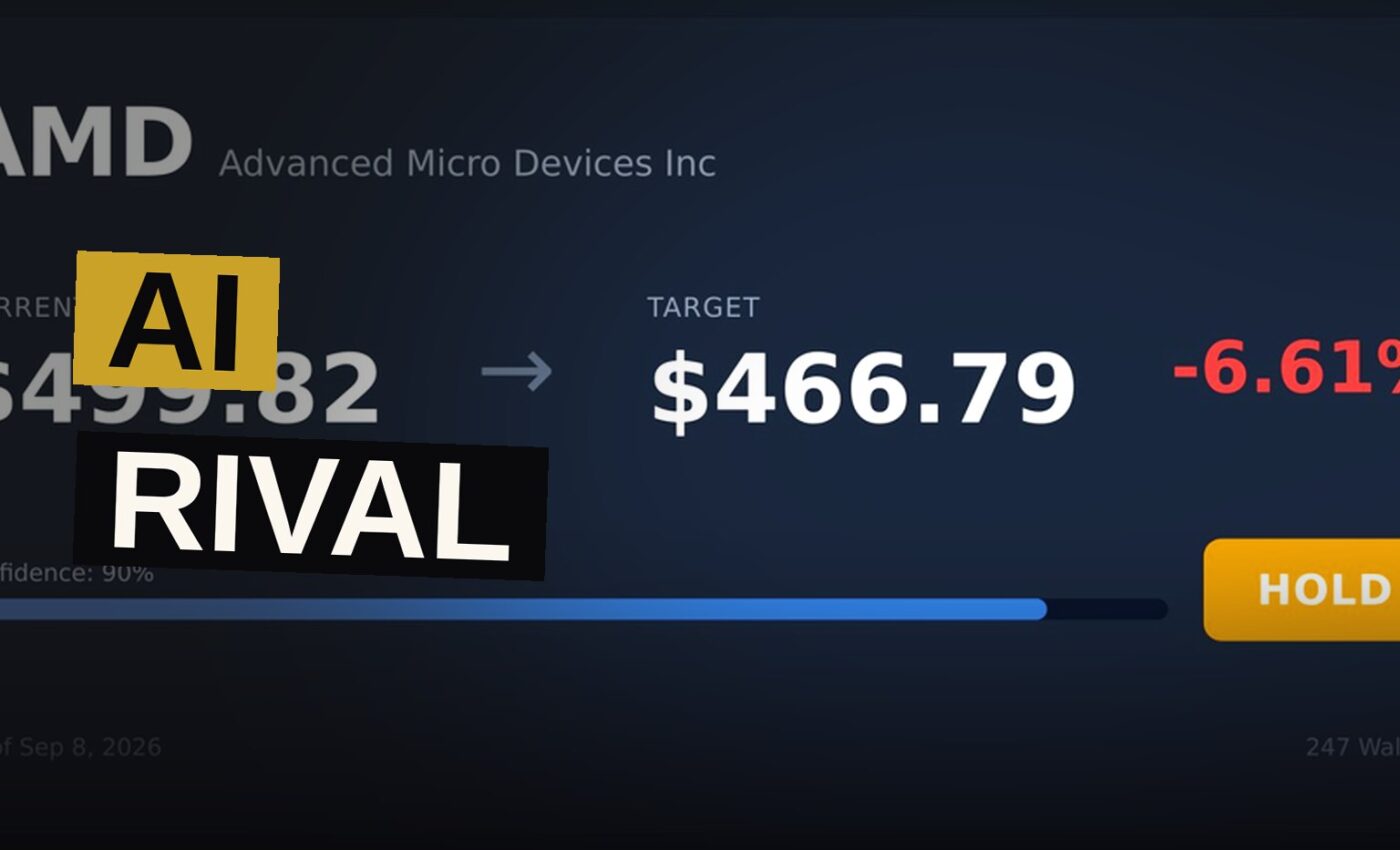
But the publication’s own model sees more room. It lands at a base case of $622.36 and an optimistic case of $645.23. The model also includes a bear case, set at $475.94.
The thinking is that the consensus is still slightly behind the earnings curve. The FY27 EPS estimate has climbed from $12.959 ninety days ago to $15.450 today, with 33 upward revisions in the last 30 days and only two down. That is the kind of revision pattern that precedes target hikes, not target cuts.
What makes this revision pattern notable is the speed. Ninety days is a short window for an EPS estimate to move by more than $2.50.
The Path to $700 and the Risks Ahead
Hitting $700 by 2027 requires clean execution on the Helios project and FY27 EPS near $20. That is a target Lisa Su has already flagged as achievable.
The revision trend supports the optimistic case. When analysts revise earnings estimates upward at this pace, price targets tend to follow. The question is whether AMD can deliver the operational results to match.
The risks are real. Export controls on AI accelerators could limit the addressable market. Memory supply constraints could slow production. Tariff risk adds another layer of uncertainty. And the Gaming segment’s 31% decline shows that not every part of the business is firing.
Still, the Data Center growth is the story that matters. A 107% year-over-year increase in that segment, with a marquee OpenAI deal attached, gives AMD something Nvidia does not have: a credible second-source position in the AI buildout.
What Investors Should Watch Now
AMD has the momentum, the analyst support, and the Data Center growth to justify its current price. The FY27 EPS revisions suggest the earnings story is still improving. The path to $700 exists, but it runs through Helios execution and near-$20 EPS.
The stock is not for the faint of heart. With a beta of 2.489, it moves hard in both directions. But for investors who believe the AI buildout needs more than one supplier, AMD is the clearest alternative play on the board.
The recent pullback looks like digestion after a massive run, not a broken thesis. The market simply wants proof. If AMD delivers on Helios and keeps the Data Center momentum going, the $700 target is within reach. If it stumbles, the bear case is the floor to watch.
The next few quarters will tell the story. The analyst revisions are already pointing in the right direction. The OpenAI deal provides the anchor. The Data Center growth provides the engine. What remains is execution on Helios and the broader earnings trajectory that gets AMD to that $20 EPS figure by FY27.
For now, the setup is as good as it has been in years. The stock has proven it can run. The question is whether it can keep running long enough to make $700 a reality rather than a target on a screen.
Source: finance.yahoo.com
Get the Notebook.
The day's best stories and every fresh verdict, in plain English, in your inbox by seven. One email a day, no more.