
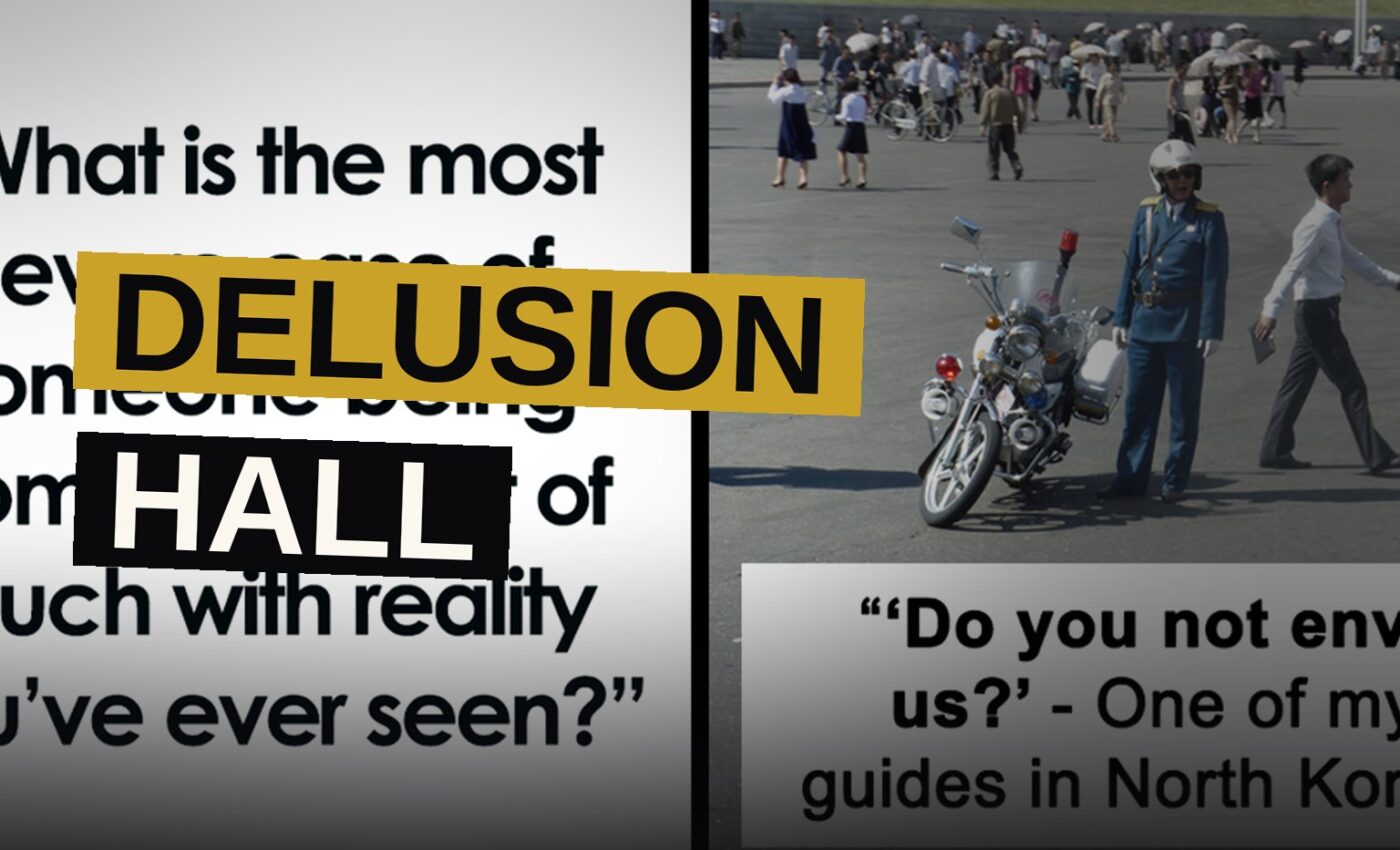
A Reddit thread asking for the most delusional things people have heard others say has drawn responses ranging from a man avoiding Asian people during the pandemic despite being Asian himself to a CEO who thought hiring three nannies was a relatable struggle for her middle-class employees.
The thread, posted by user mouldygoldie on the Ask Reddit subreddit, asked for the most severe cases of “people being completely out of touch with reality.” The answers were collected by the website Bored Panda, which also interviewed psychologist Dr. Jim Taylor about why people hold onto wrong beliefs so firmly.
The Asian Man Avoiding Asian People
One of the most striking stories came from a user whose brother announced he was avoiding Asian people on the street “for safety because of the coronavirus.”
The problem? The brother is Asian. The entire family is Asian.
“My brother told me ‘I’m avoiding Asian people if I see them on the street or anything. You know, for safety because of the coronavirus.’ He’s Asian. Our entire family is Asian,” the user wrote.
The story shows how fear can override logic even when the person holding the belief is the target of that fear.
The Flat Earther Who Denied Space
Another user described working with a woman who believed the Earth is flat and went further, denying the existence of space entirely.
When the topic came up at work, the user disagreed. The coworker responded by asking if the user had ever been to space. The user had not.
“I told her I have also never been to Japan and that does not mean it doesn’t exist,” the user wrote. “She complained to management about my intolerance of her beliefs.”
The incident shows how some people treat their perceptions as facts and react badly when challenged.
The CEO and Three Nannies
One of the most detailed stories came from a former employee of a Boston software company. The company allowed flexible hours, with many staff working from home regularly. Parents could drop their kids at school, arrive by 9:30, or leave early depending on childcare needs.
Then a new CEO arrived. After a month of observation, she called a company-wide meeting and announced that a full office from 8 to 5 was the most productive environment. All work-from-home was canceled. No late arrivals. No early departures.
Employees pushed back. They raised several objections:
- The lack of warning before the policy changed
- The need for flexibility around childcare
- The difficulty of arranging school pickups and drop-offs
- The burden of commuting into Boston
The CEO listened to all of it. Then she responded with a speech about sacrifice and doing one’s part. She ended with this: “I understand where you’re all coming from! Years ago when my kids were little, my husband and I had to hire three nannies to cover all of the times we had to work!”
The room went silent. The user realized it was time to look for another job.
“When the millionaire CEO thinks hiring 3 nannies is a relatable example to her middle class employees, it’s pretty clear she’s not going to change her mind,” the user wrote.
A Family Belief About Skin Color
Another user described a family belief that God marks people by their souls. According to this belief, people with good souls are white, and the implication for everyone else was clear.
The user tried to argue that white people also do terrible things. The family’s response was that those white people are “lost souls that will eventually find their way.” Meanwhile, they believed a non-white person would never find their way, even if they acted as if they had.
“The level of delusion this takes is one of the most frightening things to me,” the user wrote.
Why People Believe Wrong Things
Bored Panda reached out to Dr. Jim Taylor, a psychologist and author, to ask why humans can be so confident in wrong ideas. His answer pointed to evolution and identity.
“Human beings are wired through evolution to seek safety, comfort, and certainty,” Taylor said. “To change one’s beliefs, even in the face of clearly contradictory evidence, disrupts that those three attributes. Additionally, psychologically and emotionally, it is threatening to our self-identity (e.g., as a competent person) and our self-esteem (e.g., how we feel about ourselves) to have to admit that we are wrong about something, particularly beliefs that we hold dear (e.g., religion, politics).”
Admitting a mistake feels like a threat to who we are. Changing a belief, especially one tied to identity, is not just an intellectual shift. It is an emotional one.
Taylor also addressed whether everyone experiences reality differently. His answer was nuanced: humans are alike in brain structure and function, but perception is filtered through personal experience.
“Actually, humans experience reality much the same because we are all very much alike in terms of our brain structures and functions,” Taylor said. “However, we perceive reality through the lenses of past experiences, attitudes, beliefs, needs, goals, and social feedback. That is where so-called reality can differ.”
This means two people can look at the same event and walk away with different interpretations. Each believes their version is accurate. Neither is lying. Both are filtering through their own history.
Perception Is Not Reality
In a Psychology Today piece titled “Perception Is Not Reality,” Taylor laid out the difference between the two concepts. Perception, he wrote, is “the way of regarding, understanding, or interpreting something; a mental impression.” Reality is “the world or the state of things as they actually exist… existence that is absolute, self-sufficient, or objective, and not subject to human decisions or conventions.”
The distinction matters. A perception can feel completely real. It can shape decisions, behavior, and relationships. But feeling real is not the same as being real.
The Reddit thread is entertaining to read, but it points to something more serious. People go about their daily lives with warped views of the world, and those views have consequences. A CEO’s bad decision affects her employees. A coworker’s denial of space affects workplace relationships. A family’s belief about skin color affects how they treat their own relatives.
The stories show a pattern. In each case, the person holding the wrong belief was not open to correction. The flat earther complained to management. The CEO dismissed all arguments. The family dismissed counterexamples.
People do not change their minds easily. Taylor’s explanation suggests why: change feels unsafe, uncomfortable, and uncertain. It threatens self-image.
The Reddit thread offers a window into that stubbornness. It is funny to read from a distance. It is less funny when the person with the wrong belief is your boss, your coworker, or your family member.
Bored Panda gathered the selection of examples from the thread, and each one is a reminder that confident ignorance is everywhere. As one user put it, the level of delusion required for some of these beliefs is frightening.
Source: boredpanda.com