
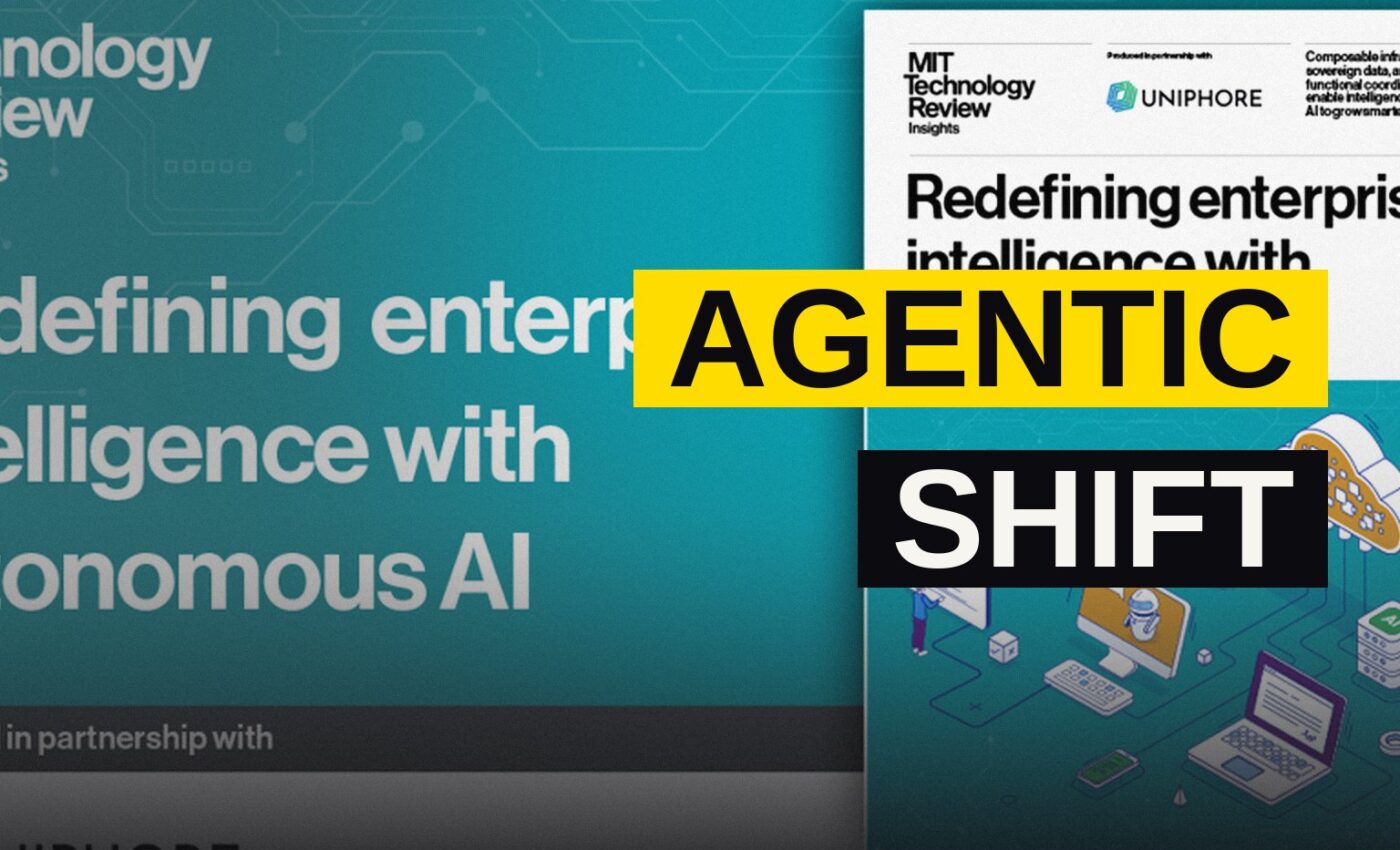
The sponsored report Redefining Enterprise Intelligence with Autonomous AI, released through Insights, MIT Technology Review’s custom content arm, makes a simple argument: enterprise AI has already taken off. It is not some distant aspiration anymore; it is running at full operational pace right now. The report’s central thesis is that the move from AI as a mere tool to AI as the very foundation of how a company operates — what it refers to as the “agentic shift” — requires a total reconfiguration of how businesses join people, processes, and data together.
The stakes are high. Global AI spending is set to reach $2.5 trillion in 2026, up 44% from the previous year. Model capabilities are advancing faster than most organizations can absorb, while the cost of performance continues to fall. But the report warns that this investment has produced fragmentation, with intelligence accumulating in silos across functions.
The Fragmentation Problem
The report identifies a recurring problem. Sales representatives often do not know about open support tickets. Marketing tools personalize content without knowing what finance already knows about a customer. Every individual department can work well on its own, yet the company as a whole fails to learn much and has less information available for action.
The issue runs deeper than simple irritation; it is a foundational flaw that holds up decisions and consumes valuable assets. The consequences are not abstract. When salespeople cannot see a customer’s recent service history, they may make duplicate offers or miss opportunities entirely. When marketing pitches personalized content without knowing a customer’s financial standing, the personalization loses its edge and becomes noise. These small gaps accumulate into larger failures of coordination, with the company as a whole failing to learn much from its own operations and having less information available for action.
What the Agentic Shift Demands
What the report calls for is not merely improved models or quicker infrastructure, but a real-time bond between people, processes, and data, paired with governance and control that make acting on that intelligence reliable. The demand, it says, is to rethink architecture and operating models together, at once.
There are three key moves:
- Rebuilding data infrastructure for accessibility rather than volume.
- Replacing fixed tech stacks with composable architectures that can evolve as models and tools change.
- Resolving questions of AI sovereignty, including where intelligence runs, who controls it, and how it operates across organizational and jurisdictional boundaries.
Data Readiness Over Data Abundance
The report draws a clear line between owning data and owning AI-ready data, and most companies find out too late how wide that gap actually is. A foundation that lets you query and prepare data where it sits, without moving it or gathering it centrally, turns raw data holdings into something AI agents can actually use.
Centralization has become harder to achieve due to data residency laws, multicloud environments, and the sheer complexity of IT systems. Sovereignty — keeping control over where models run and data resides — is what preserves adaptability instead.
Why the Sovereignty Question Matters
At the heart of the report’s argument sits the issue of AI sovereignty. It is concerned with the physical location where intelligence runs, the parties who control it, and the manner in which it functions across organizational and jurisdictional lines. These are not theoretical matters. They decide whether an organization can rely on its own judgments.
According to the report, most businesses are not increasing revenue via AI or fundamentally changing how they run. Those companies that are outperforming others follow a shared approach: they treat process redesign as the work that comes before choosing models, and they build systems with an eye toward how the technology will develop rather than fitting roles and workflows to them afterward.
Key Findings From the Report
The findings laid out in the report center on what the agentic shift actually means for companies. Rather than being a fixed end point, it is described as a mode of operation. Those organizations that overlook the fragmentation issue will keep wasting resources. By contrast, those that tackle it stand a chance to gain access to and act upon more information.
The document also notes a surge in startups pursuing the next major development in LLMs, with newcomers trying to catch up to the AI giants. This competitive environment puts pressure on existing firms to act quickly.
The Limitations of the Report
MIT Technology Review’s custom content arm, Insights, put together the report. Humans researched and wrote it, with any AI tools involved limited to production processes overseen by people.
This document concentrates on enterprise architecture instead of the wider discussion around AGI and reward hacking, both of which are covered under separate sections on the MIT Technology Review site, labeled “Deep Dive.”
What This Means for Practitioners
The guidance from the report is straightforward. Businesses should begin by tackling fragmentation, followed by establishing a base of accessible data, composable architectures, and sovereign control. While the document provides no detailed plan, it clearly indicates where organizations should be heading.
Process redesign is what the report stresses matters most. It says firms ought to regard it as the groundwork that comes before choosing a model, shaping how the technology will develop instead of fitting roles and workflows around it after it has been put into use.
The Bottom Line
The document builds a strong argument for a wider approach to enterprise AI. It contends that the shift toward agency goes beyond merely improving models or speeding up infrastructure. Rather, it concerns linking people, processes, and data in real time, along with the governance and control needed to dependably act upon that intelligence.
A clear direction exists, even if the underlying problem remains structural. The report offers a practical starting point for organizations looking to scale their AI efforts, with its three-part framework of accessible data, composable architectures, and AI sovereignty providing a concrete foundation for doing so.
This report comes with sponsorship. The main case it makes is that division stands against true intelligence, and that fixing architecture and operating methods is the way to move forward. That point is worth weighing.
Businesses that overlook the fragmentation issue will keep wasting resources. Those that tackle it will get a chance to learn from and respond to more data. The move toward agents is not an end point. It is a manner of working.
Source material: “Redefining enterprise intelligence with autonomous AI,” MIT Technology Review.
Get the Notebook.
The day's best stories and every fresh verdict, in plain English, in your inbox by seven. One email a day, no more.