
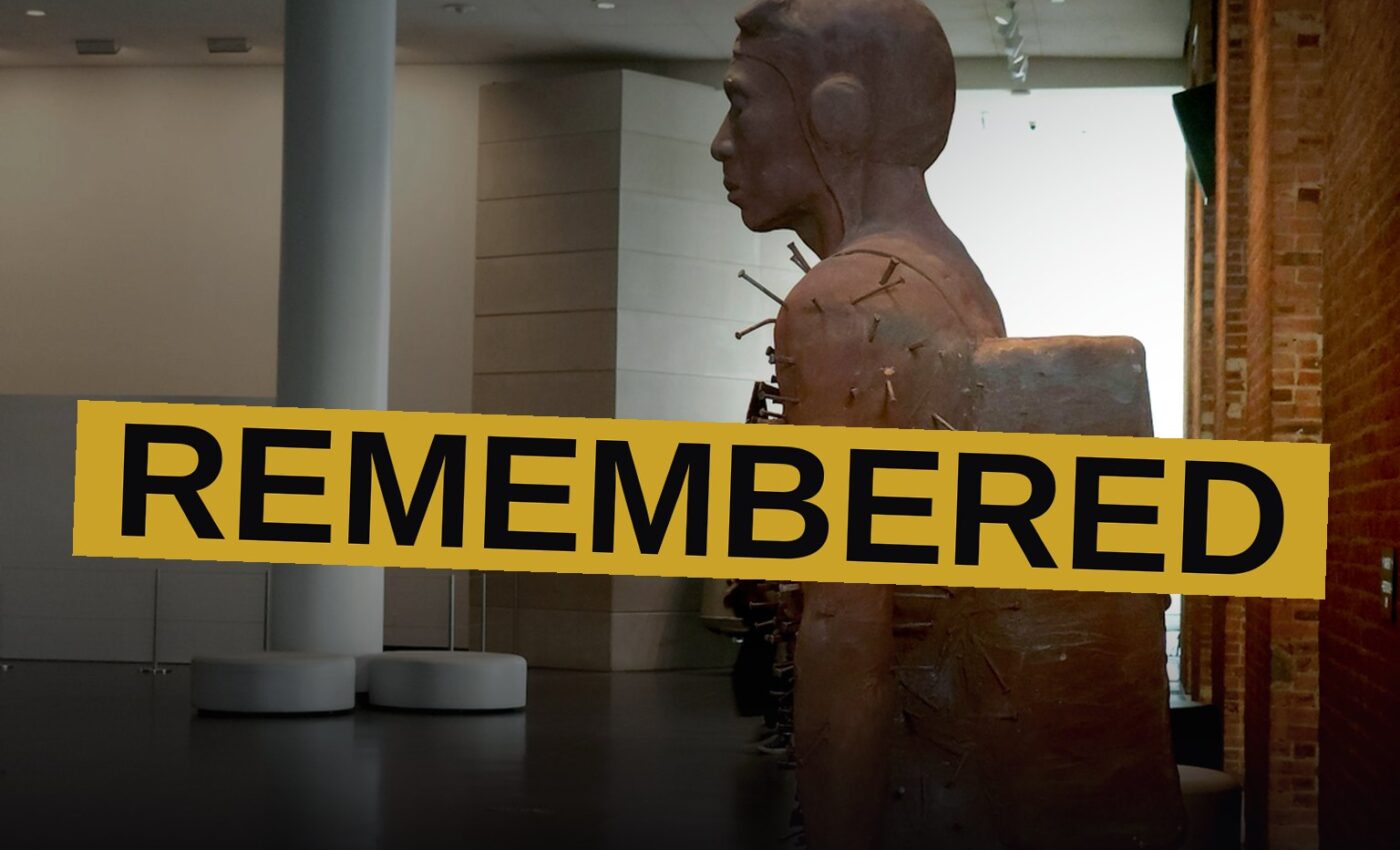
The Brooklyn Museum has placed a sculpture by Michael Richards, an artist killed in the September 11 attacks, on public display in its lobby. The work, “Free F’All” (1997), is the only piece by Richards in the museum’s collection. It marks the 25th anniversary of the attacks that took his life.
Richards was in his studio on the 92nd floor of the World Trade Center’s North Tower when the first plane hit. He was 38 years old. No one above the 91st floor survived, and his remains were never recovered from Ground Zero.
The Sculpture and Its Subject
“Free F’All” is made of fiberglass and resin, coated in rust oxide. It shows a Black military pilot with closed eyes, arms pinned to his sides, and a slight bend in his right knee. He wears a parachute pack and an aviator’s cap. Dozens of nails pierce his body from collarbone to mid-thigh, down his arms, and through his hands and feet.
The sculpture references the Tuskegee Airmen, the first African American aviators to serve in the United States armed forces. The nails represent the racial discrimination and violence those pilots endured while segregation was still enforced in the US military during World War II.
A Curator’s View
Kimberli Gant, the museum’s curator of modern and contemporary art, organized the sculpture’s reemergence. She spoke with Hyperallergic about what the piece means.
“Richards’s career was cut so short, so it’s wonderful that the museum has this sculpture and that his legacy is really living on through his work,” Gant said.
Why the Work Endures
Richards was a Caribbean-American artist whose practice linked aviation to Black freedom. “Free F’All” carries a double weight: it addresses the Tuskegee Airmen and the discrimination they faced, and it now sits in a museum lobby decades after it was made.
The sculpture’s placement in the lobby makes it visible to every visitor. It honors the Tuskegee Airmen, whose service and suffering he addressed in his art.
The Details That Matter
- The sculpture depicts a Black military pilot in full aviator gear.
- Dozens of nails pierce his body, symbolizing racial violence.
- The pilot references the Tuskegee Airmen of World War II.
- Richards died in the North Tower on September 11, 2001.
- The Brooklyn Museum now displays the work in its lobby.
One important detail: the nails in the sculpture are not decorative. They are the point.
Richards made them to show what Black pilots faced. The work stands for both the Tuskegee Airmen and the loss of the artist himself.
The sculpture is a quiet, powerful presence in a busy museum.
Source: hyperallergic.com
Get the Notebook.
The day's best stories and every fresh verdict, in plain English, in your inbox by seven. One email a day, no more.