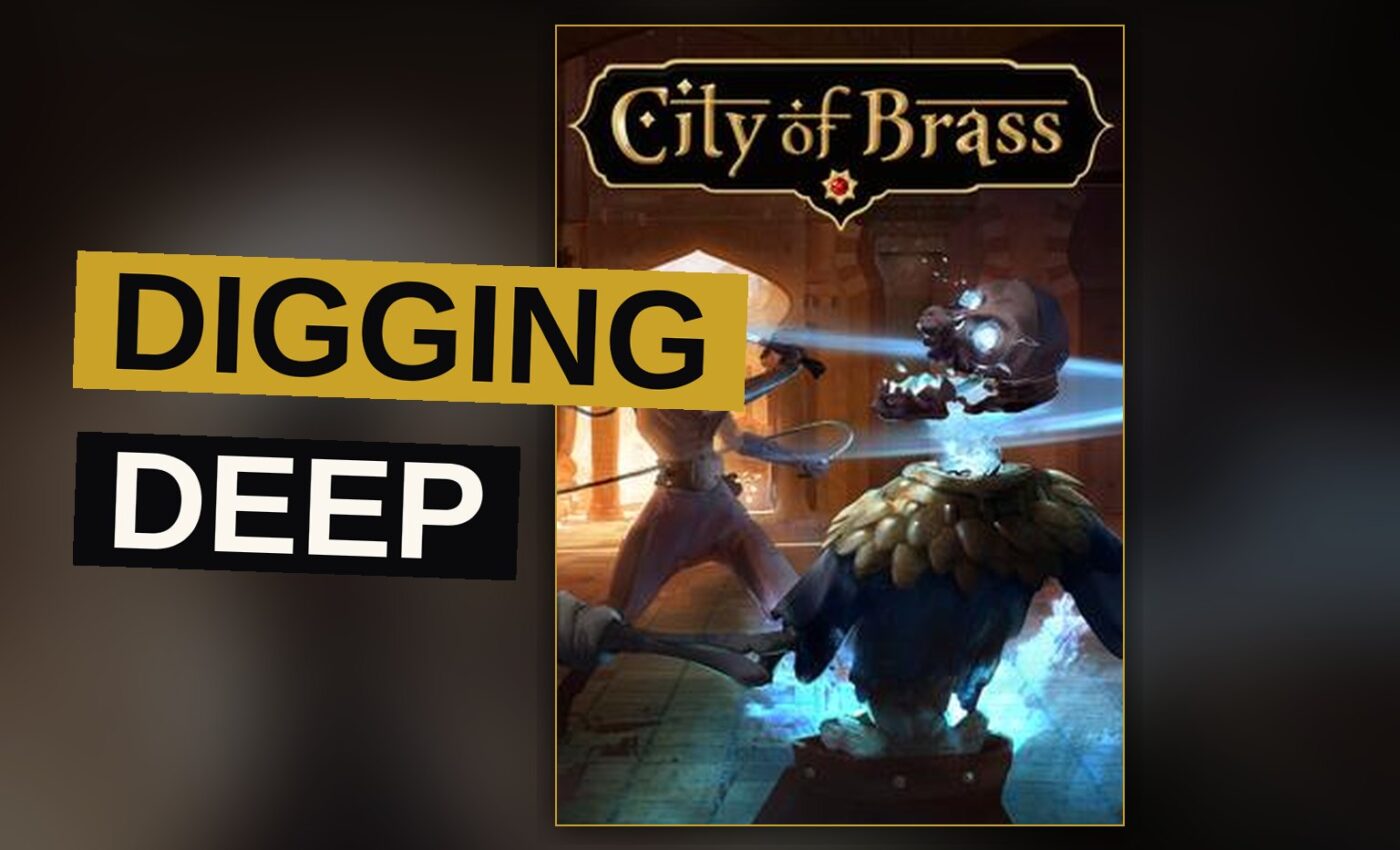
City of Brass asks you to be a thief with one ambition: reach the treasure at the heart of a mythical city. Uppercut Games built that city out of interconnecting corridors, courtyards and rooms that shift every run, then filled it with traps and enemies that punish every greedy step. The critical aggregate settled at 6.8 out of 10 across eight outlets. That number is fair. City of Brass has a genuinely clever whip and a genuinely thin game wrapped around it.
Trailer, via IGDBcom.
A Scimitar in the Right Hand, a Whip in the Left
The pitch is clean. You play a thief, first-person, armed with a scimitar and a whip. The scimitar slashes. The whip does nearly everything else, and Uppercut confirmed the design in an interview: grab objects, trip enemies, disarm them, stun them, shatter barricades, trigger traps and switches, and swing.
That is a lot of verbs for one button, and it is the best idea in the game. The developers said the systems are built to be combined in imaginative ways. Their own examples: stun an enemy with the whip, then slice with the scimitar; slide into an enemy to push it into a trap; bait one enemy so that as it closes in to kill you, it destroys other enemies nearby.
The City Shifts, the Clock Does Not Stop
City of Brass is a rogue-lite, and the structure is the familiar one. Each level has a time limit. You move through it, avoid dying, collect treasure to raise your score, and reach the end. Death is permanent, so every playthrough starts over.
The setting is drawn from the Arabian Nights: sunlit courtyards, shadowed rooms, winding corridors, all procedurally generated. The city is the reason to look, and the whip is the reason to keep moving.
Bricks, Vases and Ten Updates
Items in the environment work as weapons. Bricks. Vases. The source describes no deeper arsenal than that.
Uppercut announced City of Brass on 6 July 2017 for Microsoft Windows, PlayStation 4 and Xbox One. The Windows version hit Steam Early Access on 18 September 2017. From Early Access onward the studio shipped 10 updates, adding environments, enemies, weapons and relics, and adjusting balance based on community feedback.
What the Whip Buys You
Here is the comparison that matters most for anyone deciding whether to buy in. City of Brass gives you two tools, and they are not equal.
| Tool | What it does | Where it falls short |
|---|---|---|
| Scimitar | Slashes enemies in close combat | One job, and the whip often sets it up |
| Whip | Grabs objects, trips, disarms, stuns, shatters barricades, triggers traps and switches, swings | Carries nearly every system, so mastery is mandatory |
| Environment items | Bricks and vases used as weapons | Limited to what you find in the level |
The whip is the game. If the whip does not click for you, nothing else will carry the run.
The Traps Are the Real Enemy
The source is clear about what the city throws at you, and the threats are not equal in kind.
- Traps. They are everywhere, and the procedural layout means you cannot learn them.
- The time limit. It forces you forward, into the traps.
- Enemies. Ghoulish, dangerous, and often useful, since you can bait them into each other.
- Treasure. It raises your score, and collecting it costs you time.
The enemies are the most interesting item on that list and the least threatening. Once you understand that a closing enemy can destroy its neighbors, the combat stops being a fight and becomes a puzzle with a body in it.
Where 6.8 Comes From
The score is not a knock on ambition. City of Brass is a first-person rogue-lite with a mechanic no one else built, in a setting games rarely touch, from a studio that shipped 10 updates after Early Access. That should be better than 6.8.
It is 6.8 because the ambition is not matched by the run. The whip is not the problem. The whip is the reason to play. The problem is that everything the whip touches is thinner than the whip itself. The scimitar is fine. The whip is the reason.
What Uppercut Got Right
The 10 post-Early Access updates are the most encouraging fact in this game’s history. Environments, enemies, weapons, relics, balance. Uppercut Games is an Australian independent studio, and it kept working on a game that scored 6.8.
City of Brass is worth a look for the whip alone. The source describes a thief, a clock, a shifting city and a pile of treasure at the end of it. That is the whole pitch, and the whip is what makes it more than a pitch.
Get the Notebook.
The day's best stories and every fresh verdict, in plain English, in your inbox by seven. One email a day, no more.