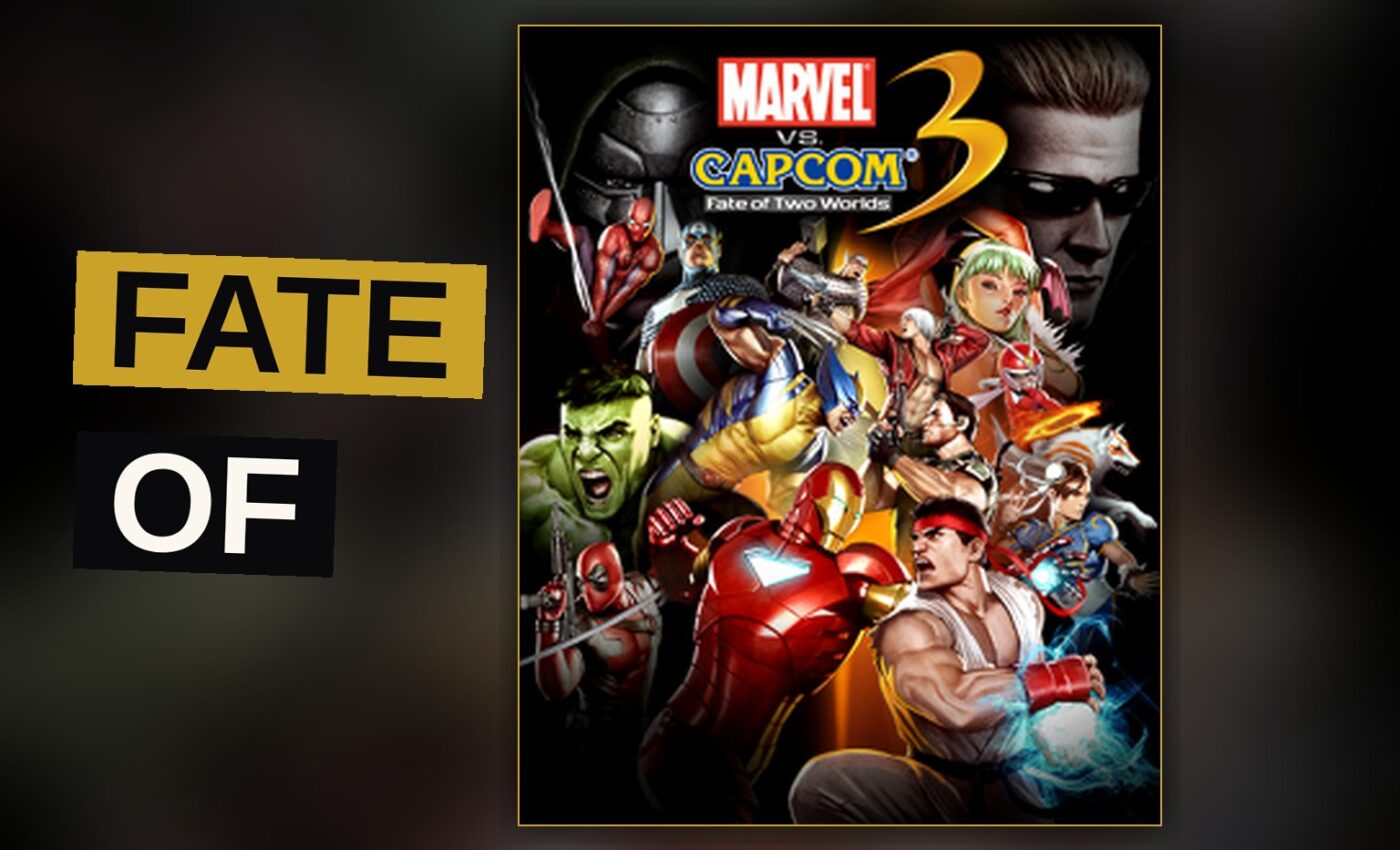
Marvel vs. Capcom 3: Fate of Two Worlds arrived in February 2011 on PlayStation 3 and Xbox 360, and it did the one thing a crossover fighter cannot afford to get wrong. It let you put three characters on a team and then made you care which three. Capcom developed the game with Eighting and published it, and it stands as the fifth entry in the Marvel vs. Capcom franchise. It is also the first in the series to drop two-dimensional sprites in favor of three-dimensional character models. That shift matters, but it is not the reason this game still holds up. The reason is the fighting.
Trailer, via Jac Rios.
Three Characters, One Life Gauge
The core loop is simple to state and hard to master. Players pick a team of three and fight one-on-one, switching between characters at any point in the match. You win by draining the opponent’s life gauge and beating the entire enemy team, or by holding the most cumulative health when time runs out. The tag system carries over from earlier games in the series, but Capcom added new methods of play meant to open the game up to people who had never touched a versus fighter.
That accessibility push is the smartest decision in the package. Marvel vs. Capcom 2: New Age of Heroes split its attacks across four buttons, two pairs of low and high-strength punches and kicks. Marvel vs. Capcom 3 cuts that to a simplified three-button scheme of light, medium and heavy attacks, modeled after Tatsunoko vs. Capcom. The stated aim was to knock down the wall of complicated controls and open up the field of strategic fighting.
Ryota Niitsuma and the Three-Button Bet
Producer Ryota Niitsuma had worked on Tatsunoko vs. Capcom: Ultimate All-Stars before this, and he brought its control philosophy with him. That is a real risk in a legacy franchise. Strip buttons from a series built on execution, and the veterans howl. But the three-button layout does not flatten the game. It relocates the difficulty. You stop fighting the controller and start fighting the matchup.
The assist system is where that pays off. During combat you can call in one of your off-screen characters to perform a single special move. That one button press is the difference between pressure and a punish. It also means your team composition is a live decision, not a menu choice you make once and forget.
Hyper Combo Gauge and What It Buys
As characters deal or receive damage, the team’s Hyper Combo Gauge fills with energy. Players spend that energy on three techniques the source lays out clearly:
- Hyper combos, stronger versions of special moves
- Snapbacks, which force the current opponent off screen and replace them with a teammate
- Crossover combinations, which summon your entire team to fire their hyper combos at once
That is a tight economy. Every snapback is a hyper combo you did not get to use. Every crossover combination is a bet that you can close the round before the gauge refills. The game asks you to spend a shared resource across three characters, and that single design choice does more for tension than any visual upgrade.
The 2.5D Question
Marvel vs. Capcom 3 renders its cast with three-dimensional models, but gameplay stays locked to two dimensions. The result is a 2.5D graphical design, and it is the right call. The camera holds a side view, the fighting plane never wobbles, and the models get to carry detail that sprites could not. This is the first entry in the franchise to make that jump, and it lands.
What the shift does not do is change how the game reads. You still need to see the startup of an attack, the gap in a block string, the moment an assist is vulnerable. Three-dimensional models can clutter that information if a studio gets greedy with camera movement. Capcom did not. The side view stays honest.
A Roster Built for Arguments
The character roster draws from both Capcom’s video game franchises and the comic book series published by Marvel Comics. That is the whole premise of the franchise, and this entry executes it with a cast broad enough to start fights at the select screen. Critics praised the roster when the game launched, and they were right to.
Where the game drew fire was its online component. Reviewers knocked the lack of features and game modes, and that criticism holds up. A fighting game lives or dies on what you do after the credits, and Marvel vs. Capcom 3 shipped thin in that department. The fighting was there. The scaffolding around it was not.
Two Million Units and a Fast Sequel
The commercial story is not ambiguous. More than 2 million units shipped worldwide a month after the game’s debut, which made it a commercial success by any measure Capcom needed. Less than a year after release, Capcom announced an updated version titled Ultimate Marvel vs. Capcom 3. That standalone update arrived in November 2011 with additional characters, stages and gameplay tweaks.
Read that timeline again, because it is the most revealing fact about this game. A full-priced follow-up landed nine months after the original. Players who bought in during February 2011 were looking at a paid revision before the year was out. That is not a knock on Ultimate, which delivered more of what people wanted. It is a knock on how the base game was positioned. The features and modes that critics flagged as missing did not get patched in. They got resold.
That pattern has not aged well. It is the clearest reason to weigh this release differently now than reviewers did in 2011.
What Still Holds
Strip away the release strategy and the online shortcomings, and the core remains excellent. The three-button scheme gives new players a real entry point without gutting the depth that veterans expect. The assist calls create constant, readable decisions. The Hyper Combo Gauge forces teams to share a resource, which means every character on your squad is making a claim on the same pool. The 2.5D presentation gave the franchise a visual identity it could build on.
The roster is the other durable asset. A crossover fighter is only as good as the arguments it starts, and this one starts plenty. Pairing Capcom’s video game characters against Marvel’s comic book characters is a premise that sells itself, but the execution has to hold up under repeated play. It does.
What does not hold up is the sense that you got a complete product. The online component was the weak point at launch, and the absence of modes made the package feel like a foundation rather than a house. Capcom addressed that with Ultimate Marvel vs. Capcom 3, and charged for the privilege. A game can be great in the lab and still leave a bad taste in the wallet.
Where It Lands
Marvel vs. Capcom 3: Fate of Two Worlds is the best pure fighting engine the franchise had produced to that point, and the three-dimensional models gave the series a look it never lost. The three-button system is a genuine success, the assist and gauge mechanics create real strategic pressure, and the character roster is deep enough to sustain years of play. More than 2 million units shipped in a month because the game earned it.
The online component and the thin mode selection are the reasons this score is not higher. Those are not cosmetic complaints. They are the difference between a fighting game you play for a season and one you play for a decade. Ultimate Marvel vs. Capcom 3 added much of what the base game lacked within a year, which is both a credit to Capcom’s responsiveness and an indictment of what shipped first. The foundation was strong. The house came later, and it cost extra.
Judged on the fighting alone, this is a standout. Judged as a full release, it is a great game with a short shelf life that Capcom chose to shorten further. That tension is the honest story of Marvel vs. Capcom 3: Fate of Two Worlds, and it is why the game lands where it does. 8.8 of 10.
Get the Notebook.
The day's best stories and every fresh verdict, in plain English, in your inbox by seven. One email a day, no more.