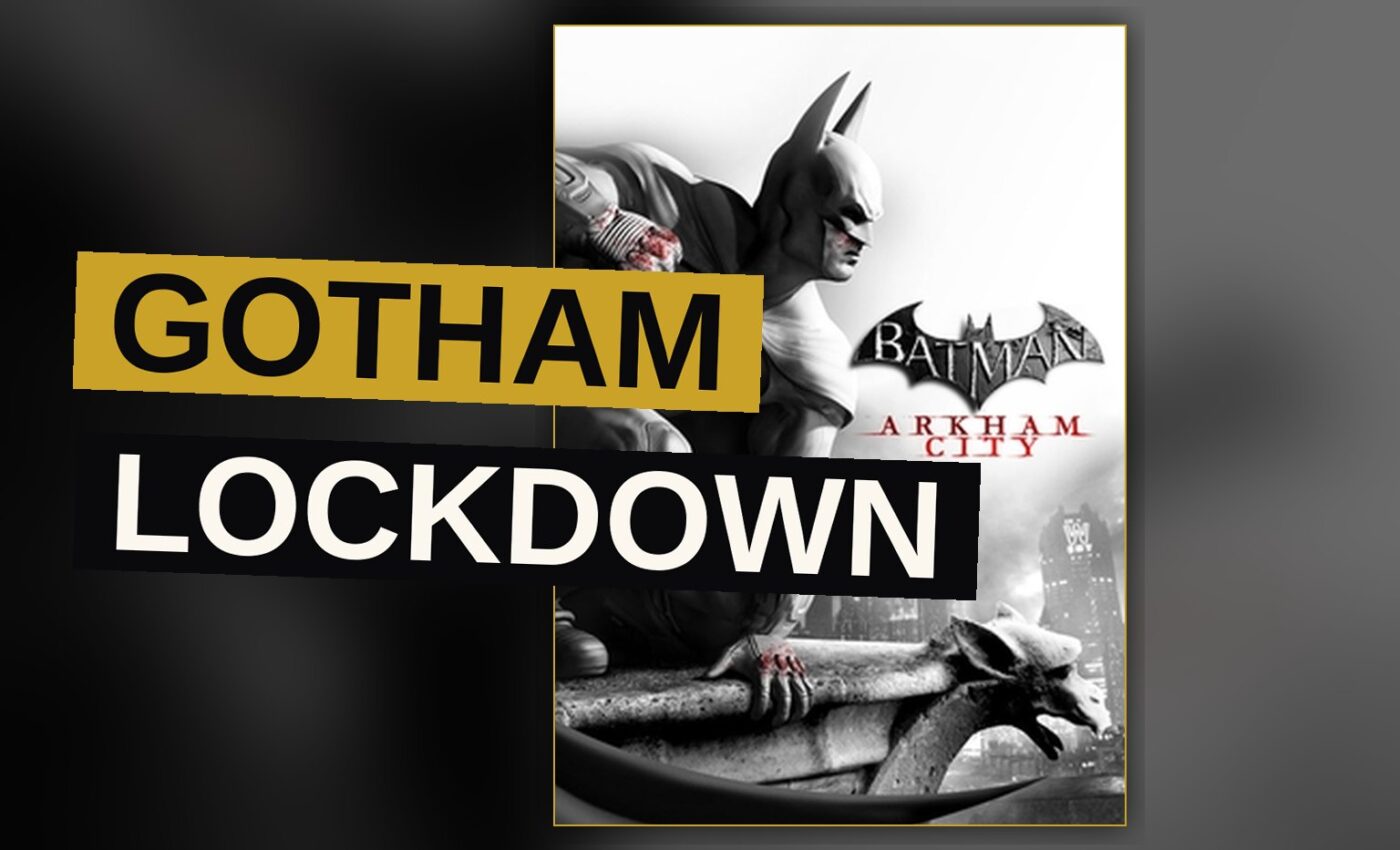
Batman: Arkham City turned a hallway into a city. Rocksteady Studios’ 2011 sequel to Batman: Arkham Asylum takes the tight, atmospheric foundation of the first game and drops it inside a walled prison district in the heart of Gotham. The result is the rare follow-up that keeps what worked and doubles the scale without losing the pressure that made the original work.
Arkham City is a super-prison enclosing the decaying urban slums of Gotham, run by warden Hugo Strange. Bruce Wayne is locked inside it, and the game’s answer to that premise is to hand the player the whole map almost immediately.
Trailer, via Batman Arkham.
A Sequel That Opens the Gate at the Start
The first Arkham game was a corridor with secrets. Arkham City is open to the player from the beginning, and the freedom changes how the game feels. Batman moves through a district built for thugs, gangsters and insane criminal masterminds, and the player can travel anywhere inside its boundaries.
That sounds like a small change. It is not. Arkham Asylum used locked doors to pace its story. Arkham City uses distance, and distance is a better teacher. You learn the map because you have to cross it, not because a door opened.
Rocksteady conceived the sequel while still developing Arkham Asylum, then moved into serious production on Arkham City. The writing credits go to veteran Batman writer Paul Dini with Paul Crocker and Sefton Hill, working from the long-running comic book mythos rather than inventing a new one.
Hugo Strange and Protocol 10
The plot does not waste time. Bruce Wayne holds a press conference to declare his opposition to Arkham City. TYGER mercenaries arrest him on the spot and imprison him inside the facility.
Hugo Strange then tells Wayne he knows Wayne is Batman, and releases him into the prison’s criminal population. Strange is preparing something called Protocol 10, and the game lets that phrase sit in the background for hours before it pays off.
Wayne gets his equipment from an airdrop sent by Alfred Pennyworth, and becomes Batman. The first rescue is Catwoman, about to be executed by Two-Face, who wants respect from the prison by killing her. The Joker tries to assassinate Catwoman, and Batman follows him to a hideout in the Sionis Steelmill.
The Titan Blood and the Cure
What Batman finds in the steelmill is the engine of the whole game. The Titan formula is unstable in the Joker’s blood and is slowly killing him. Joker captures Batman, performs a blood transfusion, and infects him with the same fatal disease. Joker also says Gotham hospitals have been poisoned with his infected blood.
So the clock is not just Batman’s. It belongs to a city that does not know it is on one.
Batman goes to Mr. Freeze, who had been developing a cure but was kidnapped by the Penguin. Tracking Penguin to the Cyrus Pinkney National History Institute, Batman beats his forces, the imprisoned monster Solomon Grundy, and finally the Penguin himself. Freeze is freed, and he says he has already developed the cure, but its instability makes it useless.
Batman works out that the restorative properties of Ra’s al Ghul’s blood can complete it. He tracks an assassin to Ra’s’ underground lair and confronts Ra’s and his daughter Talia, Batman’s former lover. Freeze builds the antidote with Ra’s’ blood. Harley Quinn steals it before Batman can use it.
What the Villains Do With the Clock
When Batman returns to the Joker, the Joker is healthy. While the two fight, Strange activates Protocol 10, which turns out to be a plan to wipe out the entire population of Arkham City and destroy Gotham’s criminal element. TYGER troops start executing inmates. Strange launches missile strikes from his base in Wonder Tower.
A missile hits the steelmill and buries Batman in rubble. Talia arrives before Joker can take advantage and offers him immortality in exchange for sparing Batman’s life. Catwoman helps Batman escape, and Alfred convinces him to end Protocol 10 before chasing Talia and the Joker.
Batman infiltrates Wonder Tower and disables Protocol 10. Ra’s al Ghul is revealed as the true mastermind behind Arkham City, and mortally wounds Strange for failing to beat Batman. With his dying breath, Strange activates Protocol 11, the self-destruction of Wonder Tower. Batman and Ra’s escape. Ra’s kills himself rather than risk capture.
Talia, Clayface, and the Monarch Theater
The ending is a machine built to strip Batman of every possible win. Joker threatens to kill Talia unless Batman meets him at the Monarch Theater. Batman arrives, Joker demands the cure, and Talia stabs and apparently kills him. Talia admits she stole the cure from Quinn. Then a second Joker, still sick, kills her.
The healthy Joker reanimates into the shapeshifting Clayface, who had been posing as a healthy Joker the whole time at the ailing villain’s request. Batman takes Clayface down. Joker blows up the theater floor and drops Batman into Ra’s’ lair below.
Batman destroys Ra’s’ rejuvenating Lazarus Pit before Joker can use it, and drinks part of the antidote. He debates curing his enemy, Joker attacks him, and the vial smashes. Batman says that despite everything, he would have saved him. Joker dies of the illness. Batman carries the body out. Commissioner Gordon asks what happened. Batman puts the body on the hood of a police car and leaves without a word.
Combat, Stealth, and Catwoman
The mechanics hold up because they are built for the space. Arkham City is an open world action-adventure game that folds in tactics from stealth games, presented from the third-person perspective with the camera free to rotate around the playable character. Combat and stealth abilities, detective skills, and gadgets all feed both fighting and exploration.
New areas unlock through main story progress or new equipment. Side missions sit off the main path and unlock additional content and collectible items. Catwoman is playable, with her own campaign running parallel to the main plot.
Here is how the two leads differ in practice:
| Batman | Catwoman | |
|---|---|---|
| Role | Main campaign | Parallel campaign |
| Core tools | Combat, stealth, detective skills, gadgets | Her own story campaign |
| Playable | Yes | Yes |
That table undersells it slightly, but the shape is right. Catwoman is not a bonus skin. She is a second way through the same prison.
The Arkham City Scorecard
Ranked by what actually carries the game:
- The open city and the freedom to cross it from the start.
- The Titan blood plot, which gives every character a deadline.
- Hugo Strange and Protocol 10 as the background threat.
- Catwoman’s parallel campaign.
- Side missions and collectibles.
The order matters because the game’s reputation rests on the first item and its emotional weight rests on the second. Protocol 10 is the loudest idea in Arkham City, but it is not the best one. The best one is simpler: Batman is dying, the Joker is dying, and only one cure exists.
Our Verdict on Arkham City
Batman: Arkham City earns its reputation. The open district could have flattened the tension of Arkham Asylum, and instead it raises it, because every trip across the city costs time Batman does not have. The Titan blood transfusion is the smartest thing in the script. It turns the Joker from a problem Batman solves into a problem Batman shares.
The Clayface reveal is the weakest major beat. It is a twist that exists to extend a fight, and it arrives after Talia’s death has already done the real damage. The game does not need it.
What does need saying is that Arkham City is the rare sequel that understands its predecessor’s limits. Arkham Asylum was a hallway. Arkham City is a city. Same disease, bigger body.
Get the Notebook.
The day's best stories and every fresh verdict, in plain English, in your inbox by seven. One email a day, no more.