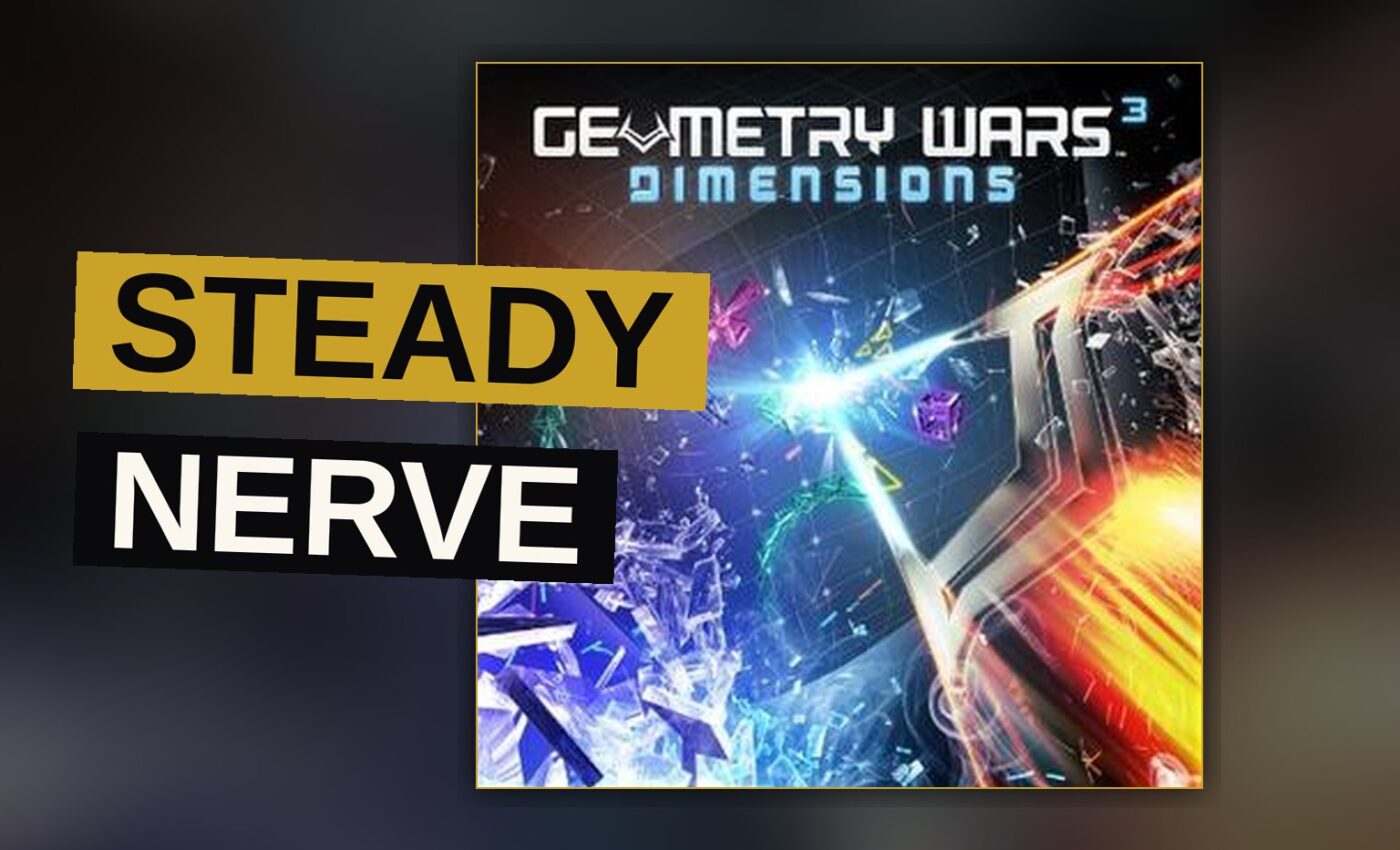
Geometry Wars 3: Dimensions arrived in November 2014 with a problem it did not create. The series’ original studio, Bizarre Creations, had been shut down by Activision, and the franchise sat idle until Lucid Games picked it up. That makes this the sixth Geometry Wars game, the first built without the team that invented it, and the first in the series to land on PlayStation hardware. It is also, by the evidence, the best one.
Lucid Games did not play it safe. Geometry Wars 3: Dimensions takes the flat, twin-stick arena that defined the series and bends it onto 3D grids — spheres, cylinders, curving surfaces that change how you read a threat. The claw-shaped ship still fires independently of where it points, so you can strafe one way and shoot another. The enemies still come in waves of geometric shapes with one purpose: destroy you.
Trailer, via XBOX.
3D grids and the claw-shaped ship
The shift to 3D grids is the headline change, and it earns the billing. On a flat plane you learn to read the whole field at once. On a curved grid, the far side of the surface wraps out of view, and enemies climb toward you from angles a flat arena never allowed. It is disorienting in the right way.
The core loop is unchanged and still ruthless. You destroy shapes, you collect small green diamonds called geoms, and the geoms feed your score multiplier. Skilled players can push that multiplier into the ten-thousands. That single number is the whole game: stay alive long enough to build it, then stay alive a little longer to spend it.
Supers are expendable powerups you pick before a run starts. Some drop turrets that fire on enemies for you. One unleashes a massive wave of bullets. Extra lives and extra supers arrive when you hit certain point totals, and the thresholds shift by mode.
Four drones, six in Evolved
Drones are the other system worth understanding. You select a companion before the game begins, and it performs one job while you focus on not dying. The base game ships four. The Evolved edition expands that to six: Attack, Collect, Ram, Snipe, Defend, and the new Sweep drone.
Collect does the busywork, hoovering up geoms so your multiplier climbs without you breaking position. Attack and Snipe add firepower. Ram turns the drone into a battering object. Defend and Sweep cover ground you cannot. The choice shapes how a run plays more than any single super.
| Mode or feature | Base Dimensions | Dimensions Evolved |
|---|---|---|
| Total levels | Over 50 single player levels | Over 100, including 40 all-new |
| 3D grids | Included | 15, including 5 all-new |
| Battle modes | Over 10 | 12, including 4 all-new |
| Companion drones | 4 | 6, including Sweep |
| Hardcore mode | Not included | Included, with separate leaderboard |
Pacifism, King and Claustrophobia
The mode list is where Geometry Wars 3: Dimensions shows its range. Adventure and Classic Arcade anchor the single player side, with over 50 levels in the base release and over 100 in Evolved. The battle modes include Pacifism, King and Claustrophobia, each rewriting the rules rather than reskinning the arena.
Pacifism strips your guns and makes you survive on movement alone. King walls you into a safe circle that dissolves the moment you leave it. Claustrophobia closes the space around you. These are not variations on a theme; they are arguments about what the game is.
Evolved adds four more battle modes and five more grids on top of that. It also adds Hardcore mode, which removes drones and supers entirely and gives players a separate leaderboard. That is the purist’s cut, and it is the right call.
Cooperative and online competitive multiplayer
Multiplayer covers both cooperative and online competitive play, and both work. Co-op splits the chaos across two ships, which changes the geometry of survival without softening it. Competitive turns the same arenas into a race, and the leaderboards — community and friend — give the scores somewhere to live.
The single player structure holds up on its own, though. Adventure mode strings levels together with enough variation to keep the 3D grids from blurring into one another, and Classic Arcade is there for players who want the old discipline back.
What Geometry Wars 3: Dimensions does not do is explain itself. There is no tutorial worth the name, no hand-holding, no concession to anyone who has not played a twin-stick shooter before. That is a choice, and for this series it is the correct one.
What Lucid Games got right
Lucid Games inherited a franchise built by a studio Activision closed, and the easy move would have been a faithful reissue. Instead the team rebuilt the arena itself. The 3D grids are not a gimmick bolted onto a proven formula; they change how you track enemies, how you position, how you fail. That is the difference between a sequel and a repackaging.
The drone system is the second real addition, and it is the one that will divide players. Six drones with distinct jobs give runs a strategic layer before the first enemy appears. They also give weaker players a way through content that would otherwise stop them cold. Hardcore mode exists precisely because Lucid knew that, and shipping both is the honest answer.
The mode count is generous to the point of excess. Pacifism, King and Claustrophobia are the standouts, and the four new modes in Evolved are worth the upgrade. Some of the twelve battle modes land harder than others, and a few feel like variations rather than ideas. That is a minor complaint against a package this deep.
Where the interface falls short
Where the game stumbles is presentation outside the arena. The interface is functional and little more, and the structure of Adventure mode occasionally buries its best levels behind weaker ones. These are small things. They do not touch the core.
The core is what matters. Geometry Wars 3: Dimensions understands that a twin-stick shooter lives or dies on the clarity of its threat and the speed of its response. The claw-shaped ship moves exactly as it should. The geoms pull you into danger, which is the point. The multiplier climbs, and you take one risk too many, and you start again.
That loop has survived a studio shutdown, a platform shift and more than a decade of imitators. Lucid Games did not just preserve it. The 3D grids and the drone system push it somewhere new without breaking what made it work. For a series that could have coasted on nostalgia, that is a real achievement.
Across 13 outlets, the published critical aggregate sits at 8.5 out of 10, and that number holds up. Geometry Wars 3: Dimensions is the best entry in the franchise since Retro Evolved 2, and the first one built by a team that had something to prove. It proved it.
Get the Notebook.
The day's best stories and every fresh verdict, in plain English, in your inbox by seven. One email a day, no more.