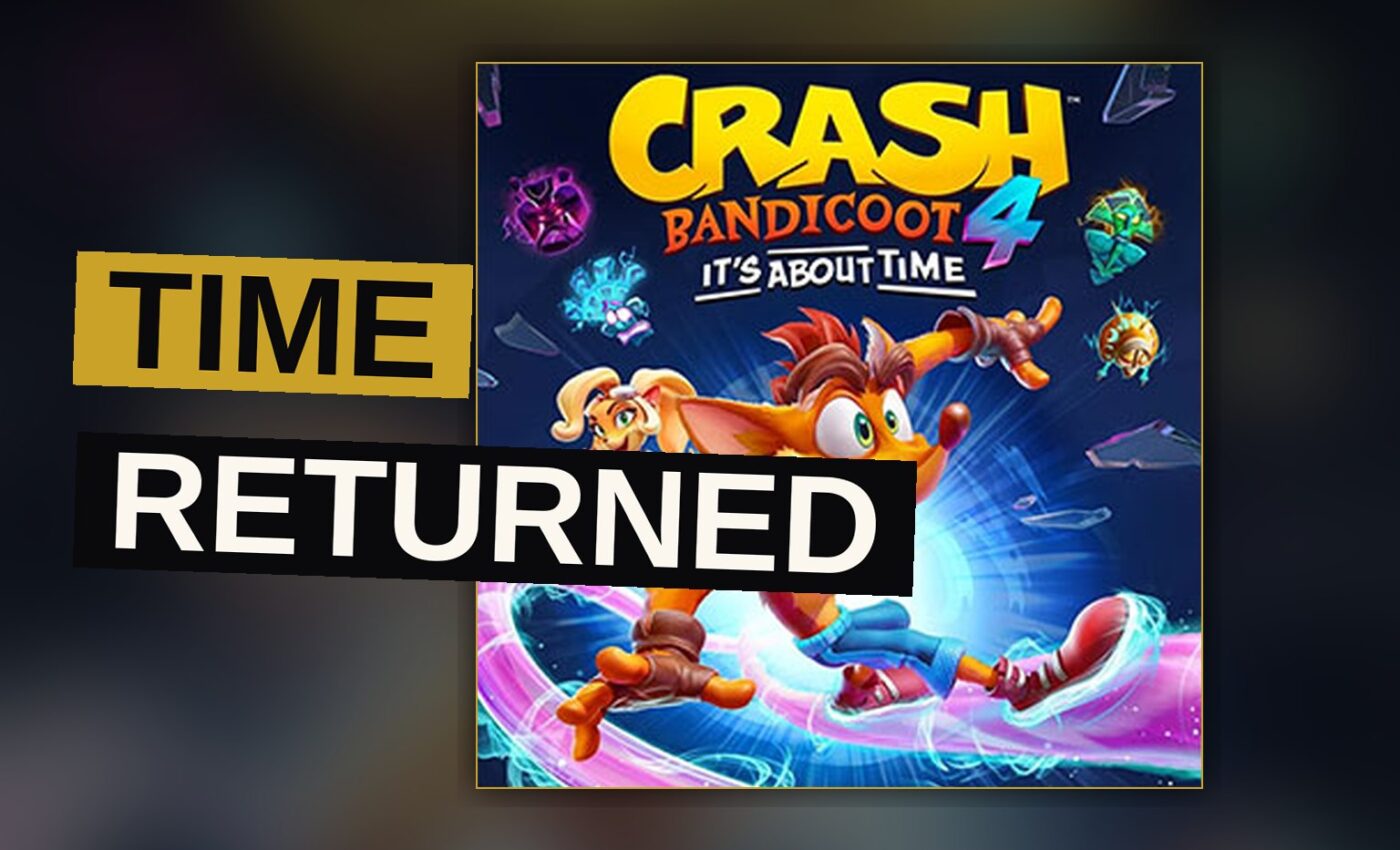
Crash Bandicoot 4: It’s About Time is the eighth main game in the series and the fourth in its internal chronology, and it arrives with a job to do: prove the original trilogy’s formula still holds. Toys for Bob developed it, Activision published it, and it first landed on PlayStation 4 and Xbox One in 2020. Versions for Nintendo Switch, PlayStation 5, Xbox Series X/S and PC followed in 2021. The result is a platformer that trusts its own history and then pushes past it.
Trailer, via Crash Bandicoot.
Crash, Coco, and the Quantum Masks
The story picks up after Crash Bandicoot: Warped. Uka Uka tries to free himself and his acolytes, Doctor Neo Cortex and Nefarious Tropy, from their prison in the past. His effort rips a hole in space and time and knocks him out. Cortex and N. Tropy escape, abandon Uka Uka, and find the rift links their universe to the rest of the multiverse. They decide to conquer every dimension.
To do it, they build the Rift Generator, which opens other space-time rifts, and recruit Doctors N. Gin and Nitrus Brio for an army. Aku Aku senses power coming from N. Sanity Island’s central peak and sends Crash to look. Crash finds Lani-Loli, one of the Quantum Masks — four ancient witch doctor masks with power over space and time, who appear only when something has opened the multiverse. Crash and his sister Coco set out to find the other three and seal the rifts.
That structure matters, because the Quantum Masks are not set dressing. They alter levels and give the player new ways to move and to beat obstacles. The game keeps the series’ core platforming and builds on it rather than replacing it.
Five Characters, Ten Dimensions
You mostly play as Crash or Coco, and you can switch between them from the map at any time. Levels progress along a linear map split into ten “Dimensions,” each with its own theme. Five characters are playable, and three of them — Cortex, Dingodile and Tawna — get their own gameplay and their own levels.
Dingodile’s path is the strangest and the best. He retired from villainy to run a diner, then got sucked into a rift after getting revenge on a group of moonshiner bats who blew up his business. Now he crosses dimensions looking for home. Tawna is an alternate-dimension version of Crash’s old girlfriend, an adventurer who insists on working alone. She will not explain what happened to Crash and Coco in her own dimension.
The camera stays third person, with sections that run toward the screen or shift to a side view. Crash and Coco jump, double jump, spin, crawl, slide and slam. They grind rails, hang off them, hop across them and run along marked walls. Crates carry Wumpa Fruit, which grant an extra life at 100 in the Retro style, and Aku Aku masks, which shield the player.
Modern and Retro, and What Each Costs You
Before starting, you pick a play style, and you can switch it any time in the options menu. “Modern” sends you back to the latest checkpoint when you die. “Retro” gives you a limited number of lives, shown as a floating head of whoever you are playing; you collect more inside levels, and losing the last one restarts the level from the beginning. Neither style changes the difficulty or how much progress you earn.
Toys for Bob described its gameplay goal as “tense, precise execution.” The team wanted Crash’s jumping, spinning, sliding and body slamming to feel familiar and satisfying, and it wanted to top the difficulty of the original trilogy while smoothing the curve. The studio also called it “the biggest Crash game ever,” which shaped the scope and length.
Here is what that adds up to, ranked by what actually decides whether you finish it:
- The Quantum Masks. They are the reason levels stay interesting past the first dimension. Time manipulation changes how a room reads, not just how it looks.
- The Retro play style. It restores real stakes. Modern is the kinder default, but Retro is the one that makes a level mean something.
- Dingodile. A retired villain running a diner and hunting for home is the sharpest idea in the game, and his levels do not play like Crash’s.
- Tawna. She is the most intriguing thread in the story and the game declines to pull it. That withholding is deliberate, and it still costs something.
- Coco. Swapping between her and Crash at will is convenient and welcome, but the two play nearly the same.
- The crate hunt. Collecting is fine. It is also the part most likely to wear you down.
Where It Pushes Back
The difficulty is the real argument here. Toys for Bob said it wanted to exceed the original trilogy, and it does. That is a promise kept and a warning. Levels demand precision, and the Retro style punishes you for lacking it. The Modern option exists so you can see the ending, and choosing it is not a failure.
What holds Crash Bandicoot 4 back from a higher mark is that its best ideas are unevenly spread. The Quantum Masks and Dingodile carry sections that feel genuinely new. Tawna’s levels and the alternate-dimension premise gesture at a bigger, stranger game that the campaign never fully becomes. The result is a strong platformer with a few rooms that are better than the game around them.
The preservation work is the part worth praising. Crash’s jump, spin and slide still land the way they did decades ago, and the added moves do not muddy them. That is harder than it sounds, and it is why this reads as a continuation rather than a remake in disguise.
Crash Bandicoot 4: It’s About Time is the best argument yet that the series did not need to be reinvented, only extended with care. It is precise, it is hard, and it respects what came before without hiding behind it. 8.6/10.
Get the Notebook.
The day's best stories and every fresh verdict, in plain English, in your inbox by seven. One email a day, no more.