
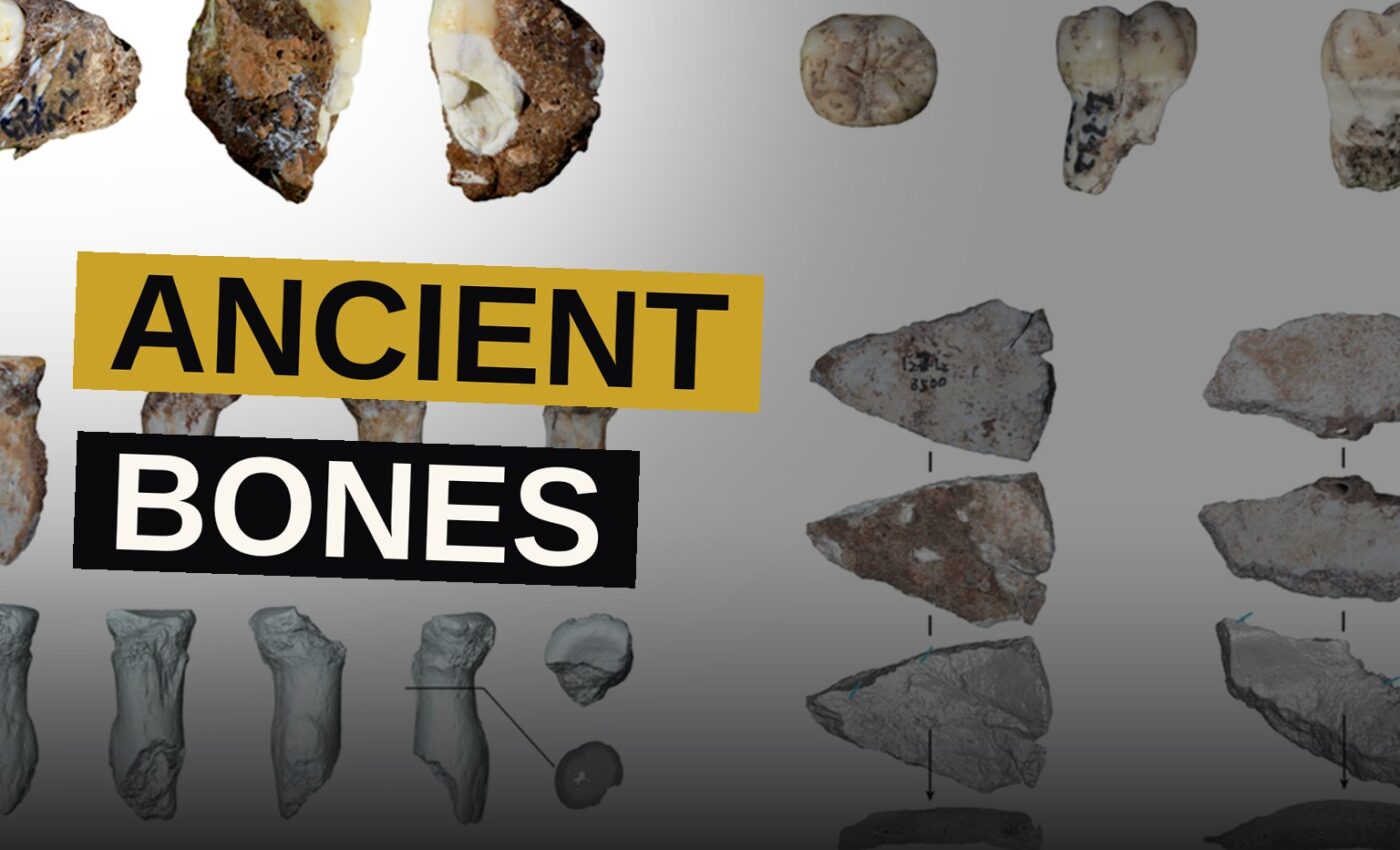
In a cave in southwest China, researchers have found the first Denisovan arm bone, along with thousands of prehistoric animal bones and stone tools. The discoveries reveal that these mysterious human cousins lived in a wooded setting for over 100,000 years, hunting and cutting up large animals.
Researchers working at Bianfu Cave in Yunnan province have brought up five human fossils, close to 1,400 stone tools, and over 64,000 animal bones. Two papers released Wednesday (Sept. 9) in Nature explain how the team recognized the remains as Denisovan through protein study. The cave saw use from 190,000 to 70,000 years back, with the human fossils coming from a period between 134,000 and 167,000 years ago.
The Denisovans were a people of humans who once made their home in Asia, and they vanished roughly 30,000 years ago. Through ancient DNA, we now know that these Denisovans, along with Neanderthals and modern humans (Homo sapiens), share a distant common ancestry, and that all three groups mixed their bloodlines in days long past. Yet while the bones of Neanderthals and modern humans turn up in number across many sites, the remains of the Denisovans number only a few fragmentary specimens, scattered from Siberia to Laos.
This dig at Bianfu Cave alters the earlier picture entirely. The fresh find, a radius — one of the paired bones in the forearm — stands alone as the sole Denisovan radius ever uncovered. Prior to this discovery, the only bodily remains known from Denisovans were a small finger bone and a single rib fragment.
Excavating Bianfu Cave in 2019
Bianfu Cave sits in the Yunnan province of southwestern China. In 2019, archaeologists excavated several stratigraphic layers of the cave and discovered the large cache of artifacts and bones, including four teeth from an unknown human lineage. The Yunnan area is where Denisovans and modern humans are known to have met and mated, so researchers were unsure which group had used tools to butcher animals inside Bianfu Cave.
Screening the Bones With Protein Analysis
The team relied on zooarchaeology by mass spectrometry, or ZooMS, for their examination of the bone pieces. ZooMS is a method of protein analysis that extracts collagen from the bones of an unknown species and then matches the protein signature against the distinctive “fingerprint” of known reference animals.
The researchers used ZooMS on the Bianfu Cave bones and found that three fragments matched the collagen signature of members of the Homo genus. Later, proteomic analysis revealed that two teeth and three bones from the cave shared a specific amino acid variation tied to Denisovans.
How the Radius Was Identified
In the new research, scientists noted that the newly found radius features a large head where it attaches to the humerus at the elbow, which resembles Neanderthal specimens more closely than modern human ones. However, the bone’s general form matches more closely with that of modern-human radii, they reported in one of their papers.
The fact that the Denisovan radius was shaped more similarly to the radius in humans “likely provided functional advantages for lightweight, precise manipulation,” study co-author Qiaomei Fu, director of the Ancient DNA Laboratory at the Institute of Vertebrate Paleontology and Paleoanthropology, part of the Chinese Academy of Sciences, in Beijing, told Live Science in an email.
The distinct traits of the Denisovan radius indicate that the people who lived near Bianfu Cave had different physical requirements placed upon their bodies and different behavioral adjustments, according to the researchers.
Little is known about Denisovans, partly due to there being no complete skeleton found yet. The majority of the fossils that researchers have examined consist of fragments of the skull and teeth.
Stone Tools and Hunting Evidence
A separate investigation examined the complete series of cultural remains from Bianfu Cave in an effort to understand what Denisovans did there. Among the roughly 1,400 stone artifacts found inside the cave, some 200 were flake tools, and most of those were fashioned from a sedimentary rock known as sandy mudstone.
The researchers described in their study how animal bones found in the cave show signs of being worked by these tools, indicating that Denisovans hunted, cut up and broke open cow- and deer-like animals to get at their marrow on a regular basis.
The stone tools discovered at Bianfu Cave contrast with the more advanced implements produced by Neanderthals during the same period. Researchers say the Denisovan tools were fashioned rapidly and resourcefully using local materials.
Denisovans at Bianfu Cave were found to be making bone tools, a practice also engaged in by Neanderthals. The researchers argued that this finding points to bone tool use being more common across Pleistocene human groups than experts had believed. It underscores the need for improved understanding of the human evolutionary record of eastern Asia, they wrote.
Meeting and Mating in Yunnan
In Yunnan, Denisovans and modern humans came together and reproduced. The researchers pointed out that the distinct qualities of the Denisovan radius point to distinct mechanical pressures on their bodies and separate behavioral adjustments.
The research has added fresh details to what archaeologists know about the mysterious Denisovans, yet the investigators say there is still more work to be done.
“We hope that similar proteomic analyses will aid in the identification of further Denisovan long bones in the future,” Huiyun Rao, an associate professor at the Institute of Vertebrate Paleontology and Paleoanthropology, Chinese Academy of Sciences, and colleagues wrote, “to further understand the adaptive behavior of Denisovans in response to climate change or competitive pressure from contemporary hominins.”
What ZooMS Revealed
The researchers’ findings show how ZooMS and proteomics can make sense of fossil fragments that would otherwise defy classification.
Careful, patient archaeological work at the Bianfu Cave has revealed what can be gained from such labor. Inside a cave in southwest China, where animal bones and simple stone tools are plentiful, researchers have recovered the first Denisovan arm bone ever found. That discovery offers a window into how these mysterious humans lived.
There is still much we do not know about the Denisovans. Yet every new bone found and every fresh examination contributes a missing part to the picture. The scientists behind the research believe that similar studies of proteins will help identify more Denisovan long bones down the road.
Key Numbers From the Studies
- Bianfu Cave used from 190,000 to 70,000 years ago
- Five human fossils dating to between 134,000 and 167,000 years ago
- Nearly 1,400 stone artifacts recovered
- More than 64,000 mammal bones recovered
- About 200 flake tools among the artifacts
- First Denisovan radius (arm bone) found to date
- Denisovans went extinct around 30,000 years ago
The arm bone recovered from Bianfu Cave remains a singular and important relic. It serves as proof that the history of humanity is not a straightforward progression from past to present, but rather a tangled network of connected peoples who lived, hunted, and interbred throughout Asia. In a forested setting, the Denisovans flourished by hunting and consuming large game animals. We now understand a bit more about their methods.
Source: livescience.com
Get the Notebook.
The day's best stories and every fresh verdict, in plain English, in your inbox by seven. One email a day, no more.