
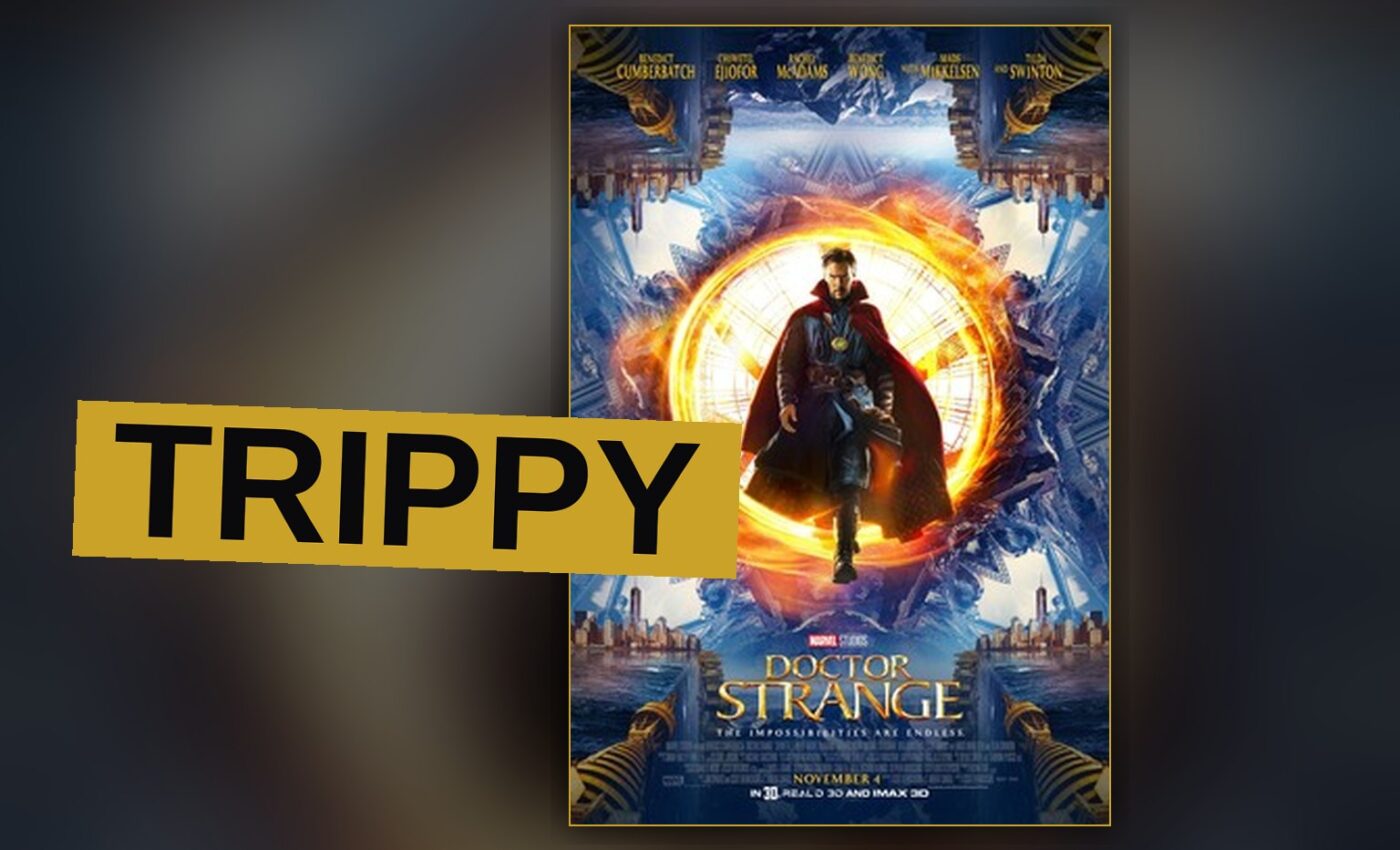
Doctor Strange arrived in 2016 as the 14th film in the Marvel Cinematic Universe, and it carries a tagline that tells you exactly what it wants to be: “The impossibilities are endless.” Scott Derrickson directs from a screenplay he wrote with Jon Spaihts and C. Robert Cargill. Benedict Cumberbatch plays Dr. Stephen Strange, an arrogant neurosurgeon who loses the use of his hands in a car crash and rebuilds himself as a sorcerer. It runs 115 minutes. It is a fantasy film wearing a superhero costume, and for long stretches that works.
Trailer, via Marvel Entertainment.
A Beheading at Kamar-Taj
The film opens in Kathmandu, where the sorcerer Kaecilius and his zealots break into the secret compound Kamar-Taj and behead its librarian. They steal pages from a book belonging to the Ancient One, a long-lived sorcerer who has taught every student at Kamar-Taj, Kaecilius included. The Ancient One chases them, but they escape.
In New York City, Strange is wealthy, acclaimed and arrogant. A car crash on the way to a speaking conference wrecks his hands. He can no longer operate. Christine Palmer, a fellow surgeon, tries to help him move on. He refuses. He chases experimental surgeries instead, vainly, and the film is honest about how ugly that desperation looks on a man who has never had to be humble.
Pangborn Sends Him to Nepal
Strange learns about Jonathan Pangborn, a paraplegic who regained the use of his legs for no reason anyone can explain. Pangborn points him toward Kamar-Taj. Mordo, a sorcerer under the Ancient One, takes him in.
The Ancient One shows Strange her power. She reveals the astral plane and other dimensions, including the Mirror Dimension. She agrees to train him, reluctantly, because his arrogance and ambition remind her of Kaecilius. That parallel is the spine of the movie, and Derrickson knows it.
Strange studies under the Ancient One and Mordo, and from ancient texts in the library now guarded by Master Wong. He learns that Earth is shielded from other dimensions by three Sanctums — New York City, London and Hong Kong — all reachable directly from Kamar-Taj. The sorcerers’ job is to protect them. Pangborn, by contrast, chose to channel mystical energy only to heal his paralysis. That choice sits in the film as a quiet rebuke to Strange’s ambition, though the movie never quite forces him to answer for it.
Cumberbatch and the Finger-Tutting
Cumberbatch described Strange as arrogant, and said the film is “about him going from a place where he thinks he knows it all to realizing he knows nothing.” He compared the character to his Sherlock Holmes, calling both “intelligent” with “smatterings of the same colors.”
The mysticism resonated with him. Spirituality has mattered to Cumberbatch since he spent a gap year teaching English at a Tibetan Buddhist monastery in Darjeeling, India. You can feel that in the performance, which is more settled than the script sometimes deserves.
Strange’s abilities include casting spells with what Cumberbatch called “tongue-twisty fun names,” creating mandalas of light for shields and weapons, and opening portals for quick travel. He also gets a Cloak of Levitation for flight and the Eye of Agamotto, a relic holding an Infinity Stone that can manipulate time. Cumberbatch took great care with the physical movements, knowing fans would study them. He called the gestures “balletic” and “very dynamic,” and got help with finger-tutting from dancer JayFunk.
That detail matters more than it sounds. The hand work is the film’s best invention, and it is the one thing here that does not feel borrowed from another Marvel movie.
Ejiofor Plays Mordo as a Believer
Chiwetel Ejiofor plays Karl Mordo, a Master of the Mystic Arts, close to the Ancient One and a mentor to Strange. This Mordo is a combination of different characters from the Doctor Strange mythos. Unlike the comics, he is not introduced as villainous. Ejiofor called him “a very complex character that, really, I don’t think can be nailed down either way.” Derrickson said the change came from casting Ejiofor and from conversations between them.
Ejiofor is the best thing in the film. He plays Mordo as a believer, not a fanatic, and the movie is smarter for letting him stay sympathetic.
Benedict Wong plays Wong, the library’s guard, and he is used sparingly. Rachel McAdams plays Christine Palmer, and the film gives her little to do beyond worry. Mads Mikkelsen plays Kaecilius, a villain with a motive the script states but never makes you feel. Tilda Swinton plays the Ancient One, and her casting remains the film’s most debated decision.
Michael Stuhlbarg appears as Dr. Nicodemus West, Benjamin Bratt as Jonathan Pangborn. Scott Adkins, Zara Phythian, Alaa Safi and Katrina Durden fill out the zealots.
A Rights Deal in April 2005
Doctor Strange took decades to reach theaters. Various incarnations of an adaptation had been in development since the mid-1980s. Paramount Pictures acquired the film rights in April 2005 on behalf of Marvel Studios. Thomas Dean Donnelly and Joshua Oppenheimer were brought on to write a screenplay in June 2010.
In June 2014, Derrickson was hired to direct, with Spaihts re-writing. Cumberbatch was chosen for the title role in December 2014, which forced a schedule change around his other commitments. That delay gave Derrickson time to work on the script himself, and he brought Cargill in to help.
Principal photography began in November 2015 in Nepal, moved to England, and wrapped in New York City in April 2016. The film had its world premiere in Hong Kong.
“The impossibilities are endless.”
That tagline is doing a lot of work for a movie that, in the end, is fairly conventional about what it does with them.
What the Mirror Dimension Gets Right
The Mirror Dimension sequence is the film’s high point. It takes the city and folds it, and the effect is not just spectacle — it changes what a fight can be. The portals do the same thing on a smaller scale. Strange’s training montages move quickly and never overstay.
The film’s problem is that it keeps reaching for the same beats the MCU had already worn smooth by 2016. An origin story, a mentor’s death, a final battle against a villain with a philosophical grievance. Kaecilius wants what he wants for reasons the script explains, but Mikkelsen never gets a scene that makes the argument land.
The Ancient One’s death is meant to be the emotional turn. It plays as a plot requirement instead. Swinton is good in the role, but the film never lets her be strange enough.
Where This One Lands
Doctor Strange is a well-made movie with a genuinely great lead performance and one truly original action set piece. It is also a movie that plays it safe whenever it has a choice. Cumberbatch’s work and Ejiofor’s Mordo are worth the ticket. The rest is competent, and competent is not the same as memorable.
The film’s best idea — that magic is a discipline, not a superpower, and that it costs something to learn — gets stated and then mostly abandoned. The sequel would have room to pick it up. This one just gestures at it.
Get the Notebook.
The day's best stories and every fresh verdict, in plain English, in your inbox by seven. One email a day, no more.


