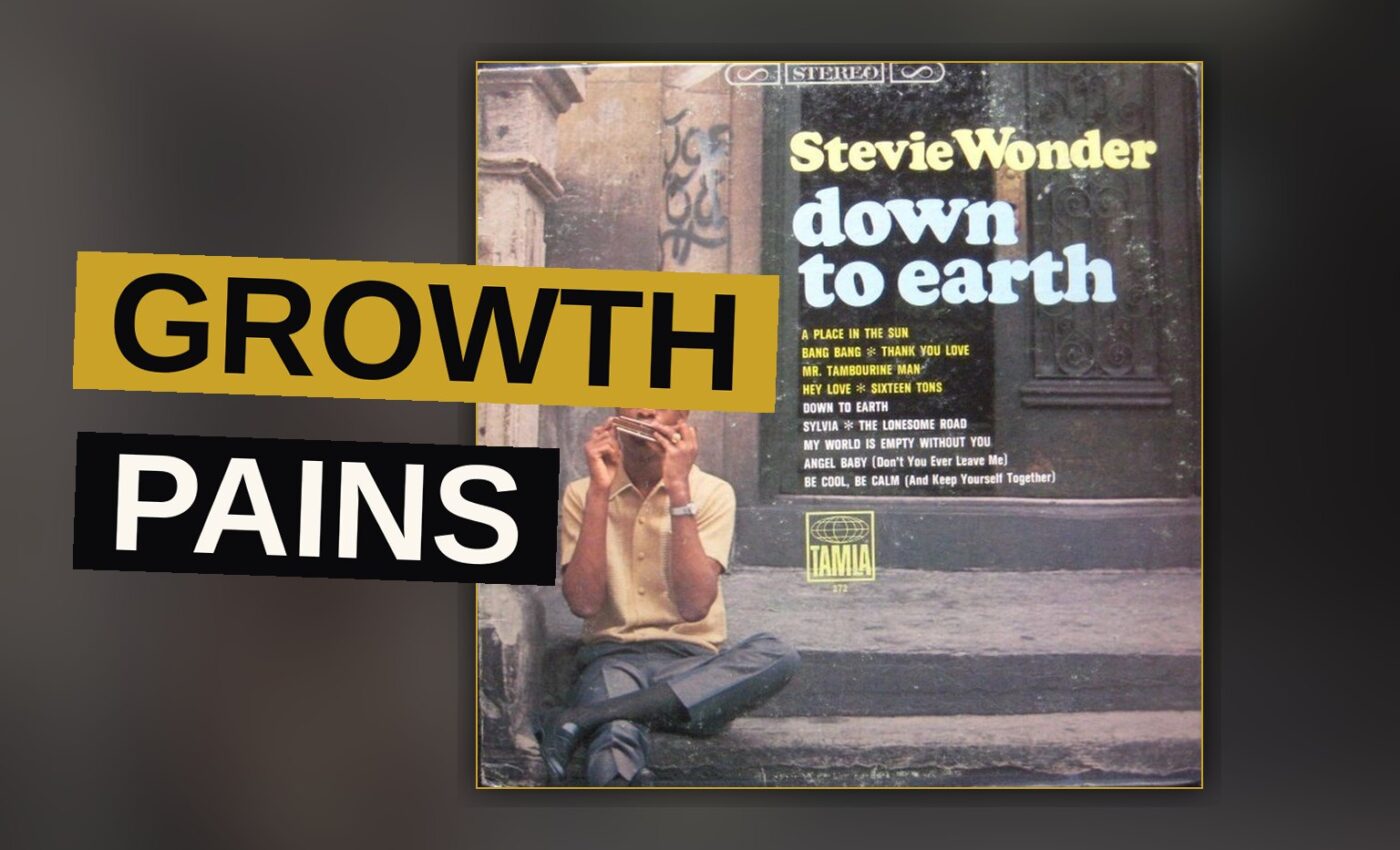
Stevie Wonder’s Down to Earth, released in 1966, is a record caught between two places. It finds the teenage star reaching for something more serious than the pop confections of his early hits, but it never quite lands the knockout punch. The album is a transitional work, one where Wonder’s ambition outruns the material he was given. The result is a fascinating, uneven listen that rewards patience more than it demands repeat spins.
A Place in the Sun Leads the Way
The record opens with its strongest moment. “A Place in the Sun” is a sweeping, optimistic anthem that lets Wonder stretch his voice over a lush arrangement. It is the sound of an artist learning to carry a message, not just a melody.
From there, the album takes a curious turn. “Bang Bang” is a cover, and Wonder handles it with a theatrical growl that feels slightly out of step with his natural warmth. The title track, “Down to Earth,” follows, and it is a gentle, reflective ballad that shows his growing confidence as a storyteller. “Thank You Love” is sweet and uncomplicated, a thank-you note set to a bounce that works better in theory than in execution.
“Be Cool Be Calm (And Keep Yourself Together)” is a strange one. The spoken-word intro and the pleading chorus feel like a lecture dressed as a love song. It is not a failure, but it is a stumble. “Sylvia” rights the ship with a breezy, mid-tempo groove that suits him, and “My World Is Empty Without You” is a sharp, aching plea that leans into the desperation of the lyric. It is one of the few moments where the album’s emotional weight lands cleanly.
The Lonesome Road and Other Missteps
The back half of the record is where Down to Earth loses its footing. “The Lonesome Road” is a dirge-like spiritual that drags. Wonder’s vocal is committed, but the arrangement is heavy and the pace is sluggish. “Angel Baby (Don’t You Ever Leave Me)” is worse. The song is a clumsy plea, and the melody never quite settles, leaving Wonder to over-sing his way through a chorus that doesn’t earn the effort.
“Mr. Tambourine Man” is a miss. Wonder’s version strips the song of its hazy charm and replaces it with a bright, almost cheery bounce that misses the point entirely. “Sixteen Tons” fares a little better. Wonder’s take is a curiosity, a spin on a working man’s lament, and while it doesn’t fully work, it is at least interesting.
The album closes with “Hey Love,” a propulsive, horn-driven number that reminds you what Wonder does best. It is the second-best track on the record, a shot of pure energy that suggests the artist he would become. The song is a glimpse of the future, and it ends the album on a high note that the middle sections never quite reach.
Growth Without the Hits
The problem with Down to Earth is not ambition. Wonder is clearly trying to expand his range, to sing about something more than teenage romance. The problem is the material. Too many of these songs are either covers that don’t fit him or originals that don’t match his talent.
But the growth is real. Wonder’s voice is stronger, more controlled, and more expressive than it was on his earlier records. He is learning to bend a phrase, to hold a note, to sell a feeling. The moments of uncertainty and awkwardness on tracks like “Angel Baby” and “The Lonesome Road” are the price of that growth. They are the sound of an artist trying things that don’t all work.
Down to Earth is a stepping stone. It is not a great album, and it is not even a very good one. But it is an important one. It shows Wonder pushing against the limits of the pop machine, reaching for a sound and a seriousness that would fully flower just a few years later. For fans of his later work, it is a fascinating document of the struggle. For everyone else, it is a pleasant, forgettable record with two or three songs worth keeping.
The verdict is clear. Down to Earth is a transitional album, worth hearing for the glimpses of greatness it contains, but not one that holds up as a complete statement. It is the sound of a prodigy figuring out what he wants to say.
Sometimes, that is enough.
6 of 10.
- Artist: Stevie Wonder
- Album: Down to Earth (1966)
- Tracks: 12
- Total runtime: 33 minutes
- A Place in the Sun2:59
- Bang Bang2:38
- Down to Earth2:50
- Thank You Love2:49
- Be Cool Be Calm (And Keep Yourself Together)2:51
- Sylvia2:31
- My World Is Empty Without You2:51
- The Lonesome Road3:08
- Angel Baby (Don’t You Ever Leave Me)2:47
- Mr. Tambourine Man2:34
- Sixteen Tons2:50
- Hey Love2:54